Why would God need our trials and torments if He already knows every fate?
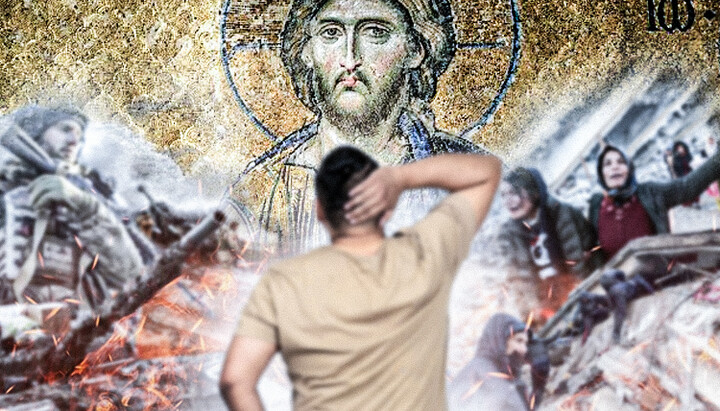
A human being before the face of God. Photo: UOJ
The UOJ regularly receives letters from readers asking for commentary on various issues related to faith. Some of these questions are so profound that they transcend the personal opinion of any one person. So we offer you an invitation to reflect on the following:
1. If God is so great, all-knowing, and all-powerful, why would He create a world in which He already knows who will believe in Him and who won’t? Why does He demand faith, worship, and ritual observance from creatures He made inherently fragile and uncertain? Why the theater of suffering, pain, and salvation if the outcome of every soul is known to Him from the start?
2. Why would the Absolute and Eternal One need the faith of the simple and transient? If God created EVERYONE and EVERYTHING and exists beyond time and outside the created world, why would He care about our questions of good and evil, obedience, spiritual growth, faith, love, rituals, confession, or Communion – He, who can do EVERYTHING?
3. If God influences our lives, then He must also be involved in the horrors people suffer every day without deserving them. If He doesn’t intervene, then what is the purpose of prayer? Does this mean that by praying and believing you secure a place in heaven, and by not doing so, you're condemned to eternal torment? That’s not freedom, that’s coercion and blackmail – right?
***
These are what we call eternal questions to God – questions that have no definitive answers, yet people continue to ask them from generation to generation.
What could someone with a microscope for eyes say about Ivan Shishkin’s Morning in a Pine Forest? He might be able to focus on one tiny spot of the canvas – but would that give him the ability to understand the whole painting, to grasp the artist’s vision? When we speculate on what God needs or doesn’t need, or whom He will forgive or not, we’re trying to step into God’s place and analyze His motives from our limited vantage point.
Looking through the microscope of our intellect at divine providence, we should understand that all the categories we apply to God are shaped by our experience of His creation.
Is a soccer ball big or small? Compared to a quark, it’s enormous – like a galaxy. Compared to the Milky Way, it’s insignificantly tiny. To speak meaningfully about anything – including God – in superlatives, we need something to compare it to. Without time or creation, what could God even be compared to? He simply is the One Who Is. His omnipotence and omniscience are only meaningful in relation to creation.
Perhaps God needed a world in which He could be reflected; where He could give Himself to His creation – so that the energy of love that dwells in Him might be shared with those willing to receive it. Maybe He wanted to see Himself through our eyes. Yet whatever we may say about this is still no more than imagination.
We might begin to understand His providence more deeply not by contemplating God, but by reflecting on ourselves.
God certainly doesn’t need our offerings, rituals, confessions, or Communion. He is self-sufficient. And He certainly doesn’t need our experience of suffering and pain. We need that experience. All the evil in the world takes place in a world created by the Creator. And no matter how often we claim that it's not God but the free will of His creatures that is to blame, ultimately, the Creator – not the creation – bears responsibility.
But let’s consider what we mean when we say “evil,” “horror,” “pain,” “suffering.” Where do these ideas come from? Why do we assume they’re bad? Likely because we’ve experienced what it’s like when they’re absent.
When I was young, I hardly noticed my spine. Of course, I knew I had one – but I didn’t care about it. That changed when I began to feel pain. Then I understood how good it is when nothing hurts, and how bad it is when it does. That understanding came only through comparison.
Had Adam, Eve, and their descendants never experienced death, suffering, or pain, they would never have known that Eden was paradise. If they had never lost God, they wouldn’t know how vital it is to be with Him. Living in bliss, they would not have recognized it as bliss. To distinguish between colors, we need contrast. There’s no other way.
Revelation tells us that our earthly life is a kind of preparatory school before entering eternity.
Here, we are to learn to distinguish good from evil, joy from sorrow, pain from delight. We are now tasting the fruit of the Tree of the Knowledge of Good and Evil – not because God needs us to, but because we need to. All the rituals, rules, commandments, and efforts we go through on this journey are lessons taught by God so that we might grow into the fullness of His design for us.
Yes, God could have created us in a fully ready-made state for eternal life. But our value would be minuscule. To become godlike, we need a deeper experience. God is involved in our lives – but not in the way we imagine. The essence of prayer is precisely to allow Him to participate in our lives.
Eternal joy and eternal torment are not punishments or rewards. They are the states of the soul in relation to God. God Himself remains unchanged.
But even that is not the whole picture. We truly know nothing about ourselves or the world we live in – because we perceive everything through the filter of our physiology. One of the greatest mysteries is time itself. Like everything else that is created from nothing, time is a product of our brains.
We imagine that God once was alone, and then decided to create the world, humans, and then started time. That’s how it appears to us in human terms. But if that were the case, it would mean that change happens within God – yet God does not change. If we exist now, there can never have been a time when we didn’t exist. In God, nothing new arises, and nothing disappears.
All that exists – has existed, and will exist – has always existed in God as an idea. And so, the world and all that is in it has always existed in God. The full essence of our being will only be revealed in the life of the age to come.
P.S.
Still, all my reasoning here is no more than the musings of a man born blind trying to describe a blooming spring garden.
Read also
A tale of two oaths and a mother on a mountain
The story of a drought in Judea reveals the depths of God's justice and the price of a human promise.
Collapse of Babel's tower of globalism
October 24 is United Nations Day. An analysis of the crisis of secular institutions and the ideology of globalism through the prism of biblical Babylon and Pentecost.
Archpastor's word for weary city dwellers
When exhaustion weighs us down, we turn to ancient sermons to ask profound questions about human destiny and the nature of existence.
Brother of tax collector and brother of Lord
The Gospel is silent about the son of Alphaeus, and commentators have argued for centuries over who he was. And the Church commemorates two apostles named James in close proximity.
Prayer commemorations instead of loving embraces
At every Orthodox wedding, the choir sings a hymn to the martyrs. For families separated by war, these words carry a special meaning.
Honest atheism vs. spiritual hypocrisy
The 70th anniversary of Albert Camus’s Nobel Prize recalls an uncompromising challenge to Christianity. An honest unbeliever brings theology back to the mystery of the Cross.