May 17 marks one year since the demolition of Tithe Monastery
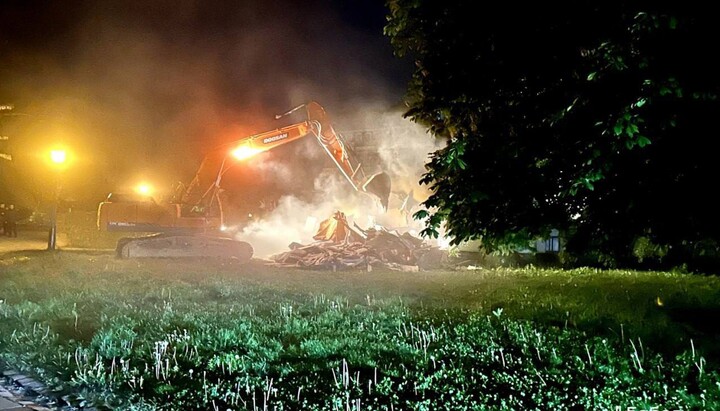
The demolition of the Tithe Monastery in 2024. Photo: Babel
Equal-to-the-Apostles Volodymyr and Olga of the Tithe Monastery of the Nativity of the Most Holy Theotokos in Kyiv. The destruction of the holy site occurred during the night of May 16-17, 2024.
The UOJ recalls how events unfolded.
On the evening of May 16, around 10:30 PM, security forces arrived at the monastery, cordoned off the temple, and did not allow either the monks or the faithful to approach it. Soon, heavy machinery – bulldozers and trucks – arrived, and the destruction of the Orthodox shrine began.
By 12:20 AM on May 17, the temple's debris was already being transported away on trucks. According to the monastery, during the demolition, the altar with relics, icons, crosses, and other sacred items were in the temple, and they were removed as "construction debris".
It is especially cynical that the demolition took place during the curfew and without any documents being entered into the registry of enforcement proceedings, indicating a violation of legal norms.
In connection with the anniversary of this event, Bishop Clement of Borova, vicar of the Kyiv Metropolis and abbot of the Tithe Monastery, gave a speech in which he emphasized the spiritual significance of the destroyed shrine: “This temple was not only an architectural adornment but also a symbol of spiritual heritage, inextricably linked to the beginning of the Christian history of Rus.”
In his address, Bishop Clement particularly noted the pain caused by the actions of the destroyers: “Those who demolished our temple said it was an 'illegal building'. But who gave them the right to destroy what was founded on the faith and prayers of the people? I do not write these words with offence – I write them with pain. Not for the temple made of wood and stone, but for the human hearts in which the fear of God has faded.”
The bishop reminded of the warning of the Apostle Paul: “If anyone destroys God’s temple, God will destroy him; for God’s temple is holy, and you are that temple” (1 Cor. 3:17). “Yes, the apostle speaks of man as the temple of the Holy Spirit. But how can someone, in whom God lives, destroy temples consecrated for prayer? To raise a hand against God’s house, one must first destroy the temple within their own soul,” emphasized the bishop.
Bishop Clement recalled that the temple was built on the land sanctified by the blood of the first martyrs – the holy passion-bearers Theodore and his son, the infant John, and was consecrated by His Beatitude Metropolitan Volodymyr, and after the fire, by His Beatitude Metropolitan Onuphry.
“We may be dispersed, the building may be demolished, but the Church of Christ cannot be destroyed – and the gates of hell will not prevail against it,” concluded Bishop Clement, expressing hope that in the future, a new cathedral will arise in the place of the destroyed temple.
Earlier, the UOJ reported that there is now only trash and weeds on the site of the monastery's demolition.
Read also
Volodymyr-Volynskyi Eparchy marks 30 years since restoration
The Pantanassa Icon and relics of Prince Volodymyr have arrived in Kovel and will visit churches across the Volodymyr-Volynskyi Eparchy to mark the 30th anniversary of the restoration of the episcopal see.
Bukovyna faithful bring humanitarian aid to Kherson region residents
The UOC’s Chernivtsi Eparchy delivered food to Holy Spirit Cathedral in Kherson.
Ukraine must have its own faith: Poroshenko's party lays out peace terms
Poroshenko’s party European Solidarity described church policy as a matter of national sovereignty and said there can be no compromises in this area.
432 UOC churches damaged in Ukraine during war, report says
According to the Religion on Fire project, 807 religious buildings in Ukraine have been damaged or destroyed as a result of hostilities.
DESS official gives number of clergy exempt from mobilization in Ukraine
A DESS representative said the actual number of clergy exempt from mobilization is significantly lower than the number of religious organizations designated as critical.
Cabinet keeps gas prices unchanged for religious organizations
The Cabinet has fixed gas prices for religious organizations through the end of the 2026–2027 heating season.