Why you shouldn’t put a vyshyvanka on your soul
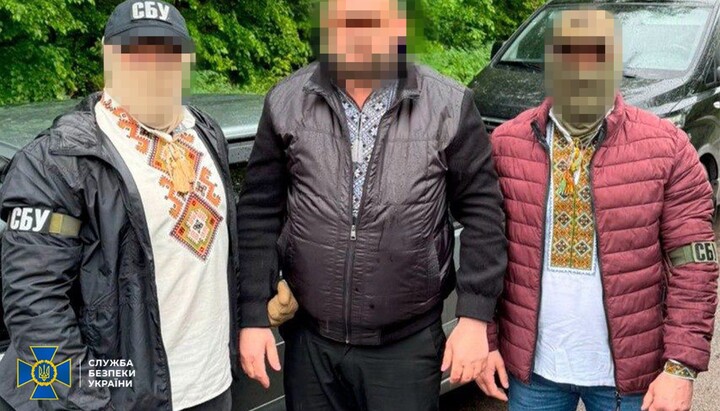
OCU cleric and SBU officers in vyshyvankas. Photo: SBU
On Vyshyvanka Day, Ukraine’s Security Service (SBU) published a photo of the arrest of OCU “priest” and Zoriane village council head Mykhailo Oleinyk, who was caught accepting bribes in a land scheme. Both Oleinyk and the arresting SBU officers were proudly wearing vyshyvankas (embroidered shirts – Ed.). The scene is, at once, comical and sad. Here’s why.
In Ukraine, the vyshyvanka has long ceased to be merely an ethnic garment, like those found in Mexico, Peru, or Norway. Ukrainians are taught that wearing a vyshyvanka connects them to a grand, ancient heritage. It is promoted almost as a sacred “vestment” of a true Ukrainian, the main symbol of “Ukrainian spirituality,” a sign of “light and goodness.”
Children in schools are even asked to write essays on the theme: “Before you put the vyshyvanka on your body, you must put it on your soul.”
Epifaniy Dumenko has claimed that the OCU cannot be imagined without embroidery, suggesting that the colors of the vyshyvanka allegedly carry church symbolism. Thus, only the “worthy,” the true bearers of the “Ukrainian spirit,” are deemed fit to wear it. The “unworthy” are not.
For example, Roman Hryshchuk, a leading church raider in Bukovyna, upon seeing UOC parishioners in vyshyvankas, wrote that their appearance made him not want to wear one anymore. In his view, people who attend the Ukrainian Orthodox Church have no right to wear a vyshyvanka – it should be reserved for the OCU.
Now let us return to Oleinyk and the SBU. This OCU cleric, who also served as a village head, was caught taking bribes as far back as 2016 and has been under investigation ever since. At the time, local OCU “hierarch” Illarion Protsyk said such actions by someone entrusted as a pastor were “unacceptable and inappropriate,” comparing Oleinyk to Judas Iscariot.
Yet despite this, Protsyk has continued to serve liturgies together with this “Judas.” And now Oleinyk has been arrested again – for yet another bribery charge.
But this time, too, Oleinyk was wearing a vyshyvanka.
And the problem isn’t just him or the OCU. On May 15, social media was flooded with grandiose photos of well-fed officials and MPs dressed in vyshyvankas. And it’s doubtful that most of them are any more honest than Oleinyk.
The vyshyvanka is beautiful. It is part of our history. But it is not a “talisman” or a “shield of goodness.” It does not confer some elevated spiritual belonging. It is just clothing.
Christ tells us that this true belonging must be found not on the outside, but within – “The Kingdom of God is within you.”
But that’s hard. It’s easier to just put on a vyshyvanka.
Read also
Why is it legal to kill a person before birth but not after?
Children are the most privileged members of society. Yet that same society officially permits children to be killed – and on a massive scale.
Honoring the Bolsheviks’ successors at Kyiv Lavra
It was under the Reserve that the relics of the saints were desecrated, Lavra churches were turned into an atheism museum, and toilets were installed in sanctuaries.
"Degenerates" and "stupid animals": anti-UOC activists turn on children
Future historians will wonder how a vast country’s information agenda could have been shaped for so long by people so petty, vicious, and utterly contemptible.
Zelensky sees murder of Polish priest but not of Sviatohirsk monk
Why does Zelensky react so emotionally and swiftly to the murder of a Catholic cleric while remaining completely silent about the murder of an Orthodox monk?
UOC vs. OCU numbers: pollsters count, social media recount
Official polling suggests Dumenko’s structure has an overwhelming lead in the number of parishioners, while social media polls paint a very different picture. Which should we believe?
Who is working for the Kremlin in Poland? OCU, Uniates and Catholics versions
Who in the conflict between Poland and Ukraine is "an agent of the Russian Federation"? Zelensky, who gave the UPA name to an AFU special operations center? Nawrocki, who stripped him of an order for it? Polish MEPs?