OCU activists seize UOC Church of St. Panteleimon in Vilne
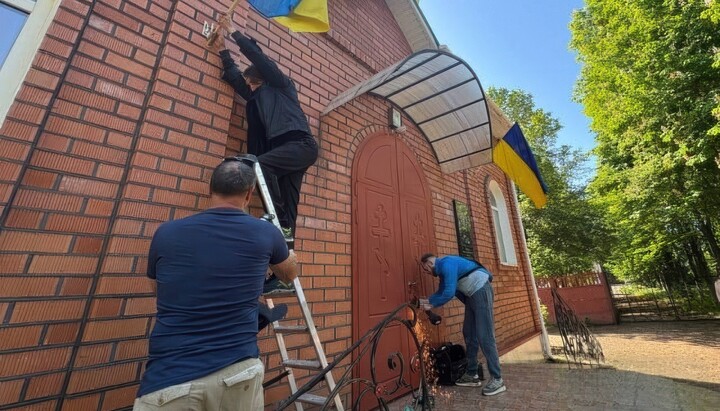
Activists cutting the locks on the UOC Church of St. Panteleimon. Photo: 1kr.ua
On May 22, 2025, activists of the Orthodox Church of Ukraine (OCU) used a grinder to cut the locks and seized the Church of the Holy Great Martyr and Healer Panteleimon, which belongs to the Ukrainian Orthodox Church (UOC), in the village of Vilne, Kryvyi Rih district, Dnipropetrovsk region.
According to claims circulated by OCU activists, the community allegedly “returned to its church” following an official transition. However, the actual situation stands in stark contrast to this narrative.
The legitimate UOC parish assembly
The actual parish of the UOC church had never made a decision to join the OCU. On the contrary, during a lawful parish assembly, the faithful confirmed their allegiance to the Ukrainian Orthodox Church and His Beatitude Onuphry.
Facts regarding the so-called “transition”:
- On May 14, 2023, a meeting was held near the House of Culture in the village of Vilne, which was presented as a “parish assembly.” This event was initiated by former UOC cleric Maksym Krylach, who had been suspended from ministry.
- The gathering included not only residents of Vilne, but also individuals from neighboring villages – Radionivka and Lozuvatka.
- Faithful members of the UOC parish did not take part in the event.
- The community had previously submitted written notices to local authorities and police, warning them of the illegality of the planned meeting.
Two-year struggle for the church
Following the illegitimate “assembly” in 2023, OCU activists spent two years pursuing the official re-registration of the parish. Despite documents containing falsified information, the church was re-registered on April 3, 2025.
Attempts to seize the church:
- On the eve of Pascha 2025, OCU representatives attempted to enter the church, but were blocked by the UOC community. Police intervention also prevented a forced seizure.
- The church was then closed during the ensuing legal proceedings. On May 22, however, OCU activists broke in.
Position of the UOC parish
The UOC faithful in Volne continue to regard the seizure as unlawful. The parish has repeatedly reaffirmed its loyalty to the Ukrainian Orthodox Church and has never agreed to a change in jurisdiction.
As noted by the Kryvyi Rih Eparchy of the UOC, the discussion on transferring the parish’s jurisdiction was conducted without the participation of the parish priest, Archpriest Maksym Omelchenko, or any actual members of the religious community. Many of those involved in the so-called “assembly” were not only non-members of the parish but were not even residents of the village where the church is located.
Such actions are seen as a direct violation of the Law of Ukraine “On Freedom of Conscience and Religious Organizations” and may be interpreted as efforts to destabilize the situation and incite interreligious hostility.
This case represents yet another example of the UOC churches being forcibly seized under the guise of a “voluntary transition,” where the genuine community remains loyal to its Church while the change is imposed by a group of activists without the participation of real parishioners.
Read also
Met. Meletiy consecrates house of worship for UOC community in Dankivtsi
Members of the persecuted UOC Intercession parish in Dankivtsi have converted a house into a place for communal prayer and worship services.
OCU eparchy sells church center site to developer for housing
The OCU’s Volyn Eparchy sold land intended for a spiritual center to a private developer planning to build townhouses and residential buildings.
SBU names UOC priest’s wife a suspect in Cherkasy region
The SBU accused Matushka Kateryna Prykotenko of “spreading enemy propaganda” through correspondence with parishioners.
UGCC cleric calls Russian Orthodox literature dangerous for clergy
While examining the causes of divisions within the UGCC, Yustyn Boiko concluded that Russian Orthodox literature had influenced Greek Catholic clergy.
UOC will play major role in achieving peace, says Vadym Novynskyi
UOC Protodeacon Vadym Novynskyi believes the Church will help bring about reconciliation within Ukrainian society after the war ends.
Catholic media outraged by forcible conscription of Uniate cleric
The Vatican’s Apostolic Nunciature has demanded the return of a forcibly mobilized Greek Catholic cleric.