A government scenario for communities that managed to expel raiders
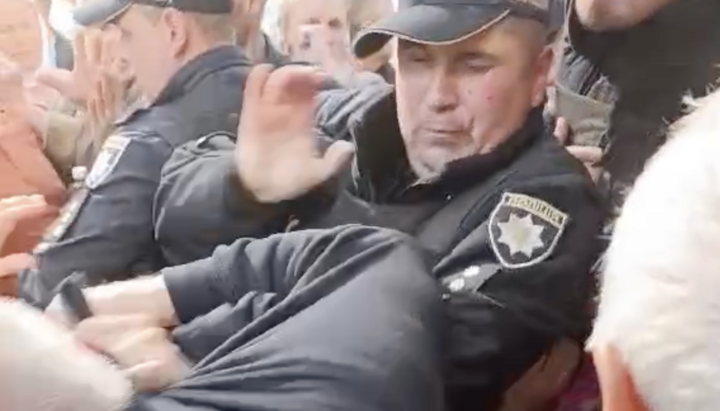
A police officer using force against parishioners in Ust-Putyla. Photo: UOJ
Sources in the Bukovynian Ust-Putyla report that on May 27, this tiny village was literally flooded with police. Law enforcers were going door to door checking if men have registered weapons. They also visited the school, where they made it clear to children and teachers that defending their church is not the best idea.
These police actions remind the scenario of events in another Bukovynian village - Verkhni Stanivtsi.
There, let us recall, OCU militants led by Hryshchuk also seized the church, but the UOC community managed to drive them out. In the following days, Stanivtsi was similarly cordoned off by the police, who similarly inquired whether the men had weapons. And when they were convinced that there was no danger of armed confrontation, a demonstrative seizure was carried out. The police pushed back the parishioners, made a corridor for the raiders, and they, breaking down the doors, seized the shrine.
Both Stanivtsi and Ust-Putyla are rare examples where parishioners managed to drive out OCU militants on their own. Such occurrences in religious conflicts are rare. Moreover, it is a precedent that can serve as an example for others. And since the authorities work in tandem with the "state" OCU, they are looking for "anti-crisis" scenarios. In Verkhni Stanivtsi, this scenario worked - the repeated seizure with the help of law enforcement was successful. Obviously, it will be applied in Ust-Putyla as well. Judging by the footage from this village on May 21, where police were actively using force against elderly clerics and parishioners, it is unlikely that law enforcers will show any leniency during a new assault on the church.
Unfortunately, it must be stated that in Bukovyna, the actions of these "guardians of the law" do not quite correspond to the etymology of the word. People to whom the state has given a monopoly on force are using it not for protection or the rule of law. They are using it for the reprisal of one group of Ukrainians against another.
And if the Verkhni Stanivtsi scenario is repeated in Ust-Putyla, it would be more appropriate to call the law enforcers "OCU-enforcers". Unfortunately.
```
Read also
Why is it legal to kill a person before birth but not after?
Children are the most privileged members of society. Yet that same society officially permits children to be killed – and on a massive scale.
Honoring the Bolsheviks’ successors at Kyiv Lavra
It was under the Reserve that the relics of the saints were desecrated, Lavra churches were turned into an atheism museum, and toilets were installed in sanctuaries.
"Degenerates" and "stupid animals": anti-UOC activists turn on children
Future historians will wonder how a vast country’s information agenda could have been shaped for so long by people so petty, vicious, and utterly contemptible.
Zelensky sees murder of Polish priest but not of Sviatohirsk monk
Why does Zelensky react so emotionally and swiftly to the murder of a Catholic cleric while remaining completely silent about the murder of an Orthodox monk?
UOC vs. OCU numbers: pollsters count, social media recount
Official polling suggests Dumenko’s structure has an overwhelming lead in the number of parishioners, while social media polls paint a very different picture. Which should we believe?
Who is working for the Kremlin in Poland? OCU, Uniates and Catholics versions
Who in the conflict between Poland and Ukraine is "an agent of the Russian Federation"? Zelensky, who gave the UPA name to an AFU special operations center? Nawrocki, who stripped him of an order for it? Polish MEPs?