To beat, or not to beat – that is the question
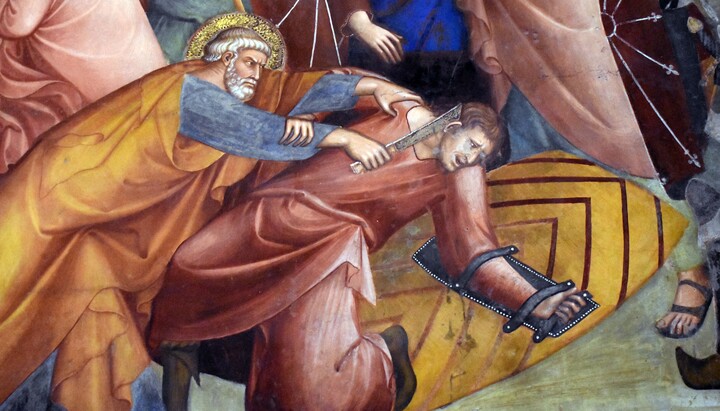
The Apostle Peter cuts off Malchus’s ear. Fresco from San Gimignano, Basilica of Santa Maria Assunta
Christ has ascended into heaven, but He left us on earth – as His presence in time and space. Each of us, as a member of His Church, is called to follow His will and be an instrument of His divine Providence in the world. That means everything Christ said to His disciples also applies to us: The world must hate us, persecute us, and crucify us. And if that’s not happening – then perhaps we should worry: are we truly His?
Seen in this light, many of the things we experience today in Church life fall into place. We are outraged, we demand justice and the rule of law. And rightly so. But if that’s our only response, then we might as well be outraged at the Gospel too.
What justice was there in the crucifixion of Christ?
What justice is there in the innocent suffering in place of the guilty?
Or should we ask instead: are we with Christ – or with the world?
So what should we do? What did Christ do? On the Saturday of Lazarus, He headed toward Jerusalem. One word – one cry to arms – and the zealots, daggers tucked in their cloaks, would have risen and swept away everything in their path.
Later, He had the power to summon legions of angels, who would have left neither Romans nor high priests alive.
But Christ called for neither warriors nor angels. He chose the road of suffering – of shame and torment – though He had every power to secure an easy victory. Obeying to His Father's will, He chose to drink the bitter cup of injustice, out of love for humanity and for our salvation.
And we – who do deserve what we suffer – what should we do? Should we rise up, revolt, demand justice and our legal rights?
I think we must avoid extremes. Of course, where action is possible, we should act. We must stand together as a community in times of trial. We must appeal to the law.
But for a good shepherd, people – the souls and well-being of his flock – must come before buildings and property.
I struggle to understand the revolutionary fervor of those clergy who are willing to lead their parishioners into beatings, tear gas, and trauma under the banner of “defending a shrine,” as though enticing them with martyrdom. Perhaps I don’t understand something – forgive me.
But I believe we should learn from saints closer to our time. Look at the newly canonized elders of the Glinsk Hermitage. In July 1961, when the communists closed their monastery, they too could have resisted. They could have caused a scandal that would make Western headlines. But they chose instead to flee to hidden corners, to live in prayer – and became saints.
“When they persecute you in one city,” said the Savior, “flee to another.”
He did not allow His zealous disciples James and John to call down fire from heaven on the Samaritans, saying, “You do not know what spirit you are of.”
Maybe we, too, have forgotten what spirit we are of.
Maybe we’ve forgotten how Christ taught us to treat our enemies.
We are not called to fight evil in the world as if it were ours to conquer.
A calf, locking horns with an oak tree, is not fighting evil – just bruising itself.
Our task is to take our mind out of the world that lies in evil, so that when the time comes to part with the body, we may depart from the world freely.
We don’t fight evil.
We ignore it.
To think that we can defeat evil by using its own weapons is both foolish and naive. Fight like that long enough, and you yourself become the evil.
Evil can only be conquered in one way: by refusing to let it enter or take root in us.
We don’t need to “save the world.”
We need to save ourselves from the world.
And that’s something entirely different.
You don’t fight Pharaoh.
You flee him.
Let God deal with Pharaoh.
As for us – we were told, “Follow Me.”
This earthly life is a wilderness – a Sinai – where many will perish. Only those who understand what spirit they are of, who can recognize the voice of the good, wise Shepherd, and not confuse it with the cries of some untried herdsman, will make it to the Promised Land.
We were told by the Savior that in this world we would have sorrow – and through many sorrows must we enter the Kingdom of God.
A modern-day ascetic once said: “For us, justice is to endure injustice – as Christ did – if, indeed, we wish to be saved.”
May God grant us the strength to do so.
Read also
Honest atheism vs. spiritual hypocrisy
The 70th anniversary of Albert Camus’s Nobel Prize recalls an uncompromising challenge to Christianity. An honest unbeliever brings theology back to the mystery of the Cross.
The valley of trouble and the gateway of hope
One soldier buried an expensive cloak and some gold beneath his tent. Because of this, all Israel lost a battle. Why did one man’s sin bring disaster upon an entire nation?
From love spells to bishop's throne
Antioch’s most powerful sorcerer sent demons against a devout young Christian woman three times – and failed every time. In the end, a demon himself revealed the truth that led to his conversion.
The Weeping Queen of Blachernae
On the night of the Feast of the Protection, only two people witnessed the miracle in the Church of Blachernae. Everyone else prayed and saw nothing. Yet they, too, received grace.
Deadly spiral of human hatred
The tragedy of Lebanon's civil war lays bare how dehumanization and fear can turn human beings into monsters.
Woe to expectant mothers – or to those of little faith?
God commanded one prophet not to have children, yet told his people in exile to bear sons and daughters. What does this apparent contradiction tell us today?