On the Day of the Leave-taking of the Ascension of the Lord
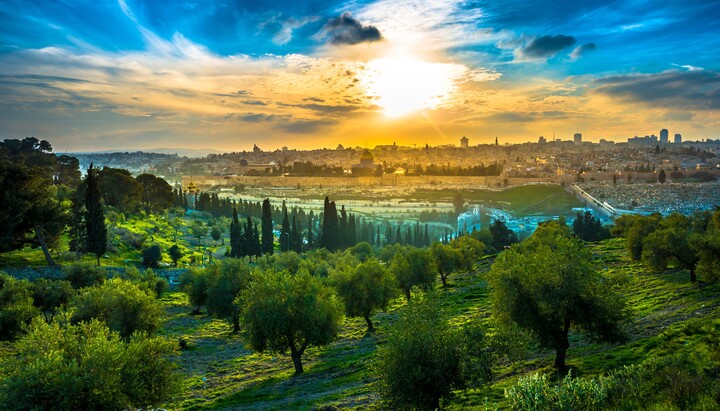
The Mount of Olives. Photo: Family of Israel
The Mount of Olives – also called the Mount of the Olive Trees – from which our Lord Jesus Christ ascended into Heaven. Let us climb, in spirit, to its very summit and gaze down with our spiritual eyes at the world below. By earthly measure, this mountain is not so tall. But in spiritual terms, it soars to unimaginable heights, for it stands at the very heart of all creation.
The mountain is encircled by a valley, smothered in a heavy, black-grey smog. Through this thick haze, neither people nor buildings can be seen clearly. All is shrouded by the sulfurous fumes of human passions. Now here, now there, fiery flashes – like bolts of lightning – pierce the gloom. These are the places where people slaughter one another en masse.
Sharp antennas rise like needles through the smog. Some of them emit waves that fill people with fear and hatred. Others broadcast endless entertainment, lust, and hedonism. These are the mass media. Mixing and colliding, their signals create a diabolical cocktail that slowly drives humanity mad. The air in this valley is unbreathable. Those who inhale it live in torment – and die in torment – falling into bubbling, fiery lava.
But the one who resists infection by this valley’s poison climbs higher, toward the summit of the Mount of Olives. Here the air is clean, and along the slope begins a beautiful mixed forest, alive with birdsong. Among the trees lie lovely meadows, speckled with wildflowers and herbs. Scattered across them are settlements of people who managed to rise above the dark madness of humanity. These are not greeted in the morning by grim newsfeeds, but by a gentle cat purring and nudging them to rise for prayer. A curious dove peeks through the window. Friendly trees tap gently on the glass to say goodnight – or greet the dawn. These people live in an illusion of peace and safety, though mortal danger lurks beside them every minute.
Hidden behind that illusion are a thousand and one sorrows. Massive landslides sweep through the forest without warning. A death sentence arrives in the form of a diagnosis. An earthquake or a war shatters the fragile crystal of blessed prosperity. A family’s income collapses, health fails, betrayal strikes – and suddenly, the landslide carries off the delicate joy of earthly happiness.
Those who understand this do not linger in that forest paradise. They know it is time to move on – away from danger. But doing so means breaking the heavy chains of attachment and climbing even higher. Beyond the forest, the ascent becomes steep. There are almost no trees – only sheer cliffs and soaring eagles, watching the few travelers below. The path is hard. The heart is constantly tempted to turn back – to the warmth and comfort of the forest left behind.
Yet the one who summons the courage to ascend further, reaching a great height, looks back in wonder and sees that not only the stifling valley but even the forest has vanished from view. Down below stretches a sea of heavenly clouds, billowing in radiant white. And above – on moonlit nights – hang the pearly clusters of stars, from which choirs of angels sing their praise to God. By day, the sun of Divine Love rises in the sky – so brilliant one cannot gaze upon it without going blind. Its rays reflect in the dazzling snow-white mantle of the summit, sending joyful sparks into the depths of the soul, bringing with them Divine peace and bliss.
A narrow path winds to the top – where, at its end, opens a wondrous realm in which there is no more pain, nor sorrow, nor sighing – only Light. And in dissolving into that Light, we ourselves become light.
Read also
Brother of tax collector and brother of Lord
The Gospel is silent about the son of Alphaeus, and commentators have argued for centuries over who he was. And the Church commemorates two apostles named James in close proximity.
Prayer commemorations instead of loving embraces
At every Orthodox wedding, the choir sings a hymn to the martyrs. For families separated by war, these words carry a special meaning.
Honest atheism vs. spiritual hypocrisy
The 70th anniversary of Albert Camus’s Nobel Prize recalls an uncompromising challenge to Christianity. An honest unbeliever brings theology back to the mystery of the Cross.
The valley of trouble and the gateway of hope
One soldier buried an expensive cloak and some gold beneath his tent. Because of this, all Israel lost a battle. Why did one man’s sin bring disaster upon an entire nation?
From love spells to bishop's throne
Antioch’s most powerful sorcerer sent demons against a devout young Christian woman three times – and failed every time. In the end, a demon himself revealed the truth that led to his conversion.
The Weeping Queen of Blachernae
On the night of the Feast of the Protection, only two people witnessed the miracle in the Church of Blachernae. Everyone else prayed and saw nothing. Yet they, too, received grace.