Lutherans call for removal of "Filioque" from the Nicene Creed
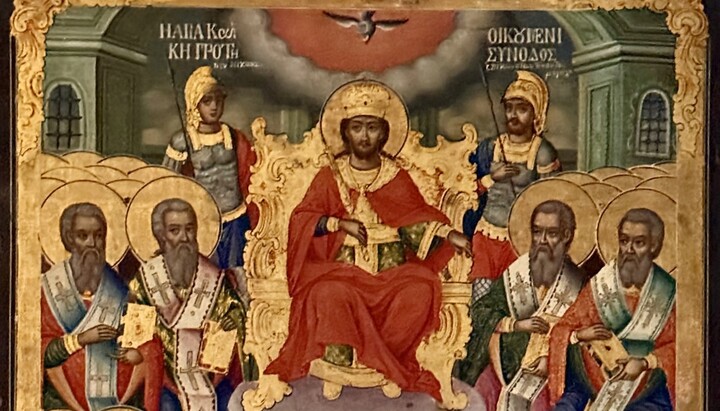
The icon of the First Ecumenical Council. Photo: ec-patr.org
The International Joint Orthodox-Lutheran Commission on Theological Dialogue has recommended that Lutheran churches abandon the use of the insertion "and the Son" (filioque) in the Nicene Creed, according to the official statement of the commission, published following the meeting dedicated to the 1700th anniversary of the First Ecumenical Council, reports the UOJ in America.
The commission calls on all Lutheran churches that still use the altered version of the Creed to return to the original Greek text, in which the Holy Spirit "proceeds from the Father," not "from the Father and the Son."
It should be recalled that the filioque wording was added at a local council in Toledo in 589 to combat the Arian heresy, but later became the subject of serious theological controversy. Over the centuries, the Orthodox Fathers of the Church have consistently opposed this innovation, asserting that it contradicts both Holy Scripture and Holy Tradition.
In John’s Gospel, Christ explicitly states that the Holy Spirit proceeds from the Father, without reference to Himself: “But when the Helper comes, whom I shall send to you from the Father, the Spirit of truth who proceeds from the Father, He will testify of Me” (John 15:26). It is on this theological basis that the Orthodox position is founded: the Holy Spirit proceeds only from the Father.
The Roman Church, on the other hand, officially established the dogma of the "double procession" of the Spirit at the Council of Florence in 1438 – "from the Father and the Son as from one principle." This became the theological divide between East and West, ultimately formalized in the Great Schism of 1054.
It is noted that today, centuries later, representatives of Western Christianity are beginning to recognize both the theological and historical erroneousness of this insertion. "Filioque" has become a symbol of the arbitrary interference of papal authority in the Holy Tradition of the Church, contrary to the decisions of the Ecumenical Councils.
For Orthodox Christians, this decision by the Lutherans is a step towards Truth.
As previously noted in the UOJ, the theological dialogue between the Orthodox and Lutheran Churches on the issue of filioque has been ongoing for several years. More on the previous statement: The Orthodox and Lutheran Commission issued a statement on "filioque".
Read also
Khust Eparchy honors memory of St. Job of Uholka
A Liturgy is served in Mala Uholka, a birthplace of St. Job of Uholka, on the saint's feast day.
UOC parish in Cologne donates ultrasound machine to Kharkiv region hospital
In Cologne, UOC believers raised funds for an ultrasound machine for the Kehychivka district hospital in the Kharkiv region.
Shevchuk tells Pope Leo of Ukraine's preparations for "another harsh winter"
The head of the UGCC expressed "special gratitude" to the Pope for his phone calls with Putin and Zelensky.
Berlin hierarch comments on Phanar document published by UOJ-USA
Metropolitan Mark called the information about the 2018 "Unification Council" alarming if confirmed, and expressed hope that Patriarch Bartholomew will reconsider his position.
UOC marks Synaxis of All Saints of Volyn Land at Lutsk cathedral
Metropolitan Serhiy of Ternopil and Kremenets led the Liturgy on the feast day of the Lutsk cathedral of All Saints of the Volyn Land.
SBU detains OCU cleric who organized draft evader's escape for money
In Transcarpathia, law enforcement officers detained a clergyman of the OCU who arranged for a draft evader to be smuggled into Slovakia for $15,000.