Details of Archbishop Ioannis's visit to Phanar made public
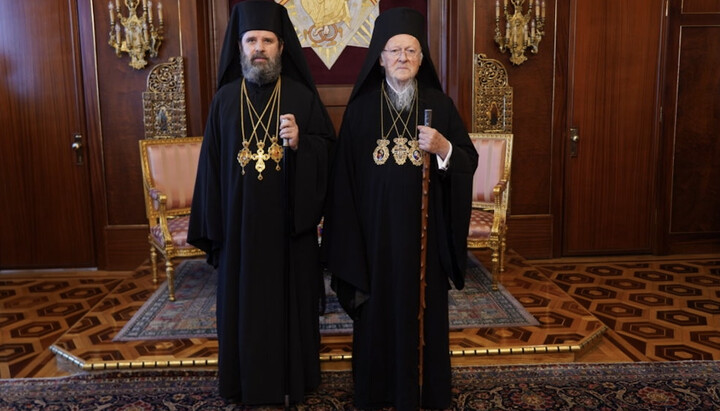
Archbishop Ioannis and Patriarch Bartholomew. Photo: vimaorthodoxias.gr
According to the Greek resource "Vima Orthodoxy", the first visit of Archbishop Ioannis of Tirana, Durrës, and All Albania to the Phanar just three months after his enthronement became a kind of test to see if the new Primate will truly follow in the footsteps of the blessedly reposed Anastasios.
Journalists are questioning whether Bishop Ioannis will truly be the "continuator" of his predecessor or leave his own mark in church policy. According to the authors of the publication, "this is where Orthodox cohesion is judged."
As "Vima Orthodoxy" reported, at the official reception in the Throne Hall, Patriarch Bartholomew characterized the presence of the new Archbishop of Albania as a "testimony to Orthodoxy".
Archbishop Ioannis, for his part, called his visit "an act of unhypocritical love" and thanked the Ecumenical Patriarchate for its support during the dark decades of atheism.
However, journalists of the publication are questioning how easy it is to maintain this cohesion when other Churches keep distance.
The publication notes that Serbian Patriarch Porfirije, four years after his enthronement, has still not visited the Phanar. The same applies to the new Bulgarian Patriarch Daniel.
The journalists wonder whether they will follow the example of Archbishop Ioannis or if relations with the Constantinople Patriarchate will "freeze".
Sources from the Greek Ministry of Foreign Affairs note that geopolitical tensions in the Balkans complicate church diplomacy. Nevertheless, "Vima Orthodoxy" believes that the joint service at the Patriarchal Church of All Saints sent a clear signal: "The Phanar remains the coordinator."
As the publication writes, the Patriarch recalled the "miracle" of Anastasius: the restoration of a Church that emerged almost dead from Hoxha's labor camps.
According to "Vima Orthodoxy", Archbishop Ioannis stood beside Archbishop Anastasios for decades; now he must prove that he can independently handle the challenges: the mass migration of young people, interfaith balances, and even the nationalist voices that are sometimes triggered by Tirana.
According to "Vima Orthodoxy", in a the tete-a-tete conversation with the Patriarch, the Archbishop put forward three specific requests:
- Support for youth programs against brain drain.
- Coordination on minority issues in Northern Epirus.
- A common voice for the reopening of the Theological School of Halki.
According to a source in the Autocephalous Orthodox Church of Albania , the Patriarch pledged a “willing helping hand.” However, the question remains: how much pressure can the Phanar exert on political leaderships in Tirana and Ankara? As the publication notes, the Albanian government, which invests in a multi-religious image, sees a “bridge” hierarch positively.
However, according to "Vima Orthodoxy," some diplomats note that his his attachment to the Patriarchate may disturb circles that promote a harder “national line”.
The publication questions whether Archbishop Ioannis can maintain the the erudition and constructive spirit of Anastasios without being accused of “hellenophile sensibilities”.
At the end of the visit, the Archbishop prayed at Hagia Sophia, spoke of "light from heaven" and departed for Tirana, leaving behind question marks:
Journalists of the publication highlight the following key questions:
- Will he visit Serbia or Bulgaria first?
- How will he handle the pressures for greater Albanian autonomy?
- Will a pan-Balkan Synaxis be convened soon?
In conclusion, "Vima Orthodoxy" notes that the coming months, amid possible new geopolitical upheavals, will show whether the visit to the Phanar was a mere formality or the first stone of renewed Orthodox cooperation.
According to the publication, the future will show whether his course will justify the "resurrectionary" work of his predecessor or whether he will write a new chapter—with unity or ruptures.
Earlier, the UOJ wrote that the Albanian Archbishop concelebrated at the Phanar with Patriarch Bartholomew.
Also, Archbishop Ioannis stated that the Albanian Church deeply regrets the church situation in Ukraine.
In his words, "It is a true tragedy that has divided many Churches." "Our position has already been clearly stated in the decisions of our Synod. There is nothing more we can add to that,” he emphasized, adding that “Archbishop Anastasios had the gift of foresight and understood where everything was heading."
Read also
Medieval сhurch сrumbles as Culture Ministry сites missing agreement
The 14th–15th-century St. Nicholas Church in Chesnyky, Ivano-Frankivsk Region, is falling into disrepair.
Poland сondemns Lviv Regional Council's decision to declare 2007 year of UPA
Polish Prime Minister Donald Tusk says the Lviv Regional Council's decision to dedicate 2027 to the UPA and Roman Shukhevych is harmful to Ukraine.
OCU seeks court recognition of ownership of seized Cherkasy cathedral
The Cherkasy Regional Commercial Court will hear an OCU lawsuit seeking ownership of St. Michael's Cathedral, which was seized from UOC believers.
Lithuanian bishop: Ukraine is no model for believers' rights
Vicar of Vilnius Diocese voices concern over attempts to import Ukraine's religious conflict into Lithuania.
Hundreds of believers honor St. Alexis of Carpatho-Russia in Khust Eparchy
At the St. Nicholas Monastery in the village of Iza-Karputlash, Metropolitan Mark of Khust led a festive liturgy, concelebrated by six metropolitans, five archbishops and three bishops.
Court upholds UOC parish appeal in Voloshky over OCU switch dispute
The Northern Commercial Court of Appeal has upheld the appeal of the St. Nicholas parish of the UOC in the village of Voloshky, Volyn region, in a dispute over a transfer to the OCU.