KDA professor analyzes state religious expertise on UOC’s alleged ties to ROC
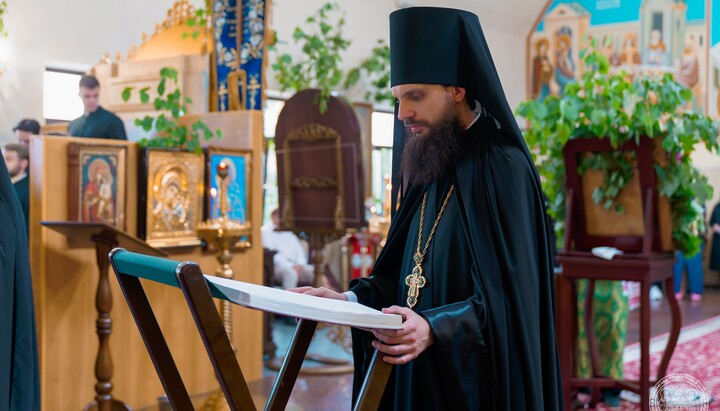
Hieromonk Herman. Photo: KDA Press Service
Hieromonk Herman (Kovach), associate professor at the Kyiv Theological Academy and secretary of the Synodal Theological and Canonical Commission of the Ukrainian Orthodox Church (UOC), has published a detailed study titled "Analysis of the Main Provisions of the Religious Studies Expert Conclusion of the State Service for Ethnic Policy and Freedom of Conscience (DESS) Dated January 27, 2023, from the Perspective of Church and Canon Law."
According to the study, the legitimate authority to interpret the internal canonical documents of the UOC lies with the Council of Bishops of the UOC, which acts as the Church’s highest ecclesiastical court, and during inter-council periods – with the Holy Synod. Since the DESS’s analysis was conducted without cooperation with the competent Synodal bodies of the UOC, the Church has no canonical grounds to recognize the DESS’s Conclusion as a document of legitimate interpretation.
Hieromonk Herman highlights the absurdity of a situation in which the state considers itself entitled to appeal to Church canons in the legislative process. In his view, such state interference in matters of canon law is incompatible with the grace-filled life of the Church of Christ.
Regarding the UOC’s status as “self-governing and independent in its administration,” Hieromonk Herman notes that the concepts of autocephaly and autonomy do not appear in the canons of the Orthodox Church as foundational sources of canon law. Instead, the canons use other terms to denote ecclesiastical independence.
Hieromonk Herman presents the following main conclusions:
- The DESS’s expert conclusion does not demonstrate the characteristics of a competent study in church and canon law.
- It cannot be lawfully used in legal proceedings against the UOC due to the fundamental incompatibility of secular and canonical legal systems.
- DESS disregards essential canonical documents and key events in the recent history of the UOC that are crucial to understanding the evolution of its self-definition.
- Under the primacy of His Beatitude Metropolitan Onuphry, the UOC has come as close as possible to the status of an autocephalous Church.
- The fundamental flaw of the DESS’s Conclusion lies in its complete disregard for the theological dimension of the Ukrainian church crisis.
As a reminder, the UOJ previously analyzed the findings of the DESS’s expert assessment concerning the alleged ties between the UOC and the Russian Orthodox Church.
Read also
UOC marks Synaxis of Poltava Saints
Metropolitan Philip celebrated the Divine Liturgy at the Horbanivka Monastery in Poltava on the feast of the Synaxis of the Saints of Poltava.
Rector of UOC church in Kramatorsk sent for second military medical exam
Lawyers have secured a second military medical examination for Archpriest Oleg Kruchinin, who was unlawfully detained by TRC officers.
Jews, Muslims, Catholics, and OCU pray together at St. Sophia Cathedral
Representatives of Jewish, Muslim, Catholic, and OCU communities held an ecumenical prayer service for Ukraine in Kyiv.
Horbanivka Theootokos Icon honored at Poltava Eparchy monastery
Metropolitan Philip of Poltava and Myrhorod led a festal service at the Horbanivka Convent.
Greek hierarch: Clergy should use social media to bring people to Church
The Church of Greece hierarch stressed that while the internet and YouTube can be useful, they cannot replace in-person participation in church life.
Odesa prosecutors appeal UOC church ruling to Supreme Court
The Odesa Regional Prosecutor's Office has appealed to the Supreme Court, seeking to transfer a UOC church to state ownership.