On the people’s victory in Chernivtsi
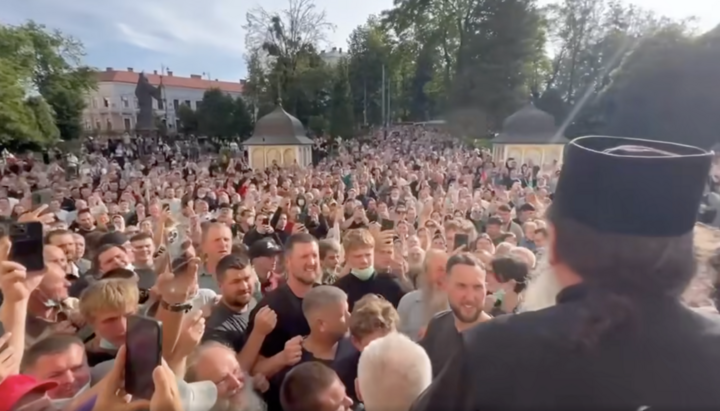
Faithful of the Holy Spirit Cathedral after reclaiming their sanctuary. Photo: UOJ
On June 17 in Chernivtsi, an event took place that many now call “historic.” In a matter of hours, nearly 5,000 parishioners of the cathedral gathered and drove out a handful of thugs who had seized their sacred temple in the name of the OCU. And the word “thugs” is no exaggeration. When men in shorts and balaclavas storm into a church and brutally beat priests – breaking their ribs, smashing their faces – these are not worshippers. Not believers. Not a “religious community.” These are common criminals, and for their crimes, they should have been immediately arrested.
But here lies the tragedy: instead of arresting them, the police sided with them. The authorities protected not the priests and the faithful from the attackers – but the attackers from the faithful. The police did not uphold the law. They shielded those who were brazenly and cynically violating it.
Instead of helping the faithful return to their sanctuary, law enforcement doused them with tear gas, used force, and sided with the raiders at every step. Simply put, the state – through its police – attempted to strip Ukrainian believers of perhaps the last thing they still had left: the right to pray in their own church.
And this is far from the first time. We’ve seen it in Lviv, Ivano-Frankivsk, Cherkasy, and countless other cities and villages. Since the end of 2022, when President Zelensky declared his push for “spiritual independence,” churches have been taken from the faithful in a sweeping, ruthless campaign. And all this while prayer is more vital than ever for Ukrainians – who live under the terror of war. Their homes are shelled, their fathers and brothers are dying at the front, their cities are being wiped off the map.
And they endure.
They endure when displaced persons are offered only words instead of help.
They endure when officials steal from the army, when food prices surpass wages.
They even endure when their loved ones are kidnapped from the streets by military recruiters.
But all patience has its limits. There is a line that must not be crossed.
For a believer, that line is the right to commune with God – not as instructed by the President, his advisors, or his ministers, but as one’s heart calls, as one's ancestors have done for generations.
On June 17 in Chernivtsi, the people showed the government that they still possess freedom. That they still have the right to confess their faith.
Not 10, not 100, not even 500 – but five thousand people came to the cathedral.
And the authorities wavered.
Have we truly reached the day when, to defend our right to pray, we must meet power with resistance?
Is there truly no other way?
Read also
Who destroyed and restored Kyiv Lavra? MinCulture's video reveals the truth
The Culture Ministry’s propaganda about the Kyiv-Pechersk Lavra has inadvertently revealed the truth.
Ternopil post on Feast of Intercession: Has calendar reformn failed?
A significant number of believers have rejected the new church calendar introduced by the OCU and UGCC with government support.
Shoulder straps or a cassock: who writes the script for UOC "fighters"?
Everything indicates that both Veliar and Pshenychny are ordinary performers of someone else's script. There is only one question – does the scriptwriter wear shoulder straps or a cassock?
Why is it legal to kill a person before birth but not after?
Children are the most privileged members of society. Yet that same society officially permits children to be killed – and on a massive scale.
Honoring the Bolsheviks’ successors at Kyiv Lavra
It was under the Reserve that the relics of the saints were desecrated, Lavra churches were turned into an atheism museum, and toilets were installed in sanctuaries.
"Degenerates" and "stupid animals": anti-UOC activists turn on children
Future historians will wonder how a vast country’s information agenda could have been shaped for so long by people so petty, vicious, and utterly contemptible.