How fishermen reinvent themselves as apostles
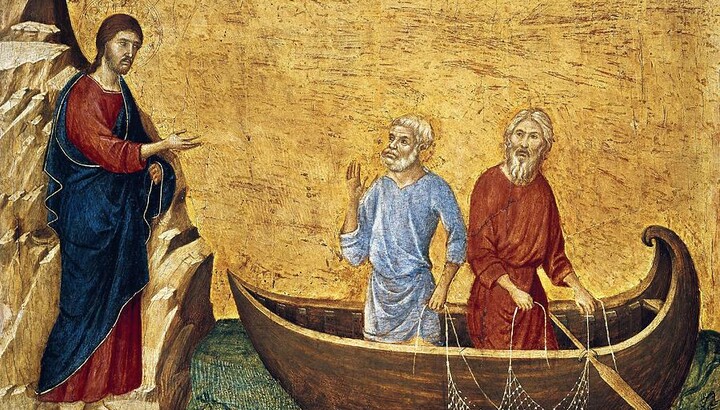
Christ Calling Peter and Andrew – Duccio di Buoninsegna. Photo: public domain
The Gospel reading for this Sunday recounts Christ’s calling of His first disciples (Matt. 4:18–23) – one of the most enigmatic and striking moments in all of the New Testament. The scene is told with astonishing brevity: Jesus approaches the fishermen and says, “Follow Me.” And they, without a word of hesitation, leave everything and follow Him. There is something profoundly mysterious in this simplicity. It is difficult to imagine a man walking up to others absorbed in their labor, saying “Follow me,” and them dropping their nets, their tools, their fish, even their families and homes – and simply going.
Who was it that called them? God made man? That is something we now know. But at the time, the apostles did not. Until the very end – until Christ’s Passion and even after His Resurrection – they did not fully understand who it was they were following. Only the descent of the Holy Spirit on the day of Pentecost would open their eyes to the true identity of the Messiah.
The calling is described in such a way that one gets the sense that these fishermen had spent their entire lives waiting for that very moment – for Christ to summon them. Only one account, that of Nathanael, offers a glimpse into the inner reason for such immediate obedience. Before He called him, Jesus said, “I saw you under the fig tree.” This hints at a prior mystical encounter with God that left a profound mark on Nathanael’s soul. But for the others, the Scriptures offer no such explanation for their unquestioning assent.
And as for Christ’s “personnel choices” for those who would be the first to proclaim the Gospel – they too remain a mystery. Preaching requires skill in speech, a certain rhetorical gift, and a foundation of theological knowledge. A fisherman is not someone trained in eloquence or public discourse. His task is to cast nets, haul in fish, and bring them to market – no great vocabulary needed. Even by today’s standards, these men would likely not pass an interview for a sales job, much less a missionary role. And yet, these simple men became bearers of God’s Word to the very ends of the earth.
Indeed, throughout salvation history, God has consistently chosen the most “unqualified” for His greatest tasks. He chose a nomadic tribe with no history or literature to be His people. He sent the tongue-tied Moses to stand before Pharaoh and his learned court. He anointed a shepherd boy, David, to be king. He Himself was born to a poor carpenter’s family, not even in a home, but in an animal stall. The one exception in all of divine-human history was the Theotokos – the Virgin Mary – whom God chose to be the Mother of His Son, the purest soul ever to walk the earth.
The fishermen became fishers of men (Matt. 4:19). And once again, God revealed that His strength is made perfect in weakness.
He takes what is frail, what seems wholly unsuited to great and mighty works, and accomplishes through it what only He can do. Human weakness in the hands of the Almighty becomes a power capable of shaking the world.
It was not by virtue of rhetorical mastery or missionary training that the apostles carried the Gospel across the known world. On the contrary – it happened not because of their qualifications, but despite them. God acts not through human advantage, but through the working of His holy will.
We cannot comprehend divine Providence. We search for motives with reason, but reason is only the dispatcher of the human heart. And it was the hearts of the apostles that recognized God in Christ long before their minds could grasp it. That is why they said “yes” to His call. Seeing Him, hearing His voice, they did not follow an argument – they followed a Man. Because, “Never has a man spoken the way this man speaks” (John 7:46).
Their ability to hear His call speaks to the deep purity of their hearts. They were simple, unpretentious men, unlike the prideful elite of their time. A humble sense of one’s own smallness – often, of one’s unworthiness – allowed even prostitutes and tax collectors to feel the divine light emanating from Christ. The “righteous” who thought themselves holy, however, could only see a rival in Him. They envied His glory, His power, His grace. And though they schemed to kill the sinless Son of Man, they would not enter Pilate’s court, “so as not to defile themselves and be unable to eat the Passover.”
Hypocrites, they feared defiling the ritual, but not their souls with the blood of the Righteous One. Only one man from the Sanhedrin defied their code and went to Pilate to ask for the body of Jesus. For him, what his colleagues thought no longer mattered. Nicodemus, like Joseph of Arimathea, had come to know that Jesus truly was the Christ.
And so the question comes to us:
Will we, beyond the rules and rubrics, be able to see the Living Christ? Will we discern the law of love – for whose sake we fast, attend services, and strive to keep commandments? Are we capable of loving the Lord with that “foolish” love that makes no calculations, seeks no logic, but flows from a heart wholly surrendered to Him?
Because God Himself loves us with a love that defies all logic. And we, too, are the most unlikely candidates for the Kingdom of Heaven. In ourselves, we have nothing that would make us worthy of it. But – O Lord, do as You have always done: save us not because we deserve it, but in spite of ourselves.
Read also
Brother of tax collector and brother of Lord
The Gospel is silent about the son of Alphaeus, and commentators have argued for centuries over who he was. And the Church commemorates two apostles named James in close proximity.
Prayer commemorations instead of loving embraces
At every Orthodox wedding, the choir sings a hymn to the martyrs. For families separated by war, these words carry a special meaning.
Honest atheism vs. spiritual hypocrisy
The 70th anniversary of Albert Camus’s Nobel Prize recalls an uncompromising challenge to Christianity. An honest unbeliever brings theology back to the mystery of the Cross.
The valley of trouble and the gateway of hope
One soldier buried an expensive cloak and some gold beneath his tent. Because of this, all Israel lost a battle. Why did one man’s sin bring disaster upon an entire nation?
From love spells to bishop's throne
Antioch’s most powerful sorcerer sent demons against a devout young Christian woman three times – and failed every time. In the end, a demon himself revealed the truth that led to his conversion.
The Weeping Queen of Blachernae
On the night of the Feast of the Protection, only two people witnessed the miracle in the Church of Blachernae. Everyone else prayed and saw nothing. Yet they, too, received grace.