There are no “laity” in the Church
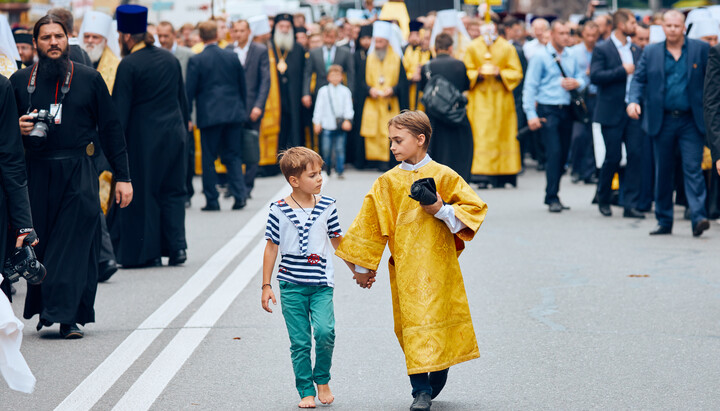
Photo: Children at the All-Ukrainian Cross Procession, 2018. Source: UOJ
In these first weeks after Pentecost, we continue to reflect on the structure of the Church and the workings of Divine Providence in the formation of the Body of Christ on earth. Sadly, even Christians themselves often perceive the Church as merely an institution intended to secure our individual salvation. But such a simplified view is one-sided. The Church consists of the people of God, whose primary calling is to serve God – that is, to offer worship. And this applies not only to clergy, but also to those Christians who, in my view, have been given the rather demeaning label of laity – that is, “worldly people,” those who live according to the ways of the world.
The Apostle Peter would certainly not have agreed with such a characterization of members of the newly formed community. “You are a chosen generation, a royal priesthood, a holy nation, His own special people” (1 Peter 2:9), he wrote to his disciples. After Christians were divided – under the influence of certain historical developments – into clergy and laity, it became awkward to speak of the “royal priesthood” of the latter. And this awkwardness still lingers. Yet those well-versed in liturgics and Church history know that the life of the early Christian community was precisely founded on the understanding of priestly ministry.
This ministry found expression in the Eucharistic assembly, which we now call a parish.
The Apostolic Church did not have a division between clergy and laity.
This does not mean that there was no distinction between the people and the one presiding over the Eucharistic assembly. The celebrant performed the Liturgy, offered the Holy Gifts, and occupied the primary place at the Eucharistic gathering. At the Mystical Supper, this was the Lord Jesus Christ Himself. After the Ascension of the Savior, His place was taken by the Apostle Peter. In the newly formed communities, the assemblies were led by the apostles and, later, by those to whom the community delegated the role of leadership.
The sacramental act in the Eucharistic gathering is made present and expressed through one person, but it is performed by the entire community. This is the nature of any Church sacramental action. Orthodox worship is not performed by the priest alone, but by the entire fullness of the Church – that is, by all the people of God. The bishop or presbyter is merely the voice and representative of this fullness. That is why, in the ancient Church, the faithful received Communion just as the clergy do today – partaking separately of the Blood and the Body of Christ.
The entire people – not only the presbyters – concelebrated at the Liturgy led by the bishop. When offering the holy oblation, the celebrant did not separate himself from the people but included himself in them.
He celebrated together with the people, and the people celebrated with their presider. The prayers of the Liturgy are likewise common prayers because they are the prayers of the Church – and the Church is the whole people of God, not just the clergy. There was no concept of prayers being read “secretly.” Such a notion contradicts the entire liturgical tradition. The practice of reading prayers silently is a late custom, and the reasons it continues today seem absurd to me.
The Eucharistic canon is read by the priest not in the singular but in the plural – on behalf of the entire community. Yet today he does so in secret, so that no one else hears. The fact that the Church’s people are no longer able to fully participate in the Liturgy is a grave violation of ecclesiology.
But this does not absolve parishioners of their duty to carry out the priestly ministry that the Apostle Peter speaks of.
We must understand a crucial truth: the faithful do not come to the Liturgy merely to repent and receive Communion, but to offer the Eucharist together with the priest or bishop. Parishioners are not spectators or observers, but full participants in the celebration of this sacrament.
A second common error, related to the first, is the belief that the Church consists of clergy who possess grace, and laity who do not (and here I am not referring to the grace of ordination). But a Christian cannot be without grace – this would contradict the very nature of the Church’s life. The Church is the Body of Christ. Each Christian, figuratively speaking, is a cell of that body. If we take the analogy of the human body, everything within it is alive. There is nothing dead in our body. Each organ, each cell fulfills its function. Likewise, in the Body of Christ – His Church – everything lives by the grace of the Holy Spirit. Each Christian, in his or her own way, partakes of this grace. And it is given to us for ministry in the Church. Naturally, this refers not to those who are Christian in name only, but to real members of God’s Church.
The Church is a grace-filled organism not because she once received the gifts of the Spirit on Pentecost and now stores them in some sort of treasury. Rather, she is grace-filled because the Holy Spirit always dwells and acts within her.
This raises an important question: what is my personal calling in the Church? What is my mission? Why has God called me into His chosen people? The general answer is the fulfillment of God’s will on earth. For God’s providence in the world is carried out primarily through the people of the Church – that is, through us. But there are also particular ministries, which arise from the very nature of the Church. Each member of the Church occupies a unique and irreplaceable position. It is equally important to understand that no one in the Church can be considered superior to another, even when they occupy a significant role in the Church hierarchy.
So that our ecclesiology does not come to a dead end, we must not forget the fundamental principles of the Church’s structure.
Many have come to view the Church as a sort of organization that should, for some reason, be subject to human laws. Some even regard the Church as a structure meant to serve governmental or social needs – something entirely alien to her nature.
But, it seems, the root of the problem is this: we are constantly trying to pit our will against the will of God within the Church and to use the Church to achieve our own goals. Yet the Church is not a human organization. It is a divine institution. The Church lives by the gifts of the Holy Spirit – by His holy will. And there is no one on earth who has the right to dictate to Her how She must live.
Read also
A lesson from a speechless donkey
The famous seer struck his donkey three times for refusing to go forward. All the while, she was saving his life – and seeing what he could not.
The time when the soul ripens
Modern society has turned youth into a cult and old age into a period of merely “living out one’s days.” The Christian perspective reveals the profound spiritual meaning of our later years.
Faith is not a checker piece in a spectator sport
Arguments about faith on social media increasingly resemble no-holds-barred fights. We turn to a saint who, sixteen centuries ago, knew how to speak to those interested only in turning theology into a combat arena.
The metropolitan who fought with a pen
St. Cyprian of Kyiv was robbed, expelled, and barred from his see. He answered with letters, books, and canons – and before his death, forgave everyone.
Loneliness under one roof
Spouses can share a home for years, raise children, and faithfully attend church – yet remain strangers to each other.
The cross – the deepest healing of the human soul
Emotional exhaustion and anxiety have become a way of life. Ancient Christian tradition offers an unexpected way out – embracing one's own cross.