Take up the cross
```html
TAKE UP THE CROSS
Still, reading traditional interpretations often "blurs the vision." You begin to perceive Christ's words through the prism of theological tradition. It's not that they distort them, but the element of surprise is lost. You don't hear them as the immediate witnesses did.
And only sometimes, if you manage to forget the familiar meanings for a moment, the words read hundreds of times suddenly astonish you when you realize what stands behind them.
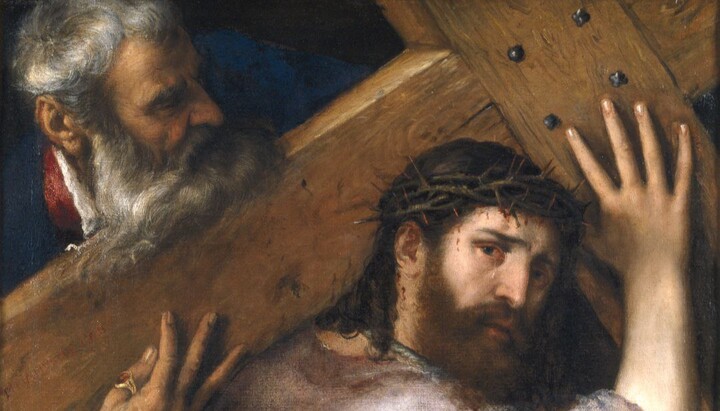
"If anyone wants to come after Me, let him deny himself, and take up his cross, and follow Me."
From numerous explanations, we know: this means that "every Christian must patiently endure precisely those insults and persecutions from the world that befall him. He must fight precisely those passions and sinful thoughts that arise in him. He must endure with humility and gratitude to God those sorrows and deprivations that Divine Providence allows him."
But they did not sound like this at all to the people gathered around Christ.
For them, the cross was not a symbol or image, but a real everyday instrument of execution (murder, death), like the gallows or electric chair for us.
Not daily, but quite often, criminals condemned to death walked the streets of Jerusalem, carrying a long wooden beam ("execution stake") on which they would later be nailed.
This very picture (not of an exalted spiritual feat, but of a mundane disgraceful execution) must have appeared before the eyes of Christ's listeners.
If you want to follow Me, become a criminal in the eyes of the world, destroy yourself and your life, take up the instrument of your execution, and voluntarily condemn yourself to death, - this is what Jesus tells them (and us). This is how His words sounded at that moment.
And He clarifies: Because whoever wants to save his own life will lose it, but whoever loses his life for My sake will find it.
"When Christ calls a man, he bids him come and die," noted Dietrich Bonhoeffer.
How to assess this call, how to understand it, how to apply it to one's own life, is a personal choice for each person. But to make this choice, you need to hear these words exactly as they were said - without others' interpretations and additional meanings.
```
Read also
About “our own” God on both sides of the war
Two similar “miracles” – and two opposite conclusions about God.
If Christians “moved in” like this
A text with reverse logic about migration and expectations from society.
Three years later: Fresh attempts to recarve the church landscape
Three years after the events in the Lavra, new calls are being heard to revise agreements with the UOC and hand monasteries over to the OCU.
The effort that transforms: Why fasting begins with the simple things
Lately, one idea is heard more and more often: that the main point of fasting is “not to eat each other alive,” and that what’s on your plate doesn’t matter. People repeat that food neither brings you closer to God nor pushes you away from Him, that you should fast “however it works out,” and that all of this is secondary.
When no one receives Holy Communion
Over three and a half years of emigration, we have been in twelve countries. And everywhere we tried to take part in local liturgical life and to receive Communion.
Deep сauses of military failures
The fact that Zaluzhnyi has finally been allowed to speak about the events of past days, I regard as a positive sign. The “expired guarantor” is gradually being squeezed, subtle but unmistakable hints are being sent – even by the British. And this is only a small fraction of what could now be said about the global military miscalculations of the ruling team.