
When no one receives Holy Communion
Over three and a half years of emigration, we have been in twelve countries. And everywhere we tried to take part in local liturgical life and to receive Communion.
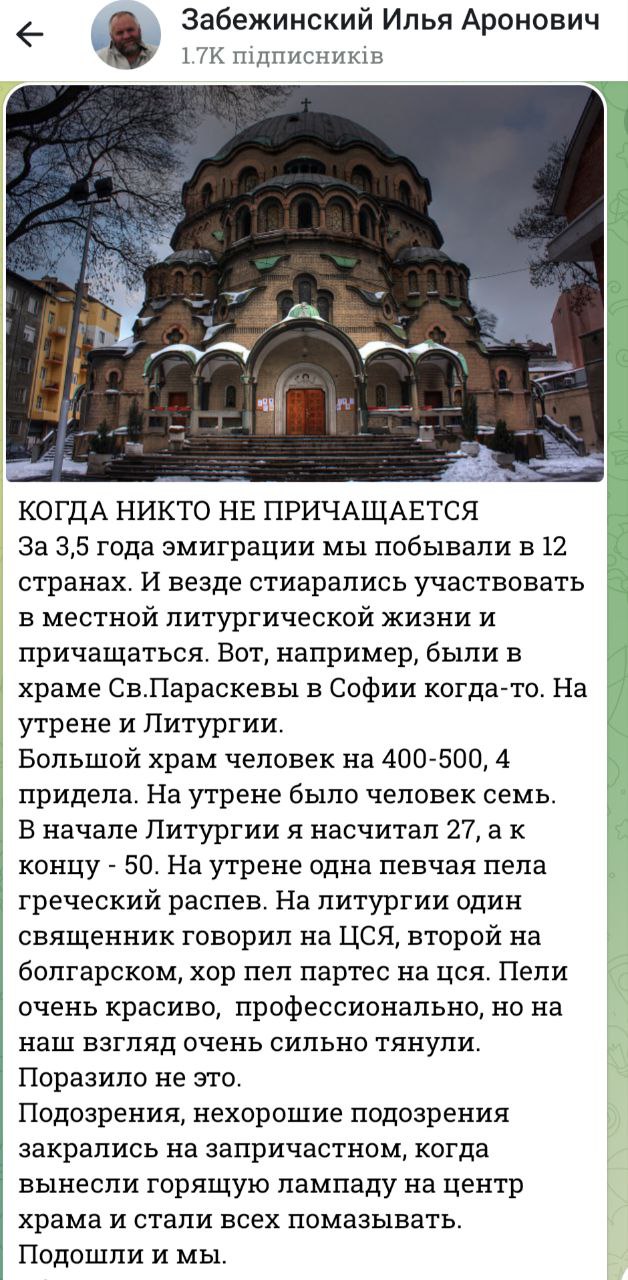
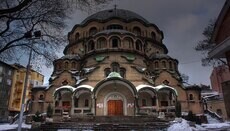
For instance, we once visited the Church of St Paraskeva in Sofia – for Matins and the Liturgy.
It is a large church, built for four to five hundred people, with four side chapels. At Matins there were about seven people. By the beginning of the Liturgy I counted twenty-seven, and by the end – fifty. At Matins a single chanter sang in a Greek chant. At the Liturgy one priest served in Church Slavonic, the other in Bulgarian; the choir sang part-singing in Church Slavonic. It was very beautiful and very professional, though to our ears everything was drawn out painfully long.
But that was not what struck me.
A suspicion – an unpleasant suspicion – crept in during the Communion hymn, when they brought a burning lampada to the center of the church and began anointing everyone. We went up as well.
“Well, this is it,” I thought, with a heavy heart.
And it really was it.
The anointed Orthodox Christians returned to their places.
Three women with small black backpacks – pilgrims, by the look of them – stepped up to the solea, arms crossed over their chests. We watched from the back for a moment.
The Royal Doors opened. The priest came out with the Chalice and said:
“With the fear of God and with faith and love, draw near.”
And… immediately carried the Chalice back into the altar.
The women with the backpacks began shouting something through the open doors and waving their hands.
The priest came out again and started talking to them in Bulgarian. That was when we stepped forward too.
He nodded to them, told them to line up on the solea. He noticed us and asked:
“Communion?”
We said:
“Yes.”
“Did you go to confession? Did you fast?”
In moments like this I always have a formula prepared – one that doesn’t offend the priest, yet doesn’t force me to betray my convictions:
“We’re from Russia, and our spiritual father blessed us to receive Communion.” (Which is the plain truth.)
He nodded and told us to stand behind the women. At that same moment several small children with their mothers appeared from nowhere.
The priest brought out the Chalice and communed all of us – about eight people, plus the children.
I walked back from the solea to my place under the gaze of the parishioners who had not communed. I did not see condemnation in their eyes. What I read was something else:
“Strangers. Odd ones.”
No one communed, do you understand? No one – except the clergy themselves, five visitors, and a few little children (sic!).
Afterward, everyone received antidoron when they venerated the Cross, and then dispersed to their homes.
Only one question will not leave me alone. To whom was the priest saying:
“With the fear of God and with faith and love, draw near”?
If he had no intention of communing anyone, then whom was he addressing – and why? Was he simply pronouncing a sacred formula?
And what stopped those who did not respond to that call from responding to Christ’s own invitation to draw near to Him?
Later I asked those women with the backpacks:
“How is that possible? No one! No one wanted to receive Communion. It’s a catastrophe.”
They said:
“That’s our tradition in Bulgaria. People commune rarely.”
And yes, there is indeed a tradition of communing laypeople four times a year – once for each of the major fasts. Because they require at least a week of fasting, a detailed confession with an advance appointment, and the full set of preparatory prayers. There are more “advanced” parishes and priests, but in general it is like this. A Liturgy at which none of the laypeople receive Communion. They came to the Divine Banquet, stood and stood, watched and listened – and then went home without tasting.