Greek opposition seeks revocation of Crete Metropolitans Election Law
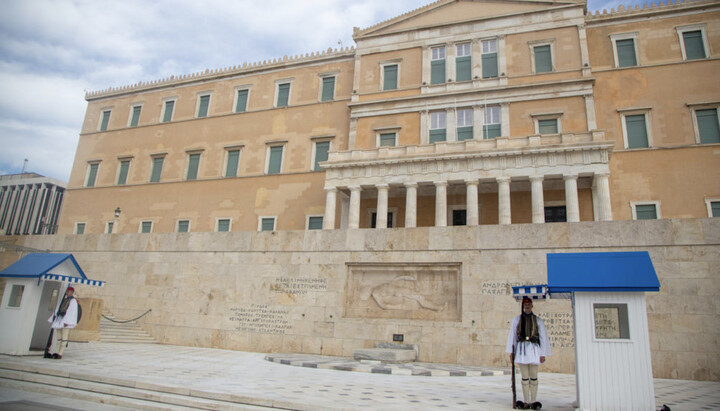
Greek Parliament. Photo: orthodoxianewsagency.gr
On July 11, 2025, the leader of the Greek party PASOK, Nikos Androulakis, and four other deputies approached the Minister of Education, Religious Affairs and Sports of Greece, Sofia Zacharaki, with an initiative to cancel or revise the amendment to the law on the election of metropolitans of the Church of Crete, either by abolishing it or by reinstating the previous provision.
The deputies emphasized that interference in church affairs violates the principle of separation of Church and state and undermines legal security and mutual respect necessary in relations between the state and religious structures.
The fact is that the amendment to Article 22 of Law No. 4149/1961, regulating the status of the Church of Crete, was included by the government in the law without prior discussions. According to the new interpretation, not only local candidates but also hierarchs of the Ecumenical Patriarchate residing outside Greece can now participate in the elections of metropolitans of the Church of Crete, which was not previously provided for.
The church authorities of Crete considered this an unacceptable state interference in church affairs. This was especially acutely perceived against the backdrop of the upcoming elections of the new Metropolitan of Kydonia and Apokoronas, following the death of the previous archbishop.
The Church of Crete reminded that for decades such legislative changes were made only in agreement with the Synod and with the participation of the Constantinople Patriarchate, to which the Cretan Church is canonically subordinate.
In its statement, the Synod noted that the elections of metropolitans in past years (1979, 1981, 1987) were conducted based on the previous version of the law, with the full consent of state commissioners and the subsequent issuance of presidential decrees recognizing their legality. The new amendment calls into question the legitimacy of those elections, creating a precedent and risk of legal instability.
On July 2, the Synod held an emergency meeting in Heraklion and decided to send appeals to the Prime Minister, leaders of parliamentary parties, and deputies of Crete, expressing protest against government actions and demanding a fair solution.
The PASOK party stated that throughout the years of post-dictatorial Greece (since 1974), the Church of Crete has enjoyed respect and autonomy, and only in exceptional cases were amendments made to the legislation — always with the consent of the Church.
In this regard, the deputies demand from the minister the immediate cancellation of the new interpretative amendment or a return to the previous legal norm.
Earlier, the UOJ wrote that the Church of Crete accused the authorities of interfering in the election of the metropolitan.
Read also
Medieval сhurch сrumbles as Culture Ministry сites missing agreement
The 14th–15th-century St. Nicholas Church in Chesnyky, Ivano-Frankivsk Region, is falling into disrepair.
Poland сondemns Lviv Regional Council's decision to declare 2007 year of UPA
Polish Prime Minister Donald Tusk says the Lviv Regional Council's decision to dedicate 2027 to the UPA and Roman Shukhevych is harmful to Ukraine.
OCU seeks court recognition of ownership of seized Cherkasy cathedral
The Cherkasy Regional Commercial Court will hear an OCU lawsuit seeking ownership of St. Michael's Cathedral, which was seized from UOC believers.
Lithuanian bishop: Ukraine is no model for believers' rights
Vicar of Vilnius Diocese voices concern over attempts to import Ukraine's religious conflict into Lithuania.
Hundreds of believers honor St. Alexis of Carpatho-Russia in Khust Eparchy
At the St. Nicholas Monastery in the village of Iza-Karputlash, Metropolitan Mark of Khust led a festive liturgy, concelebrated by six metropolitans, five archbishops and three bishops.
Court upholds UOC parish appeal in Voloshky over OCU switch dispute
The Northern Commercial Court of Appeal has upheld the appeal of the St. Nicholas parish of the UOC in the village of Voloshky, Volyn region, in a dispute over a transfer to the OCU.