Turkey's authorities to convert 10th-century Christian church into mosque
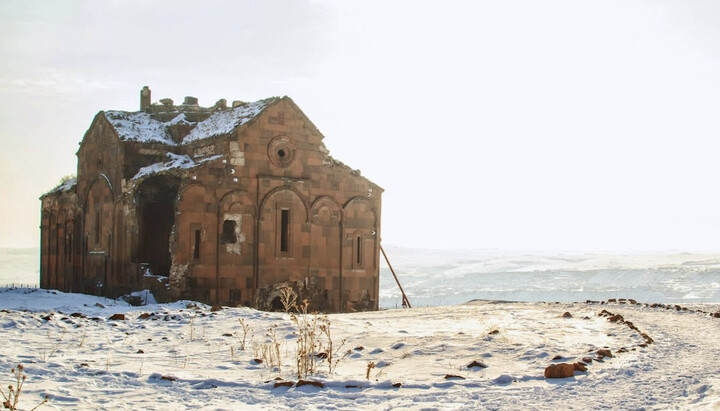
Ani Cathedral (Surb Astvatsatsin). Photo: bianet.org
On July 13, 2025, it became known about the decision of the Turkish authorities to convert the ancient Christian temple – the Ani Cathedral (Surb Astvatsatsin) – into a mosque. This was reported by the head of the archaeological excavations in the Ani Ruins area, Assoc. Prof. Muhammet Arslan.
The cathedral, built at the end of the 10th century in the Armenian medieval city of Ani (eastern Turkey), is considered one of the most important monuments of Armenian Christian heritage.
While Ani is officially listed as an archaeological site under the jurisdiction of the Culture and Tourism Ministry, the ministry’s website does not categorize the cathedral as a mosque. Instead, the building appears under the “Ongoing Projects of 2023” section as part of the “Kars Ani Cathedral Restoration (Phase 2).”
Assoc. Prof. Muhammet Arslan stated that the cathedral was converted into a mosque after Sultan Alparslan’s conquest of Ani. After the conquest, the Christian cross on the dome was removed and replaced with a golden crescent. Arslan claims that the first Friday prayer in Anatolia was held here.
However, such statements have been criticized by experts. Alin Pontioğlu, a member of the HAYCAR Architects and Engineers Solidarity Association and a contributor to the Ani Mobile App, noted that there is no reliable historical evidence confirming the conversion of the cathedral into a mosque after the conquest.
"Local accounts claim he ordered the cathedral’s conversion into a mosque but soon continued his campaign into central Anatolia. In fact, Alparslan left the cathedral as a church. His son Melikşah was beloved by Armenians for his kind treatment, and to this day, Armenian families name their sons 'Melik'," she noted.
The decision to convert the cathedral into a mosque has drawn criticism from cultural heritage protection specialists. Şerif Yaşar, chair of the Art History Association (STD), commented on both the restoration and the functional change, saying, “Sites like Ani are, first and foremost, cultural heritage areas. They reflect the shared legacy of diverse communities and beliefs. Turning this structure into a mosque in a way that disrupts public respect and peace is wrong in every sense."
According to him, the cathedral may have been briefly referred to as "Fethiye Mosque" after the Seljuk conquest in the late 11th century but fell into disuse due to earthquakes. Yaşar emphasized that converting the temple into a mosque after so many centuries is meaningless as "tt erodes social peace and the respect between faiths. Ani is a cultural site open to all visitors, converting it into a place of worship is outdated and reduces its identity to a political symbol."
He also pointed out that adding architectural elements typical of a mosque, such as a mihrab or minaret, distorts the original design of Armenian religious architecture.
"We saw this with the conversion of Hagia Sophia and the Chora Museum into mosques. These decisions are entirely political," Yaşar stated.
In turn, international organizations and the public express concern: the situation in Ani may repeat the fate of the Hagia Sophia in Constantinople, converted into a mosque in 2020 despite protests from the global community and UNESCO recommendations.
Earlier, the UOJ reported that the head of Turkey stated that by the will of Allah, Hagia Sophia will remain a mosque forever.
Read also
Met. Meletiy consecrates house of worship for UOC community in Dankivtsi
Members of the persecuted UOC Intercession parish in Dankivtsi have converted a house into a place for communal prayer and worship services.
OCU eparchy sells church center site to developer for housing
The OCU’s Volyn Eparchy sold land intended for a spiritual center to a private developer planning to build townhouses and residential buildings.
SBU names UOC priest’s wife a suspect in Cherkasy region
The SBU accused Matushka Kateryna Prykotenko of “spreading enemy propaganda” through correspondence with parishioners.
UGCC cleric calls Russian Orthodox literature dangerous for clergy
While examining the causes of divisions within the UGCC, Yustyn Boiko concluded that Russian Orthodox literature had influenced Greek Catholic clergy.
UOC will play major role in achieving peace, says Vadym Novynskyi
UOC Protodeacon Vadym Novynskyi believes the Church will help bring about reconciliation within Ukrainian society after the war ends.
Catholic media outraged by forcible conscription of Uniate cleric
The Vatican’s Apostolic Nunciature has demanded the return of a forcibly mobilized Greek Catholic cleric.