OCU: One monk per monastery
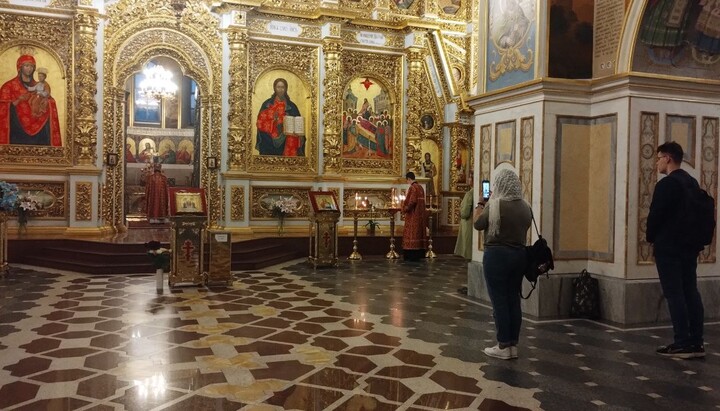
"Service" of the OCU in the Kyiv Pechersk Lavra. Photo: UOJ
At its recent “bishop’s council,” the OCU “hierarchs” praised the authorities for their efforts to destroy the UOC and once again called on everyone to join their structure.
Epifaniy (Dumenko) also announced statistics for his organization. Let’s take a brief look at them.
He claimed that the OCU has 9,000 parishes and 6,000 clergy. Yet, according to official statistics, there are only 4,500 “priests” in the structure. That’s roughly 2 churches per priest. How realistic is that? Not very.
But that’s not even the whole picture. The DESS’s mobilization exemption list shows about 2,000 OCU clergy. A simple calculation (6,000 – 2,000) means 4,000 of Dumenko’s clergy have no exemption. Yet we’ve heard no outrage or protest from the OCU. Which suggests DESS is right: in reality, the OCU has around 2,000 active clergy for those 9,000 parishes – many of them deacons. So each priest would be covering about 5–7 churches. That’s just wildly unrealistic.
The situation with monasteries is even more interesting. Not long ago, Dumenko urged Ukrainians to “listen to that quiet call” and become monks. Clearly, that appeal wasn’t for nothing. He said the OCU now has over 90 monasteries. But he was conspicuously silent about the number of monks. And not without reason.
The last known figure, announced in 2021, was 233 monks. That number hadn’t changed since 2015 (back when it was the UOC-KP + UAOC combined). We haven’t heard of any surge in tonsures in the OCU, so it’s safe to assume they’re still hovering around 230.
DESS head Olena Bohdan said in 2022 that there were about 50 monks in Kyiv alone. That leaves Dumenko with roughly 180 outside the capital (230 – 50). Subtract 63 “hierarchs” (who certainly don’t live in monasteries) and you’re left with just 120 monks for all those “monasteries.”
Divide those 120 monks by 90 monasteries and you get a truly strange number: about 1.3 monks per monastery outside Kyiv. And when Dumenko officially opens another 30 monasteries on paper, they’ll end up with literally one monk per monastery.
And this isn’t propaganda or slander. It’s just the numbers.
DESS claims the OCU is now bigger than the UOC. But the UOC has around 5,000 monastics in 260 monasteries. The OCU? Around 230 for over 90.
Monasticism is a response to grace. When a person feels Christ touching their heart, they can’t live as before – they can’t live like everyone else. A Church is alive not because it has government backing or sky-high opinion poll numbers, but because it has people who’ve answered “yes” to Christ’s call.
As they say about parish life: “parishioners vote with their feet.” The same applies to monasticism. The OCU’s clergy and faithful clearly have no desire to become monks within this structure. Maybe they sense something?
Read also
Why is it legal to kill a person before birth but not after?
Children are the most privileged members of society. Yet that same society officially permits children to be killed – and on a massive scale.
Honoring the Bolsheviks’ successors at Kyiv Lavra
It was under the Reserve that the relics of the saints were desecrated, Lavra churches were turned into an atheism museum, and toilets were installed in sanctuaries.
"Degenerates" and "stupid animals": anti-UOC activists turn on children
Future historians will wonder how a vast country’s information agenda could have been shaped for so long by people so petty, vicious, and utterly contemptible.
Zelensky sees murder of Polish priest but not of Sviatohirsk monk
Why does Zelensky react so emotionally and swiftly to the murder of a Catholic cleric while remaining completely silent about the murder of an Orthodox monk?
UOC vs. OCU numbers: pollsters count, social media recount
Official polling suggests Dumenko’s structure has an overwhelming lead in the number of parishioners, while social media polls paint a very different picture. Which should we believe?
Who is working for the Kremlin in Poland? OCU, Uniates and Catholics versions
Who in the conflict between Poland and Ukraine is "an agent of the Russian Federation"? Zelensky, who gave the UPA name to an AFU special operations center? Nawrocki, who stripped him of an order for it? Polish MEPs?