Manichaeism of Political Religion
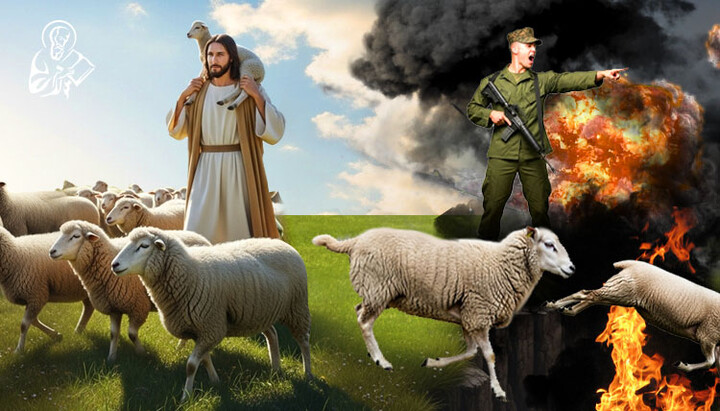
Political religion teaches people to die so that someone else can profit handsomely from the idea. Photo: UOJ
Manichaeism is a worldview built on dualism, positing two equally powerful and opposing principles: Good and Evil. It has existed in many forms and philosophical concepts throughout human history. Originally, it was a religious doctrine, founded by Mani in the 3rd century in what is now Iraq. This syncretic teaching blended diverse elements and eventually developed into a kind of global heresy.
Manichaeism is complex and multifaceted. It easily co-opts any religion, claiming a monopoly on universal wisdom, the possession of ultimate truth.
Modern Manichaeism is increasingly politicized because it so conveniently justifies militarism and xenophobia.
After all, who would resist a “fight against global evil”? Who would disagree that “evil” must be destroyed by the “warriors of light”? Political religion fits perfectly into this scheme. It sacralizes the struggle, gives it mystical significance. Compared to this sacred battle, human life becomes worthless, something to be sacrificed easily, turning people into “martyrs” of war for “light” and “good.”
Political religion is always Manichaean. There is “them” – the enemy, and “us” – the righteous. There is a cosmic battle for so-called universal truth. Political religion teaches people to die so that someone else can profit from the idea or protect their financial interests. For modern ideologues of Manichaeism, people are merely raw material to achieve their aims. But to make this material willingly fight and die for their money and interests, they must convince it that it is fighting for something that resonates with goodness and light.
In becoming such a “fighter” for the “forces of good,” a person can descend into frenzy.
Remember the scene from the film D’Artagnan and the Three Musketeers, where the fanatic, enthralled by Milady, screams: “The name, sister, the name!” People who devoutly believe in Manichaean ideas just need a name, an object for their hatred. After that, they can kill, rape, and commit horrific cruelty and sadism while believing themselves to be “warriors of light and good.” They will not be bothered in the least by the fact that the main tool of this “holy war” is pure evil.
This is why political religion is less about genuine faith than it is about ideology. Religion itself cannot serve as the direct foundation of political action. Political religion’s peculiarity is that belief in God is not an essential element. Under this label you can include communism, fascism, and similar “isms.” Political religion imbues the nation-state and its symbols with sacred significance. Within these ideologies, their own quasi-religious rituals of veneration are developed. The connection ideology tries to forge with religion is artificial and illusory, because the existential meanings of the two worldviews are fundamentally different.
Ideology belongs to this world, lying in the horizontal plane of existence. Faith, by contrast, builds its values in a vertical dimension, calling the human person beyond the horizons of the historical world.
Despite this essential incompatibility, politics has learned to exploit humanity’s religious energy quite successfully for its own selfish ends. But to do so effectively, politicians need to invent a special newspeak that can dress their geopolitical and economic struggles in the language of a “fight for God’s truth,” for human dignity and rights, for lofty values.
Political religion justifies its actions with the sacred, appealing to ideas of a supernatural realm. Political struggle becomes mythologized, cast as the earthly reflection of a cosmic battle between forces of good and evil, an arena of confrontation between our own – good and pure – and the others – dark and evil. The fight for power, money, and influence shifts from a pragmatic, worldly sphere into a moral and ethical one.
Events in this world are framed as part of – or reflections of – sacred, cosmic events.
The aim of religious-political movements is The Goal with a capital G: the ultimate mission of all humanity, supposedly sanctioned by otherworldly powers.
They do what they do not because they want it themselves, but because they claim it is the will of God or some other supernatural force.
The well-known American scholar of political religions, Mark Juergensmeyer, writes about religious wars as follows: “Such religious actions are not simply political phenomena justified with religion; true believers see them as facets of a more fundamental conflict. Real-world conflicts are linked to an invisible, cosmic war – a spiritual battle between order and chaos, light and darkness, faith and doubt.”
This means real war is perceived as holy, as the earthly mirror of a supernatural clash between good and evil. Political conflict becomes sacralized, and so does the perception of the enemy. The enemy is no longer a personal opponent but a political one. The rival political regime is not just an adversary, but the embodiment of cosmic evil, making any compromise unthinkable.
Some scholars of Islam insist on using the term “Islamism” to designate political Islam, to highlight its difference from traditional Islam. By analogy, it would be fitting to use the term “Christianism” for an ideology that demands its followers profess not the Christian faith, but specific political values.
“Christianism” is a perversion of Christianity, fundamentally different from its original understanding as a path of personal salvation.
The danger of “Christianism,” like that of other political religions, is that it corrupts faith, translating it into the realm of religiously motivated violence.
Christianity is founded on faith in the saving mission of the God-Man Christ, whose Kingdom is not of this world. It is won not with a gun in hand, but through the inner transformation of the human person.
While political religion draws demarcation lines, sets boundaries, divides, argues, and conquers, Christian faith does the opposite: it destroys boundaries, erases ethnic distinctions, removes political labels and national costumes, prioritizing the person hidden beneath all these layers.
For Christ, the human being himself is what matters most – not his social or national packaging.
Accordingly, the Church’s evaluation of social events is always purely moral, along the axis of good and evil. If supporters of any party or political group hate or, worse, kill each other, there can be no actual truth on either side. Where there is evil, there is already the victory of hell. God’s Truth can only dwell alongside Peace and Love.
Read also
The Time of the Soul's Ripening
Modern society has turned youth into a cult and calls old age a period of "living out one's days." The Christian view reveals the deep spiritual meaning of one's later years.
Faith is not a checker piece in a spectator sport
Arguments about faith on social media increasingly resemble no-holds-barred fights. We turn to a saint who, sixteen centuries ago, knew how to speak to those interested only in turning theology into a combat arena.
The metropolitan who fought with a pen
St. Cyprian of Kyiv was robbed, expelled, and barred from his see. He answered with letters, books, and canons – and before his death, forgave everyone.
Loneliness under one roof
Spouses can share a home for years, raise children, and faithfully attend church – yet remain strangers to each other.
The cross – the deepest healing of the human soul
Emotional exhaustion and anxiety have become a way of life. Ancient Christian tradition offers an unexpected way out – embracing one's own cross.
The Prophet Elisha and the mystery of the Bethel massacre
The story of the prophet Elisha and the two bears seems to be the harshest in the Bible. But in reality, it carries a profound theological meaning.