
Demon at the threshold: What Cain knew about prayer
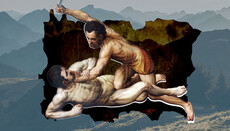
Abel does not utter a single word in the Bible. Four chapters – and complete silence. His only “speech” is the voice of blood crying from the ground. Yet sometimes silence speaks more precisely than any words.
In the Old Testament readings appointed for these days’ Lenten services, we hear the story of the first fratricide. And something in that story is strange. Cain is not a villain from the start. He is the first person who, on his own initiative, brought an offering to God. Before him, the text of Scripture contains no command about sacrifice, no prescribed model, no example. It is entirely his idea, his initiative.
And yet something goes wrong. Abel brings “of the firstborn of his flock and of their fat portions” – living, irretrievable, the best. Cain brings “of the fruit of the ground” – simply a share of the harvest. St. Ephrem the Syrian put it bluntly: “Cain brought refuse, and Abel brought the choice.” God “looked with favor” on Abel – literally, “gazed with interest.” Cain’s offering, by contrast, was not even noticed.
Rabitsu
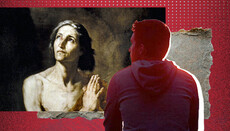
Then the text gives us one of the most enigmatic images in all of Genesis: “Sin is crouching at the door” (Gen. 4:7). The Hebrew word for “crouching” (robetz) is a masculine participle, although the word “sin” (chatta’th) is feminine. Translators usually smooth over this grammatical anomaly. But the German biblical scholar Claus Westermann argued that robetz is etymologically identical to the Akkadian rabitsu – the name, in Mesopotamian demonology, for a watch-demon lying in ambush at a house’s threshold.
Here, sin is not an abstract guilt. It is a living being that “desires” a person.
The Hebrew term describing this desire is the very same word used for a wife’s longing toward her husband in Genesis 3. Sin wants to possess Cain with something like passionate insistence. And God says: rule over it. God acknowledges that the predator is real. But Cain still has what Viktor Frankl called the space of freedom between stimulus and response. Rabitsu at the threshold is not yet a sentence.
A transaction instead of a sacrifice
Archpriest Alexander Schmemann called Cain’s offering “an attempt to establish commercial relations with God” – “I give so that You will give.” Cain makes a transaction and expects a receipt. When the receipt does not arrive, he feels cheated. The center of the sacrifice remained Cain himself. This is religious narcissism: for Cain, prayer is a way to confirm his own importance, not to dissolve into something greater than himself.
As we read, we almost automatically think: one was good, the other bad. But it is worth stopping and asking an uncomfortable question: where, exactly, does our own prayer become Cain’s? When we fast, do everything required, and then wait – if not for a miracle, then at least for some sign from above, some inner shift. And if no answer comes, something flares up inside that feels uncomfortably like righteous indignation.
Cain is not a monster. He is a man whose religiosity turned against him.
The question God asks twice
After the murder, God asks Cain: “Where is Abel your brother?” It is an exact echo of the first question in Scripture: “Adam, where are you?” In both cases, God knows the answer. In both cases, the question is a summons to confession: tell Me yourself what happened.
Cain lies – and answers with insolence: “Am I my brother’s keeper?” St. Philaret of Moscow saw something fundamental in that reply: Cain denies not only the crime, but the very idea of responsibility for another human being.
But the earth does not keep silent. “The voice of your brother’s blood is crying to Me from the ground” (Gen. 4:10), God says. Cain is a tiller of the soil; his whole identity is bound up with the earth. And it is precisely the earth that betrays him. The ground he cultivated becomes a witness against him.
The murderer’s safe-conduct
Cain’s punishment is homelessness and wandering. Yet here is what we often miss: Cain complains that he will be killed – and God places upon him a protective sign. The “mark of Cain,” which we are used to hearing as a brand of shame, is in fact a charter of protection. Origen read it exactly this way: even a murderer remains within the field of God’s attention.
St. Nikolai of Serbia wrote that repentance was possible for Cain until the very last moment – but he chose self-pity instead of self-condemnation.
Self-pity says: “My punishment is greater than I can bear” – exactly what Cain says to God. Self-condemnation says simply: “I did this.” In the first case, a person mourns himself. In the second, he faces the truth.
Abel never speaks a word. He is silent from birth to death. And after death, his only voice is blood – heard by the earth. We do not know what he thought. But in Scripture, silence can be more eloquent than any text.
Rabitsu is still at the threshold of our souls. He is patient; he knows how to wait. He hungers for the moment when prayer becomes just a little more formal, when we bring God not the best, but whatever is left in a heart torn and bruised by bustle. Perhaps Lent is precisely the time to look soberly at our own soul. To see what is lying there. And to remember the command God once spoke to Cain: rule over sin – crush it by the strength of your will.