OSCE expert: Govt “directives” toward UOC have effectively become repressive
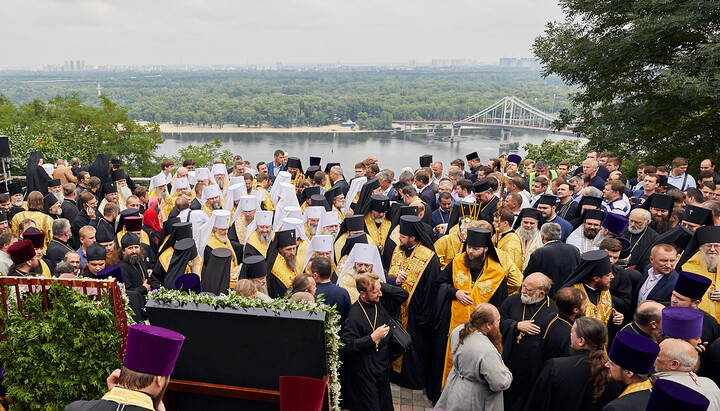
UOC moleben on Volodymyrska Hill on the Day of the Baptism of Rus’ – 2018. Photo: UOJ
Religious scholar and OSCE expert on freedom of religion Natallia Vasylevych commented on the “directives” issued by the State Service for Ethnopolitics and Freedom of Conscience (DESS) requiring the Ukrainian Orthodox Church (UOC) to eliminate alleged “ties” with Moscow.
According to the expert, “at this point, the level of escalation in relations between the UOC and the state apparatus has reached such a degree that any document titled ‘directive,’ especially when accompanied by a threat of liquidation in case of noncompliance, automatically becomes a repressive measure.” Vasylevych noted that it is particularly revealing that such a directive was addressed to “the Metropolitan of Kyiv – just a week after he was stripped of his Ukrainian citizenship for exhibiting so-called ‘signs of affiliation’ with Russia.”
The OSCE expert described the government’s policy over the past three years as a system of coercion: “We’ll show you how bad things can get if you don’t comply with our terms, and then offer a list of actions which, if carried out, will make us stop treating you badly.” As a result of this approach, “the specific terms hardly matter anymore – even if the conditions were things the UOC leadership had always dreamed of implementing, they become unfulfillable in principle – ‘principally unfulfillable,’” Vasylevych stressed.
In her assessment, these are “no longer relations between equal partners who respect each other and act reasonably toward one another.” Instead, “distortions and projections prevail,” making constructive engagement impossible.
Vasylevych warned that “instead of the hoped-for de-escalation, a new wave of escalation should be expected.” Among the factors contributing to the aggravation of the situation, she cited overall war fatigue in society, growing dissatisfaction with government bodies and wartime policies, the attitude of the OCU toward the UOC, and the resolution of church-related conflicts “through violence.”
“In the current context, which was designed specifically to apply pressure in order to force compliance, even something objectively achievable becomes unachievable,” the OSCE expert concluded. In her view, “the main problem is not the conditions themselves, but the need to change the context in which they are imposed.”
Earlier, UOJ reported that DESS ordered the Kyiv Metropolia to eliminate “violations” by August 18.
Read also
Metropolitan Onuphry congratulates Georgia on 1,700 years of Christianity
The Primate of the UOC sent a message to Patriarch Shio III on the anniversary of Christianity becoming the state religion in Georgia.
Zakarpattia marks 25th anniversary of Alexis of Carpatho-Russia's glorification
An all-night vigil was served at St. Nicholas Monastery in the village of Iza-Karputlash to celebrate the 25th anniversary of the glorification of St. Alexis of Carpatho-Russia.
DESS finds Balta Eparchy of UOC affiliated with ROC
Yelensky-headed state service said it found signs of affiliation of the Balta Eparchy Administration of the UOC with the ROC.
Upper Lavra court hearing postponed
The next court hearing in the Upper Lavra case has been scheduled for November 3.
UOC priest blesses ambulances at Kamianske medical center
A UOC priest in Kamianske blessed ambulances for a medical facility and wished its doctors God's help in their work.
Dumenko to German ambassador: Law targeting UOC also applies to other groups
Epifaniy Dumenko sought to defend Ukraine’s law restricting religious organizations during a meeting with the German ambassador.