Estonian Church files complaint with ECHR over government persecution
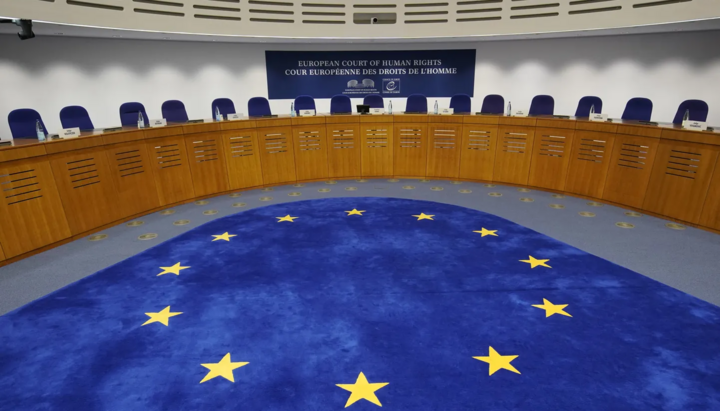
Courtroom of the European Court of Human Rights (ECHR). Photo: RONALD WITTEK
The Estonian Orthodox Christian Church and the Pühtitsa Convent have filed complaints with the European Court of Human Rights, claiming that all domestic legal remedies have been exhausted. This was reported by the outlet Postimees.
The reason for the appeal was a political declaration adopted by the Riigikogu (Estonian Parliament) on May 6, 2024, which declared the Moscow Patriarchate to be an institution supporting the Russian Federation’s aggression. According to subsequent clarifications provided by the Riigikogu, this declaration also applies to the Estonian Church and the convent.
In response, the Church and convent filed a lawsuit in the administrative court, seeking to remove the legal consequences of the declaration and to have themselves excluded from the list of war supporters.
“If the Riigikogu, when issuing such a statement, failed to ensure that it would not affect religious associations registered in Estonia and operating in accordance with national law, and if the judicial system then declared itself incompetent to consider complaints about a political statement by parliament, this creates a dangerous situation in which a person has no legal protection from unfair and hostile political declarations,” explained the lawyers representing the Church and convent.
In their complaints to the ECHR, the applicants claim that the Republic of Estonia violated Articles 9 (freedom of thought, conscience, and religion) and 11 (freedom of assembly and association) of the European Convention on Human Rights.
The Church and convent dispute the Riigikogu’s position that a political statement targeting a foreign entity can be applied to religious organizations legally registered in Estonia.
“After a preliminary review, the ECHR not only declared the complaints admissible but also ruled that they raise important questions of interpretation and application of the Convention that require urgent consideration. The Court classified the complaints as potential impact cases of significant public importance. The Republic of Estonia has been invited to present its position and express an opinion on the possibility of a friendly settlement,” the lawyers added.
According to the attorneys, “this decision clearly shows that in the current geopolitical situation, freedom of religion and freedom of association deserve the same protection as security concerns.”
As previously reported by UOJ, President Alar Karis twice vetoed a bill targeting the Estonian Orthodox Christian Church.
Read also
UOC's Sign Church damaged in Kherson air strike
In Kherson, Russian airstrikes shatter windows and damage the façade of the UOC’s Church of the Sign.
Yelensky: Not recognizing OCU means indirectly denying Ukrainian statehood
Viktor Yelensky believes that Local Churches that do not recognize the OCU thereby indirectly fail to recognize Ukrainian statehood as well.
UOC Lavra priest urges believers to accept hardships with gratitude
Archpriest Heorhiy Boyko at the prayer vigil near the Kyiv-Pechersk Lavra recalled the sufferings of Great Martyr George the Victorious.
UOC honors patron saint of Kherson land
A Divine service was held at the Holy Spirit Cathedral of Kherson on feast day of St. Barsanuphius of Kherson.
Nativity of John the Baptist Church of UOC damaged by shelling in Kharkiv
A church of the Kharkiv Eparchy (UOC) was damaged during another shelling.
Patriarch Bartholomew not to concelebrate with Bulgarian Church Primate
The Ecumenical Patriarch will attend the service at St. Alexander Nevsky Cathedral in Sofia as a guest.