Bishop of Stuttgart speaks on problems between the ROC and Constantinople
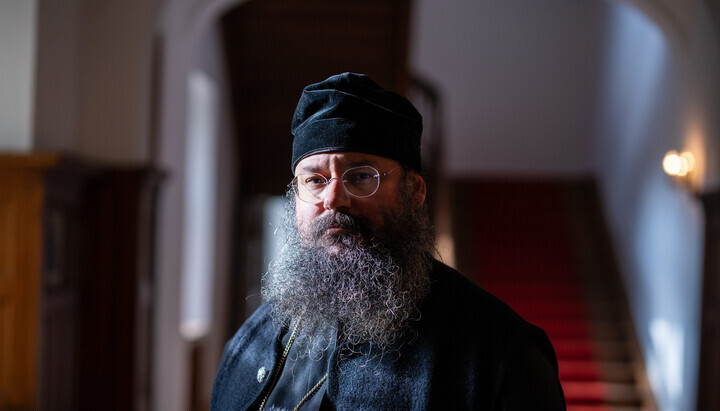
Bishop Job (Bandmann) of Stuttgart. Photo: UOJ
Bishop Job (Bandmann) of Stuttgart, of the Russian Orthodox Church Outside of Russia (ROCOR), delivered an in-depth analysis of the current crisis in Orthodoxy at the 42nd Orthodox Conference in Munich in December 2024, reports UOJ in Germany.
In his lecture, titled “The Unity of Orthodoxy in Danger: Causes and Solutions,” the German hierarch offered a critical assessment of both the Moscow Patriarchate and the Ecumenical Patriarchate, accusing both sides of political bias.
“In the history of relations among Orthodox Churches in the 20th and 21st centuries, especially between the MP and the EP, all parties can justifiably reproach one another for improper behavior,” Bishop Job stated.
Regarding the Russian Church, the hierarch pointed to its “patriotism and loyalty to the state,” which creates problems in inter-church relations. He emphasized that “the Moscow Patriarchate ought to acknowledge that it acts with political partiality and allows itself to be instrumentalized.”
Even harsher criticism was directed at the Ecumenical Patriarchate. “If one were to disregard the hopeless situation of the Patriarchate in Turkey and the resulting identity crisis, one might think that the Phanariots are driven by a ‘papist’ thirst for power,” stated the German hierarch, pointing to Constantinople’s attempts to expand its authority beyond canonical norms.
Particularly criticized were the actions of Patriarch Bartholomew in granting autocephaly unilaterally, “without the consent of all” local Churches, as well as the practice of receiving into the Ecumenical Patriarchate clerics who had been suspended or defrocked in other Churches.
“Clerics and bishops who have been suspended or defrocked in other Orthodox Churches are simply accepted into the EP at their request, and thus the sentence against them is nullified without a new trial,” Bishop Job remarked.
He also noted the political backdrop of the conflict between Moscow and Constantinople.
As a solution to the crisis, Bishop Job proposed the concept of “living conciliarity,” based on the 34th Apostolic Canon, which states that “no bishop should do anything without the consent of the first, and the first should do nothing without the consent of all.”
“If we expect the first not to act without the consent of all, then we, the individual Orthodox Churches, must also strive not to act without his consent,” the German hierarch urged, calling for mutual concessions.
The bishop also shared a shocking anecdote from Mount Athos. When asked how the crisis could be resolved, an abbot of one of the monasteries replied: “Both Patriarchs must first die,” referring to Patriarchs Bartholomew and Kirill.
Despite his criticism, Bishop Job called for reconciliation: “We can help the EP, and all of Orthodoxy, out of this crisis only through understanding and goodwill.”
As previously reported by the UOJ, the ROCOR Synod has condemned trends in Russia aimed at rehabilitating Soviet ideology.
Read also
Medieval сhurch сrumbles as Culture Ministry сites missing agreement
The 14th–15th-century St. Nicholas Church in Chesnyky, Ivano-Frankivsk Region, is falling into disrepair.
Poland сondemns Lviv Regional Council's decision to declare 2007 year of UPA
Polish Prime Minister Donald Tusk says the Lviv Regional Council's decision to dedicate 2027 to the UPA and Roman Shukhevych is harmful to Ukraine.
OCU seeks court recognition of ownership of seized Cherkasy cathedral
The Cherkasy Regional Commercial Court will hear an OCU lawsuit seeking ownership of St. Michael's Cathedral, which was seized from UOC believers.
Lithuanian bishop: Ukraine is no model for believers' rights
Vicar of Vilnius Diocese voices concern over attempts to import Ukraine's religious conflict into Lithuania.
Hundreds of believers honor St. Alexis of Carpatho-Russia in Khust Eparchy
At the St. Nicholas Monastery in the village of Iza-Karputlash, Metropolitan Mark of Khust led a festive liturgy, concelebrated by six metropolitans, five archbishops and three bishops.
Court upholds UOC parish appeal in Voloshky over OCU switch dispute
The Northern Commercial Court of Appeal has upheld the appeal of the St. Nicholas parish of the UOC in the village of Voloshky, Volyn region, in a dispute over a transfer to the OCU.