UOC accuses DESS of coercing the Church into illegal activities
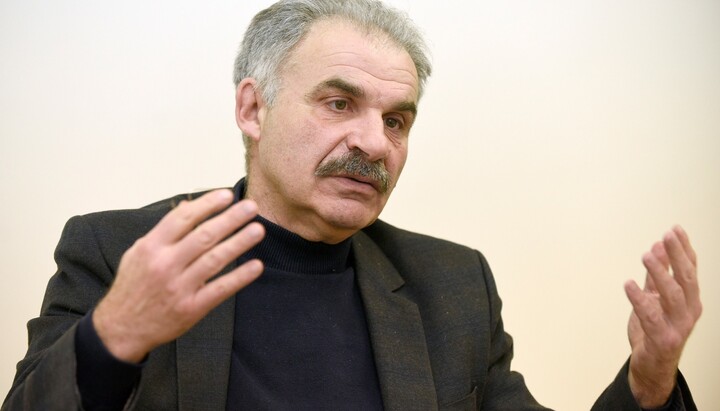
Head of the State Service for Ethnopolitics and Freedom of Conscience Viktor Yelensky. Photo: "Ukrinform"
The Ukrainian Orthodox Church is analyzing the documents received from the State Service of Ukraine for Ethnopolitics and Freedom of Conscience (DESS) in the context of their compliance with domestic and international legislation. On July 25, 2025, the press service published a corresponding comment on the official website of the UOC.
"The actions of state bodies, including DESS, regarding the possibility for millions of UOC believers to profess their religious beliefs in accordance with the Ukrainian Constitution, are being carefully studied by UOC lawyers and are considered in the context of domestic and international legislation," the statement says.
It is noted that DESS officials, in preparing their conclusions regarding "purely canonical, sacred concepts, never once sought clarifications from UOC representatives."
The UOC emphasizes that this fact, along with many other circumstances, indicates the presence of serious violations in the process of conducting research by the State Ethnopolitics.
The commentary notes that even more "scandalous" is the fact that the main conclusions were based not on Ukrainian documents, which govern the activities of Ukrainian religious organizations, but on "documents of banned Russian church organizations in Ukraine, borrowed from similarly banned websites in Ukraine."
According to the UOC, the legal assessment of such methodology and the activities of DESS experts should be provided by law enforcement agencies. "After all, a precedent was created whereby Ukrainian officials recognized as legitimate for Ukraine the documents of a state that committed aggression against the Ukrainian state."
The Ukrainian Orthodox Church reminded that they have repeatedly stated that they currently have «no administrative or legal subordination, nor any contacts with religious organizations in the state that is committing aggression against Ukraine».
"In this regard, DESS's demands to resume official contacts between the UOC and such banned organizations in Ukraine during the ongoing full-scale aggression of the Russian army against Ukraine contradict Ukrainian legislation and openly compel unlawful activities," concluded the commentary.
As reported by the Union of Orthodox Journalists, a DESS official stated that the investigation into the connections of the Kyiv Metropolis of the UOC with the Russian Orthodox Church (ROC) was conducted not by religious experts, but by organization staff.
Read also
Vinnytsia Eparchy venerates miraculous Brailiv Icon of Holy Theotokos
A Divine Liturgy and a religious procession were held at the Holy Trinity Brailiv Convent of the UOC on the feast day of the Brailiv-Pochaiv Icon of the Mother of God.
UOC Social Department aids 100 displaced families in Kyiv
Another charity event in support of refugees was held in the capital.
Khmelnytskyi TRC detains UOC priest in Cherepivka village
TRC officers mobilized the rector of the parish of Saint John the Theologian, Apostle and Evangelist, in Cherepivka, Khmelnytskyi region.
OCU outlet calls 2018 detention of Phanar delegation protection from Moscow
OCU representatives comment on Phanar official's report on 2018 "Unification Council".
Council of Churches urges Zelensky to establish military chaplain day
UCCRO said establishing Military Chaplain Day would help develop chaplaincy services in the Ukrainian Armed Forces.
Priest at Lavra prayer vigil explains why saints feared nothing
During a prayer vigil outside the Kyiv-Pechersk Lavra on the feast day of St. John the Theologian, Fr. Georgiy reminded the faithful that love casts out fear.