A knife in Zelensky’s back from UGCC and OCU
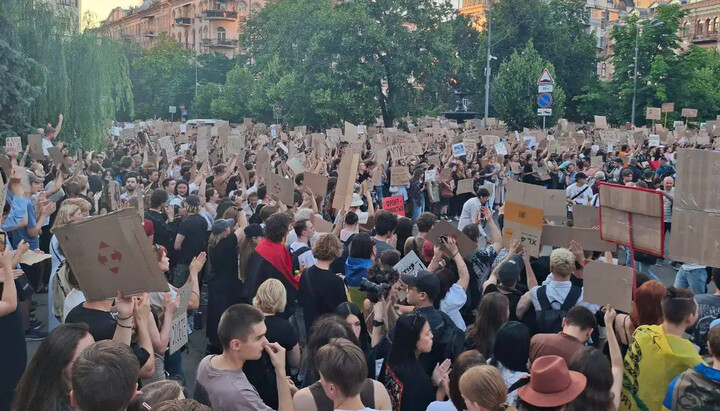
Protests in Kyiv. Photo: Ukr.net
Large-scale protests suddenly erupted across the country, and the EU launched a wave of harsh criticism against him. The President appeared to backpedal, promising to introduce a new bill that would restore NABU and SAPO’s powers. However, the anti-Zelensky momentum hasn’t died down.
Paradoxically, both the Orthodox Church of Ukraine (OCU) and the Ukrainian Greek Catholic Church (UGCC) have joined the opposition.
One of Dumenko’s more notorious operatives, the raider Roman Hryshchuk, personally took part in protest rallies and called on his numerous followers to do the same.
From the UGCC’s side, it was none other than Sviatoslav Shevchuk who spoke out. He compared the current protests to the Maidans of 2004 and 2014, stating that the authorities’ actions “undermined the people’s trust in the government, and that of international partners – in Ukraine.” He also thanked those taking part in the protests against Zelensky. OCU head Serhiн Dumenko has so far remained silent – but there’s little doubt he’s “ready to move at any moment.”
Several key points are worth noting here.
Zelensky tried to justify what was effectively the takeover of NABU and SAPO by invoking “Russian influence” on these bodies. This was a well-worn tactic, as accusations of working for “the Kremlin” had previously been used to great effect. The persecution of the UOC, the opposition, and dissident journalists had all been accompanied by wild – and entirely baseless – claims of “Russian agents.” And it always “worked.” But for some reason, not this time.
Both Shevchuk and Hryshchuk now justify their support for this new “Maidan” by appealing to the need to fight corruption. Yet under Zelensky’s rule, there have been countless corruption scandals – and everyone remained silent. They only rose up after the move against NABU and SAPO. Which suggests this isn’t really about corruption at all, but about the shifting political currents that are gradually pushing Zelensky out of the game.
The current regime has done everything to favor both the OCU and UGCC. One need only recall Zelensky’s recent lobbying before the Pope for the canonization of Sheptytsky – a man who collaborated with both Hitler and Stalin. And the OCU? It’s practically a state church now. But the moment a light breeze of change began to blow, instead of expressing gratitude or support, the leaders of the “patriotic” confessions, sensing weakness in Zelensky, are effectively signaling his overthrow.
These religious structures operate according to a primal, almost animal instinct – tear down the leader the moment he shows weakness. As Kipling put it in The Jungle Book: “Akela has missed.” And Zelensky is far from the first. One might recall Epiphany’s betrayal of his patron Poroshenko after the latter lost the presidential race, or the OCU’s criticism of Lavra Reserve director Ostapenko right after his dismissal, and so on.
As 18th-century French politician Charles Maurice de Talleyrand-Périgord famously said: “To betray at the right moment is not betrayal – it is foresight.”
Judging by current events, this phrase has long become dogma for both the OCU and the UGCC.
Read also
Why is Jerusalem “wrong” about OCU, but Constantinople isn’t?
In the eight years since the OCU was established, we have never once heard its leader suggest that the Patriarch of Constantinople is capable of error.
Who destroyed and restored Kyiv Lavra? MinCulture's video reveals the truth
The Culture Ministry’s propaganda about the Kyiv-Pechersk Lavra has inadvertently revealed the truth.
Ternopil post on Feast of Intercession: Has calendar reformn failed?
A significant number of believers have rejected the new church calendar introduced by the OCU and UGCC with government support.
Shoulder straps or a cassock: who writes the script for UOC "fighters"?
Everything indicates that both Veliar and Pshenychny are ordinary performers of someone else's script. There is only one question – does the scriptwriter wear shoulder straps or a cassock?
Why is it legal to kill a person before birth but not after?
Children are the most privileged members of society. Yet that same society officially permits children to be killed – and on a massive scale.
Honoring the Bolsheviks’ successors at Kyiv Lavra
It was under the Reserve that the relics of the saints were desecrated, Lavra churches were turned into an atheism museum, and toilets were installed in sanctuaries.