Church commemorates Prophet Elijah
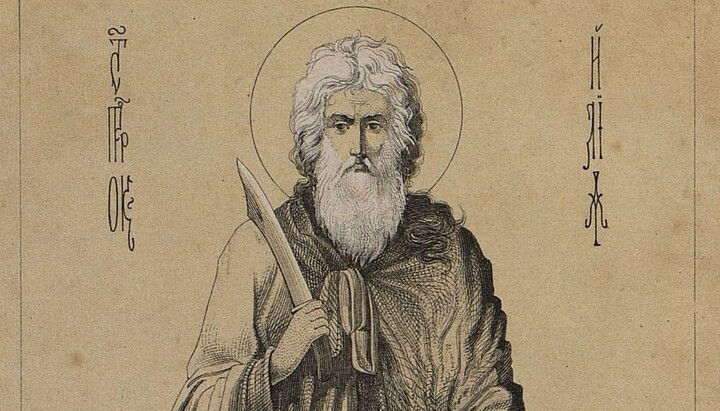
The icon of the Prophet Elijah. Photo: Wikipedia
On August 2 (July 20 according to the Julian calendar), the Orthodox Church commemorates the memory of the holy glorious Prophet Elijah the Tishbite, one of the greatest Old Testament righteous men, who lived in the 9th century before the Birth of Christ.
A Fighter Against Idolatry
Prophet Elijah was renowned for his zeal in serving the One God and his relentless fight against paganism. During the reign of the Israelite King Ahab and his wife Jezebel, who promoted the worship of the pagan god Baal, the prophet fearlessly denounced apostasy and urged the people to repent.
The most famous episode of Prophet Elijah's ministry is the contest with the priests of Baal on Mount Carmel, where he called down fire from heaven on the altar, proving to the entire nation the power of the true God.
Miracles of the Prophet
The Holy Scripture recounts numerous miracles performed by Prophet Elijah. He resurrected the widow's son in Zarephath of Sidon, multiplied flour and oil during a famine, and called down fire from heaven on the soldiers sent by the king.
By the prophet's prayer, the heavens were closed for three and a half years, and there was no rain on the earth, and then they opened again at his word.
Living Ascension to Heaven
Prophet Elijah is one of the two Old Testament righteous men (along with Enoch) who were taken alive to heaven. According to the biblical narrative, he was taken up in a fiery chariot in the presence of his disciple, Prophet Elisha.
In the New Testament, Prophet Elijah appeared alongside Moses during the Transfiguration of the Lord on Mount Tabor, emphasizing his special significance in the history of salvation.
Prophecy of Elijah's Return
The Holy Scripture contains a prophecy that Elijah will return to earth before the "great and dreadful day of the Lord" (Mal. 4:5). In Christian theology, there are various interpretations of this prophecy.
Many holy fathers saw its fulfillment in the ministry of John the Baptist, who "came in the spirit and power of Elijah" and preceded the First Coming of the Savior. Christ himself spoke of the Baptist: "If you are willing to accept it, he is Elijah who is to come" (Matt. 11:14).
At the same time, church tradition, dating back to Saint John of Damascus, teaches that Prophet Elijah will literally descend from heaven before the Second Coming of Christ. His mission will be to denounce the Antichrist and convert the "remnant of Israel" to the true faith, bringing the Jewish people to Christ.
Thus, Prophet Elijah holds a special place not only in Old Testament history but also in the eschatological hopes of the Church, remaining a living witness to the forthcoming triumph of God's truth.
Earlier, the UOJ wrote that, according to Archpriest Oleksandr Klimenko, upholding God's truth is the main lesson of Prophet Elijah.
Read also
Novynskyi: I quoted the Gospel to Zelensky on first day of war
The former Ukrainian MP said he advised Davyd Arakhamia to begin negotiations with Russia in the first days of the full-scale war and later spoke with Volodymyr Zelensky.
Sumy Eparchy venerates miraculous Korsun-Shpylivka Theotokos Icon
Celebrations honoring the Mother of God’s icon known as the “Restorer of Sight” were held at Sumy Cathedral and concluded with a car procession around the city.
Receding Dniester in Khmelnytskyi region exposes foundation of flooded church
The foundation of St. John the Theologian Church, submerged during the construction of a hydroelectric power plant, has resurfaced for the first time in 45 years.
Medieval сhurch сrumbles as Culture Ministry сites missing agreement
The 14th–15th-century St. Nicholas Church in Chesnyky, Ivano-Frankivsk Region, is falling into disrepair.
Poland сondemns Lviv Regional Council's decision to declare 2007 year of UPA
Polish Prime Minister Donald Tusk says the Lviv Regional Council's decision to dedicate 2027 to the UPA and Roman Shukhevych is harmful to Ukraine.
OCU seeks court recognition of ownership of seized Cherkasy cathedral
The Cherkasy Regional Commercial Court will hear an OCU lawsuit seeking ownership of St. Michael's Cathedral, which was seized from UOC believers.