Over 10 years, the number of countries with a Christian majority decreased
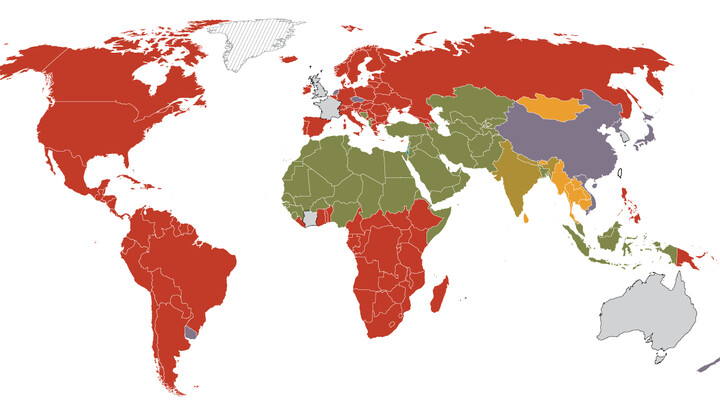
A map of the spread of Christianity in the world. Photo: pewresearch
The American research center Pew Research published data showing that from 2010 to 2020, the number of countries with a Christian majority population decreased from 124 to 120.
According to the study, which covered 201 countries and territories worldwide, four countries lost their status as Christian-majority countries: the United Kingdom, Australia, France, and Uruguay. The main reason was the mass departure of people from the Christian faith.
Loss of Christian majority
In the United Kingdom, the share of Christians by 2020 was 49% of the population, in Australia – 47%, in France – 46%, and in Uruguay – 44%. In all these countries, the category of people not affiliated with any religion – atheists, agnostics, and those who call themselves "non-believers" – has significantly increased.
In three countries – the United Kingdom, Australia, and France – no religious group constitutes a majority, but the non-religious population has become the second-largest category, almost equaling Christians in number.
In Uruguay, the non-religious population surpassed Christians, making up 52% of the country's residents. Uruguay became the only country in the Americas where Christians do not constitute a majority.
Growth of non-religiosity
Three countries have gained a majority of non-religious population: besides Uruguay, these are the Netherlands (54% unaffiliated in 2020) and New Zealand (51%). They joined seven countries that already had a non-religious majority in 2010: China (90% in 2020), North Korea (73%), Czech Republic (73%), Hong Kong (71%), Vietnam (68%), Macau (68%), and Japan (57%).
Overall, the number of countries with a non-religious majority increased from 7 to 10. Now, countries with a Christian majority make up 60% of all countries worldwide, compared to 62% a decade earlier.
Stability of other religions
The number of countries with a Muslim majority (53), Buddhist (7), Hindu (2), and Jewish (1) did not change over the decade. However, the number of countries without a religious majority increased from 6 to 7, including Côte d'Ivoire, Mauritius, Singapore, and South Korea.
The Pew Research study is based on the analysis of demographic data and sociological surveys conducted from 2010 to 2020. The center is one of the world's leading institutions for studying religious trends.
Earlier, the UOJ reported that the number of atheists in Ukraine has increased.
Read also
Lithuanian bishop: Ukraine is no model for believers' rights
Vicar of Vilnius Diocese voices concern over attempts to import Ukraine's religious conflict into Lithuania.
Hundreds of believers honor St. Alexis of Carpatho-Russia in Khust Eparchy
At the St. Nicholas Monastery in the village of Iza-Karputlash, Metropolitan Mark of Khust led a festive liturgy, concelebrated by six metropolitans, five archbishops and three bishops.
Court upholds UOC parish appeal in Voloshky over OCU switch dispute
The Northern Commercial Court of Appeal has upheld the appeal of the St. Nicholas parish of the UOC in the village of Voloshky, Volyn region, in a dispute over a transfer to the OCU.
Zelensky says 9.5M Ukrainians expected to return home from abroad
Zelensky stated that 9.5 million Ukrainians who left abroad are expected to return home to rebuild the country.
German theologian criticizes Ukrainian authorities' pressure on UOC
German theologian Regina Elsner has said that pressure from the authorities on the Ukrainian Orthodox Church places an additional heavy burden on believers during the war.
Poland bans entry to Lviv official over SS Galicia and UPA glorification
Polish Foreign Minister initiates entry ban on Lviv Regional Council deputy who proposed declaring 2027 the Year of the UPA.