Walking upon the Waters of Life’s Sea
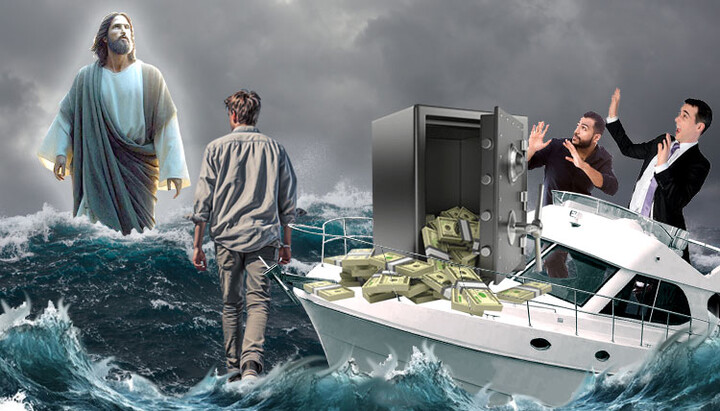
Attachments are a very heavy burden – and with such a load it is impossible to walk upon the water. Photo: UOJ
In order not to drown in this sea, one must have a heart turned toward Christ. “Let us lift up our hearts” – we hear every time before the beginning of the Eucharistic Canon. The mind, however, like Lot’s wife, pulls us down to the depths, frightening us with phantoms of dangers and fears of tribulations. Only a life without murmuring, and the acceptance of God’s will as one’s own, can keep us from sinking. Those who are strongly attached to the things and affairs of this world perish in this voyage. They overcome the pull of earth’s gravity whose spirit remains steadfastly in God.
The ballast that drags one down
Attachments are a very heavy load – and with such a burden it is impossible to walk upon the water. A mind stuffed with news, cluttered with useless information, fears, and anxieties is the heaviest ballast for such a journey. To ponder the spiritual may be interesting, and theological discussions may entertain our ego, yet they bring the soul no benefit. Far better it is to learn to live in God silently, quietly, and prayerfully.
The underwater caves that lure the drowning bear at their entrance the inscription “pleasure,” and at their exit – “disappointment.” Youth plunges headfirst into this quagmire, old age is bound hand and foot by cares, and only in middle age – having tasted disappointment to the full – can one still swim to the shore of truth.
Faith is not knowledge, but substance.
Its presence or absence is tested in sorrowful circumstances. Knowledge is like water painted upon a canvas, but faith is a living spring from which one can always drink.
Our chief enemy – egoism
Christ commanded us to love one another, yet gave no detailed instruction on how to do it. Therefore, each understands love in his own way. But true love does not conflict with freedom. Jealousy and the desire to possess are not love, but egoism – and it is our chief enemy.
It is egoism that has managed to persuade our mind that holiness is “not for us,” that it is “beyond our measure.”
Self-love and self-pity have frightened us with the sorrows we are supposedly bound to encounter on the path to God. Love of pleasure offers to “build tabernacles” at the crater of an active volcano, because “it is good for us to be here.” Thus, instead of seeking salvation, a person hides in a cardboard house of illusions, hoping that “somehow it will pass.” Yet in the depths of his soul he knows full well – it will not pass. The door for escape is hidden within our own heart. There Christ awaits us.
Salvation is possible only now
Most people want to live better. Very rarely will you meet one who wants to be saved. And salvation can never be accomplished yesterday or tomorrow – it is possible only now.
Only now can we remember God and overcome the world by the power of Christ.
Only now can we gain freedom from thoughts, immerse the mind in the heart, pray the Jesus Prayer, forgive, and release all grievances. God is with us only now, and at no other time. But the devil, throwing upon us the bridle of memory and imagination, drags us into the past or the future, not allowing us to live in the present.
And how is peace attained? By accepting with the heart and understanding with the mind that with God everything is calculated to the smallest detail, and that He never errs. Then we shall be able to walk upon the waves of life’s sea, knowing that we do so not by the strength of our own abilities, but by the grace of God – which saves all who trust in it.
Read also
The valley of trouble and the gateway of hope
One soldier buried an expensive cloak and some gold beneath his tent. Because of this, all Israel lost a battle. Why did one man’s sin bring disaster upon an entire nation?
From love spells to bishop's throne
Antioch’s most powerful sorcerer sent demons against a devout young Christian woman three times – and failed every time. In the end, a demon himself revealed the truth that led to his conversion.
The Weeping Queen of Blachernae
On the night of the Feast of the Protection, only two people witnessed the miracle in the Church of Blachernae. Everyone else prayed and saw nothing. Yet they, too, received grace.
Deadly spiral of human hatred
The tragedy of Lebanon's civil war lays bare how dehumanization and fear can turn human beings into monsters.
Woe to expectant mothers – or to those of little faith?
God commanded one prophet not to have children, yet told his people in exile to bear sons and daughters. What does this apparent contradiction tell us today?
The help God never asked for
Uzzah wanted only to keep the Ark of the Covenant from falling into the dust. Why did this well-intentioned act cost him his life, and who was really responsible for his death?