Church сelebrates Procession of Precious Cross and memory of Maccabean Martyrs
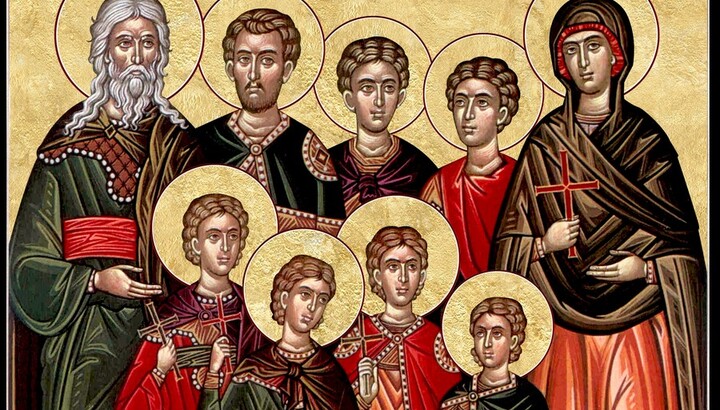
An icon of the Maccabean martyrs. Photo: public domain
On August 14 (August 1 according to the Julian calendar), the Orthodox Church celebrates two important feasts: the Procession (bringing out) of the Precious Wood of the Life-Giving Cross of the Lord, and the commemoration of the Holy Maccabean Martyrs.
The Procession of the Precious Cross of the Lord
This feast was established in memory of an ancient tradition in Constantinople, when, due to the summer heat and outbreaks of disease, a relic of the Lord’s Cross was solemnly brought out from the imperial treasury for the sanctification of water and the city. The procession with the precious wood passed through the streets of the capital, bringing spiritual cleansing and healing.
On this day, the faithful come to church to venerate the Cross, which is placed in the center of the temple. Special attention is given to the blessing of water, honey, and fruits of the new harvest.
The Commemoration of the Maccabean Martyrs
At the same time, the Church recalls the feat of the holy martyrs – the seven Maccabean brothers: Abim, Antoninus, Gurias, Eleazar, Eusebonus, Alimus, and Marcellus, their mother Solomonia, and their teacher Eleazar. These righteous ones suffered for the faith in 166 B.C., during the fierce persecutions of the Syrian king Antiochus IV Epiphanes, who sought to forcibly Hellenize the Jewish people.
King Antiochus issued a decree forbidding the observance of Jewish customs, the study of Holy Scripture, and the offering of worship in the Temple of Jerusalem. Those who disobeyed faced cruel torture and death. The holy Maccabees were seized for refusing to eat meat sacrificed to idols, in defiance of their religious convictions.
The eldest brother was tortured first – his tongue was cut out, his hands and feet severed, and then, still alive, he was thrown into a red-hot bronze furnace. The others, seeing his suffering, did not waver, but one by one accepted martyrdom, refusing to renounce the faith of their fathers.
Especially moving is the account of their mother Solomonia, who not only did not hinder her children in their struggle, but strengthened them in faith. She said to her youngest son: “My son! Have pity on me, who bore you in the womb for nine months… Do not fear this murderer, but be worthy of your brothers.” After the death of all her children, Solomonia herself was subjected to torture.
Today in churches, special services are held with the bringing out of the Cross for the veneration of the faithful. Traditionally, during the water-blessing service on this day, honey and herbs are blessed. For this reason, the feast is also popularly called the “Honey Savior.”
This feast marks the beginning of the strict Dormition Fast, which ends on the Feast of the Dormition of the Mother of God.
Earlier, the UOJ explained why the feast of the Maccabean Martyrs is the glory of the Old Testament Jews and the shame of contemporary Christians.
Read also
432 UOC churches damaged in Ukraine during war, report says
According to the Religion on Fire project, 807 religious buildings in Ukraine have been damaged or destroyed as a result of hostilities.
DESS official gives number of clergy exempt from mobilization in Ukraine
A DESS representative said the actual number of clergy exempt from mobilization is significantly lower than the number of religious organizations designated as critical.
Cabinet keeps gas prices unchanged for religious organizations
The Cabinet has fixed gas prices for religious organizations through the end of the 2026–2027 heating season.
Concert held at seized Cherkasy cathedral
The OCU thanked the musical ensemble for choosing the Cherkasy cathedral as the venue for a Baroque music concert.
OCU activist admits breaking into UOC church in Sloviansk
Oleksandr Onyshchenko said that the OCU held its first "service" at the Seraphim Church, which had previously been broken into by forcing the locks and doors.
Archimandrite Ioustinos, longtime keeper of Jacob's Well, dies in Jordan
Archimandrite Ioustinos (Mamallos), the keeper of Jacob's Well in Nablus, has died after a prolonged illness.