Ukrainian MPs urge Trump to stop persecution of the UOC
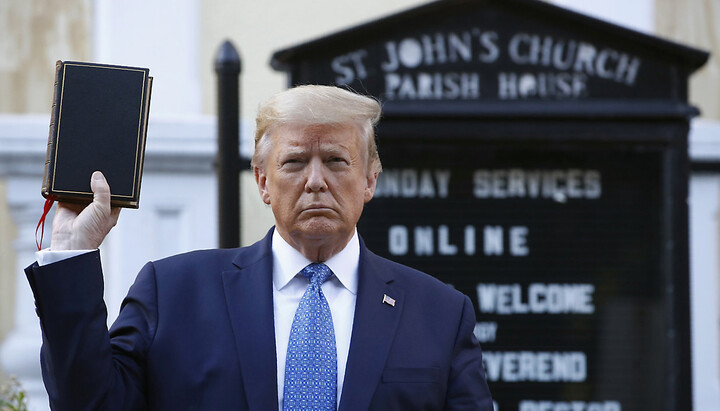
Trump with a Bible near a church in Washington. Photo: Patrick Semansky
Ukrainian MPs Oleksandr Dubinsky and Artem Dmytruk sent a letter to U.S. President Donald Trump reporting on the large-scale persecution of the Ukrainian Orthodox Church and political repression in the country. Dubinsky himself has been held in pre-trial detention for over a year and a half, while Dmytruk is in hiding abroad.
In their appeal, the MPs stress that “the largest Orthodox Church in Ukraine, the ‘Ukrainian Orthodox Church,’ has been banned,” and that in parallel “the political opposition has been destroyed, and freedom of speech and of the press eradicated.” They inform the American president that all those who disagree with government policy “have been subjected to persecution – through criminal charges or unlawful forced mobilization, which has become an instrument of extrajudicial punishment against journalists, lawyers, priests, bloggers, and politicians.”
The authors of the letter express particular alarm over religious persecution. They point out that forced mobilization has been turned into a weapon of reprisal against members of the clergy, with the authorities using military conscription as a means of extrajudicial punishment of priests for their religious convictions. The persecution, they note, affects not only the Church hierarchy but also ordinary UOC believers, who are pressured for their loyalty to the canonical Orthodox Church.
In their message to Trump, the MPs describe themselves as “civilian hostages of the Zelensky regime” and state that the number of political prisoners in the country exceeds 7,000. Their only “crime,” they write, is that they “called upon God, called for peace and an end to the war, and demanded compliance with the Constitution.” The authors emphasize that their values “came into conflict with the propaganda and the government of Zelensky, which seeks to replace God, prolong an endless war, avoid elections forever, and perpetuate lawlessness.”
Dubinsky and Dmytruk urge the American president to include in any peace agreement mandatory provisions for the protection of believers’ rights. Specifically, they demand “an end to the persecution of the faithful and clergy of the Ukrainian Orthodox Church” as one of the key conditions for establishing peace. Alongside this, they insist on the release of all political prisoners, the cessation of forced mobilization, the lifting of illegal sanctions against Ukrainian citizens, and the guarantee of voting rights for all.
Earlier, the UOJ reported that, according to the UOC’s lawyer, Robert Amsterdam, it is becoming increasingly difficult in the U.S. to ignore the persecution of the UOC.
Read also
DESS finds Balta Eparchy of UOC affiliated with ROC
Yelensky-headed state service said it found signs of affiliation of the Balta Eparchy Administration of the UOC with the ROC.
Upper Lavra court hearing postponed
The next court hearing in the Upper Lavra case has been scheduled for November 3.
UOC priest blesses ambulances at Kamianske medical center
A UOC priest in Kamianske blessed ambulances for a medical facility and wished its doctors God's help in their work.
Dumenko to German ambassador: Law targeting UOC also applies to other groups
Epifaniy Dumenko sought to defend Ukraine’s law restricting religious organizations during a meeting with the German ambassador.
Activists bused to court hearings in UOC cases, media say
A minibus has been spotted transporting protesters to and from courthouses where UOC cases are being heard.
Firefighters save historic UOC church from fire in Zakarpattia
A fire broke out at a UOC church in the Tiachiv district, damaging the altar and church furnishings.