OCU and Poland: Is Bandera still “our father” – or not anymore?
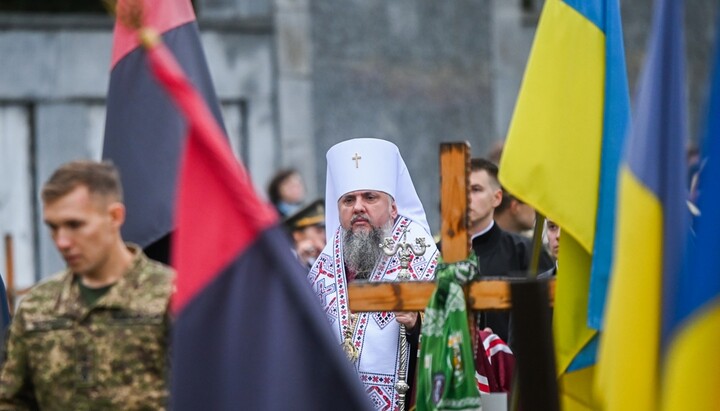
Epifaniy and OUN flags in Lviv. Photo: OCU
Just the other day, 57 Ukrainians were deported from the country for waving red-and-black flags, and Nawrocki called the Banderites “murderers and perverts,” stressing that they killed more than 120,000 people. He announced that Poland is preparing a law under which public statements in favor of the OUN or displays of its symbols will carry criminal liability.
Against this backdrop, it is interesting to consider how relations between the OCU and the Poles will now develop. Until recently, Polish authorities, thanks to their close ties with the Ukrainian government, treated Dumenko’s organization with a certain goodwill. Ukrainian diplomats, for their part, had used Poland as a channel to pressure the Polish Church, trying to push it toward recognizing the OCU.
But now it is worth recalling Dumenko’s own position – and that of his fellow “hierarchs” – toward Bandera and the OUN–UPA. In short, it has been one of outright endorsement.
Epiphany has publicly stated that the OCU considers itself “Banderite” and is proud of it. The OCU has signed cooperation memoranda with OUN affiliates, Dumenko’s clergy have sung the song “Our Father is Bandera” in large numbers, and so forth.
We do not yet know whether the Poles are determined to fully criminalize the OUN, but if they are, Dumenko and his colleagues could soon find themselves personae non gratae in that country.
Moreover, given Poland’s current importance to Ukraine, Warsaw could well demand that Kyiv reconsider its official support for Banderite ideology.
It is clear enough that all of Epifaniy’s “Banderite” rhetoric was aimed at pleasing those in power, politicians, and “Ukrainian society” – to ensure that both he and his structure would be seen as “one of us.” And he surely knew that, from a Christian perspective, the OUN’s reputation is, to put it mildly, far from spotless.
This is what always happens when a man in a cassock lays aside the Gospel and tries to fit himself into the political agenda. At first, everything seems fine – you’re in the current, in the trend. But then the trend shifts, and you’re left looking a fool.
For the time being, everything seems fine for Epifaniy, though the harbingers of trouble are in the air.
Read also
Who destroyed and restored Kyiv Lavra? MinCulture's video reveals the truth
The Culture Ministry’s propaganda about the Kyiv-Pechersk Lavra has inadvertently revealed the truth.
Ternopil post on Feast of Intercession: Has calendar reformn failed?
A significant number of believers have rejected the new church calendar introduced by the OCU and UGCC with government support.
Shoulder straps or a cassock: who writes the script for UOC "fighters"?
Everything indicates that both Veliar and Pshenychny are ordinary performers of someone else's script. There is only one question – does the scriptwriter wear shoulder straps or a cassock?
Why is it legal to kill a person before birth but not after?
Children are the most privileged members of society. Yet that same society officially permits children to be killed – and on a massive scale.
Honoring the Bolsheviks’ successors at Kyiv Lavra
It was under the Reserve that the relics of the saints were desecrated, Lavra churches were turned into an atheism museum, and toilets were installed in sanctuaries.
"Degenerates" and "stupid animals": anti-UOC activists turn on children
Future historians will wonder how a vast country’s information agenda could have been shaped for so long by people so petty, vicious, and utterly contemptible.