Why Bandera and Shukhevych are “enemies of the people” for the DESS head
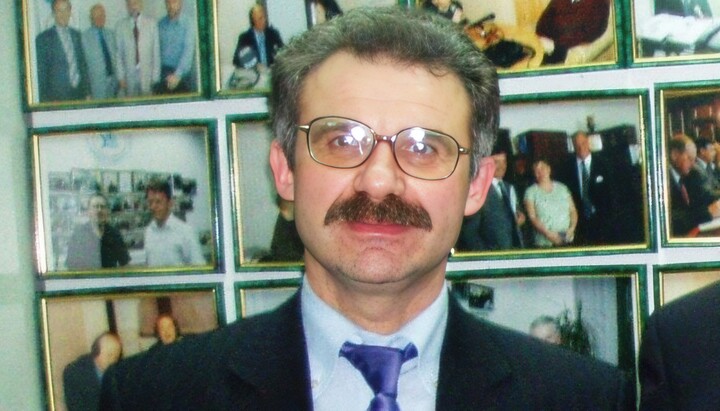
Yelensky. Photo: Radio Liberty
Recently, two of Yelensky’s old academic works from his days at the Institute of Scientific Atheism surfaced online:
- Implementation in the Ukrainian SSR of the Decree ‘On the Separation of Church from State and School from Church’ in the Early Years of Socialist Construction.
- What Is the Foreign UAOC?
The first was authored solely by Yelensky. The second he co-authored – but his name on it means one thing: he either embraced its theses entirely, or wrote them himself. And those theses speak volumes. They expose exactly how Yelensky once viewed the UAOC – an institution that today forms an inseparable part of the OCU.
Here are his own words:
- “Created by hardened bourgeois nationalists, Petliura’s henchmen, the UAOC after the defeat of the counterrevolution became a legal center around which hostile to Soviet power nationalist elements consolidated.”
- “The UAOC became a legal center of gravity for nationalist elements hostile to the people’s authorities.”
- “The autocephalist leadership are direct accomplices of the yellow-and-blue counterrevolution.”
- Members of the UAOC, he wrote, “carried out ideological indoctrination of the so-called Ukrainian Insurgent Army (UPA) bandits. The episcopate of the UAOC blessed nationalist bands, executioners for the mass killings of Soviet people.”
- “The leadership of the UAOC supports nationalist groups, spreads the ideas of clerical nationalism, and propagates the legacy of such enemies of the Ukrainian people as Petliura, Konovalets, Bandera, Shukhevych, Dontsov.”
- “The militantly inclined clergy of the UAOC… spread fabrications about the supposedly innate religiosity of Ukrainians.”
In other words, for Yelensky, Bandera, Shukhevych, Konovalets, and Petliura are traitors and villains. Nationalists are the enemy within. The UAOC is a nest of traitors. The Ukrainian flag is not a banner of freedom, but a mark of “counterrevolution.” Even the idea of Ukrainians’ natural religiosity he dismisses as a lie.
Of course, everyone can see what this was: Yelensky, then as now, trimming his sails to whatever winds of ideology could push his career forward, hungry for the perks that came with obedience. But such blatant ideological acrobatics – spitting yesterday on what he embraces today – cannot fail to shock.
Is there truly no one more disgraceful, more compromised, to head the State Service for Ethnopolitics and Freedom of Conscience?
Read also
Who destroyed and restored Kyiv Lavra? MinCulture's video reveals the truth
The Culture Ministry’s propaganda about the Kyiv-Pechersk Lavra has inadvertently revealed the truth.
Ternopil post on Feast of Intercession: Has calendar reformn failed?
A significant number of believers have rejected the new church calendar introduced by the OCU and UGCC with government support.
Shoulder straps or a cassock: who writes the script for UOC "fighters"?
Everything indicates that both Veliar and Pshenychny are ordinary performers of someone else's script. There is only one question – does the scriptwriter wear shoulder straps or a cassock?
Why is it legal to kill a person before birth but not after?
Children are the most privileged members of society. Yet that same society officially permits children to be killed – and on a massive scale.
Honoring the Bolsheviks’ successors at Kyiv Lavra
It was under the Reserve that the relics of the saints were desecrated, Lavra churches were turned into an atheism museum, and toilets were installed in sanctuaries.
"Degenerates" and "stupid animals": anti-UOC activists turn on children
Future historians will wonder how a vast country’s information agenda could have been shaped for so long by people so petty, vicious, and utterly contemptible.