UOC abbess urges the Institute of National Memory to decommunize Yelensky
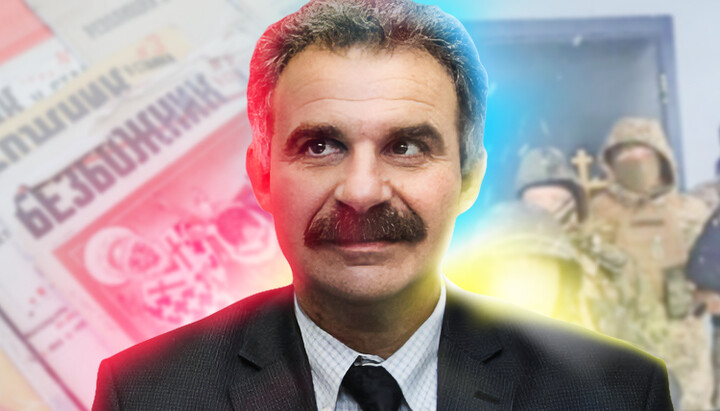
Viktor Yelensky praised Lenin and fought against the Church under the USSR. Photo: UOJ
Abbess Seraphima, superior of the Odessa Archangel Michael Monastery and head of the UOC Synodal Department “Church and Culture,” sent an open letter to Oleksandr Alferov, head of the Ukrainian Institute of National Memory, demanding attention to violations of the laws on decommunization and decolonization in the activities of the current head of the State Service for Ethnopolitics, Viktor Yelensky.
The letter provides a detailed account of the Soviet past of the current official, who between 1981 and 1991 held leading positions in the anti-religious structures of the Ukrainian SSR. Yelensky worked as an officer of the Council for Religious Affairs under the Council of Ministers of the Ukrainian SSR, senior research associate of the Atheist Education Sector at the Kyiv branch of the Institute of Scientific Atheism under the CPSU Central Committee, and head of department at the Republican Center for Spiritual Culture of the Ukrainian SSR.
“Yelensky is the author of many anti-religious works, which stress the observance of Marxist-Leninist ideology in the field of the Communist Party’s religious policy,” the letter notes. The abbess cites passages from his works where he praised Lenin as a “genius” and fought against Ukrainian “bourgeois nationalism.”
“Yelensky wrote of the persecution of religion in Bolshevik times as mere ‘fabrications.’ He described priests and monks as anti-people, counterrevolutionary, and bandit elements,” the abbess emphasized.
She pointed to Yelensky’s position regarding the Ukrainian Autocephalous Orthodox Church, which he described as “a center of consolidation of nationalist elements hostile to Soviet power” and “a legal hotbed of nationalist yellow-blue counterrevolution.”
After Ukraine gained independence, Yelensky “radically changed his rhetoric and direction of activity,” but, as Abbess Seraphima underscores, “he has never once expressed repentance for his past, nor asked forgiveness for his previous actions.”
“A communist functionary who persistently fought against religion and against ‘Ukrainian bourgeois nationalism’ cannot determine Ukraine’s current policy, in defiance of legislative norms and the principles of state-building in a democratic Ukraine,” the letter concludes.
The abbess called on the Institute of National Memory to take note of violations of decommunization and decolonization laws, since Yelensky’s continued service in state structures contradicts the principles of overcoming the imperial-totalitarian legacy.
Earlier, the UOJ analyzed why Yelensky fights against the Church under every regime.
Read also
UOC's Sign Church damaged in Kherson air strike
In Kherson, Russian airstrikes shatter windows and damage the façade of the UOC’s Church of the Sign.
Yelensky: Not recognizing OCU means indirectly denying Ukrainian statehood
Viktor Yelensky believes that Local Churches that do not recognize the OCU thereby indirectly fail to recognize Ukrainian statehood as well.
UOC Lavra priest urges believers to accept hardships with gratitude
Archpriest Heorhiy Boyko at the prayer vigil near the Kyiv-Pechersk Lavra recalled the sufferings of Great Martyr George the Victorious.
UOC honors patron saint of Kherson land
A Divine service was held at the Holy Spirit Cathedral of Kherson on feast day of St. Barsanuphius of Kherson.
Nativity of John the Baptist Church of UOC damaged by shelling in Kharkiv
A church of the Kharkiv Eparchy (UOC) was damaged during another shelling.
Patriarch Bartholomew not to concelebrate with Bulgarian Church Primate
The Ecumenical Patriarch will attend the service at St. Alexander Nevsky Cathedral in Sofia as a guest.