Unity in Suffering
```html
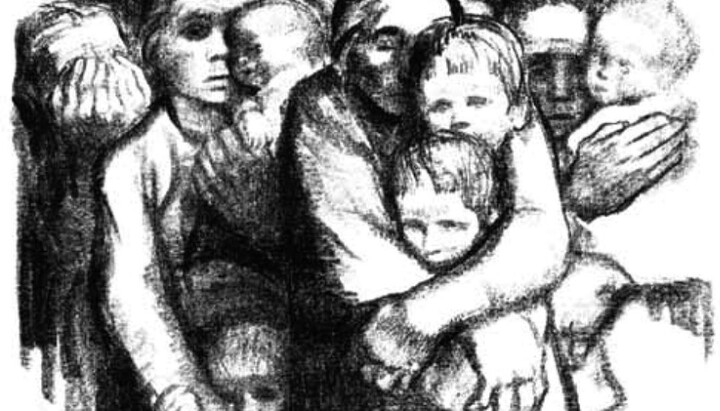
First of all, the suffering and pain of others evoke hatred towards those who caused them to suffer. But hatred demands an outlet (just like love, but in the opposite direction): remaining inside, it destroys the soul, pouring out - it generates reciprocal hatred. And with it - new murders, tortures, and sufferings. This is an endless circle from which there is no escape. Because hatred is not a way out, but a dead end.
"And because iniquity shall abound, the love of many shall wax cold."
The human heart is divided: if I feel compassion for the pain of my own and joy from the suffering of others, I am divided within myself. I have ceased to be whole.
It is not by chance that Christ calls for love towards enemies. It seems perverse, but it is the only thing that allows one to keep their heart, to remain fully human and Christian.
Compassion cannot depend on the color of the flag or skin, on language or nationality, on gender or age. Suffering and pain are experienced by every person equally. This is what unites us. In suffering, we are one. And even the God-man Jesus suffered just like any of us.
If I have forgotten how to feel another's pain as my own, even if it is the pain of my enemy, an insurmountable chasm arises within my heart between me and God. Because the only possible theodicy (justification of God's existence amidst the rampant evil) is the recognition that God always shares the sufferings of the one who suffers. Whoever they may be.
"The God whom we prayerfully called upon to intervene in the evil deeds of the world and correct them perished in Auschwitz," said John Pawlikowski. And he added: "After Auschwitz, one can only speak of God if we acknowledge that God shares the sufferings of people."
It is astonishing that even two thousand years after the crucifixion of Christ, people find it so difficult to come to terms with this thought. Jesus dies on the cross, experiencing terrible torments. He shares the pain of the repentant thief, but also the sufferings of the other, whose heart remained full of hatred and malice. "In all their affliction, He was afflicted" (Isaiah 63:9).
This is not at all the God we sought for ourselves - the God of victors and warriors, the Judge and Almighty. He is the One who suffers with us, whoever we may be (whether we are ready or not ready to share this suffering with Him).
And perhaps in this lies a completely incomprehensible meaning of such calamities. The tension between us, mutual (or one-sided) animosity spills over into hatred and mutual (or one-sided) destruction. And then Christ, suffering in the one who suffers, dying with each dying person, through His suffering and death calls us to mercy, compassion, and a new unity as brothers and sisters.
Whoever torments another person inflicts wounds on Christ. Whoever kills another person kills Christ. But by tormenting and killing Christ, I torment and kill myself, because Christ lives within me as well.
2.
The sufferings and death of Christ remain one of the greatest mysteries, despite the fact that over two thousand years, tons of paper have been written on this topic.
Why would an almighty God become a weak and insignificant being? Could the world not be corrected in another way? Indeed, has it been corrected?
Why surrender Yourself into the hands of tormentors and executioners if You can save all their victims with just one wish? What is the meaning of all this?
Of course, one could say, for example, that God wishes to save not only the victims but also their executioners by showing them the feat of sacrifice and love. And thereby incline them to repentance. But how many cases of such repentance of executioners do we know? And which of Christ's tormentors repented? Does the Gospel not remain silent about this?
The beauty of the Savior's feat and death undoubtedly attracts the hearts of many people to Him. But even this reason does not fully exhaust the mystery.
```
Read also
How anti-church media shape our agenda
It is striking how anti-Church media outlets manage to set the agenda for us Orthodox Christians. They have somehow convinced people that concelebrating with Russian Orthodox Church (ROC) clergy, or even attending an ROC service, is haram, taboo, a red flag. But why on earth should that be?!
Two tragedies. Two very different standards
Oleksandr Matsievskyi said “Glory to Ukraine!” before he was executed. The whole world witnessed his murder. Politicians, government officials, and Ukrainian and international media spoke about him. He was posthumously awarded the title of Hero of Ukraine. And rightly so. Because the killing of an unarmed person is a tragedy and a crime.
Regarding the attack on the Holy Dormition Sviatohirsk Lavra's monks
As of now, there has been no official information about the opening of a criminal investigation into the attack on the monks of the Holy Dormition Sviatohirsk Lavra.
Culture Ministry paves way for mass seizure of UOC churches?
In recent years, we have seen the Ministry of Culture increasingly terminating unilaterally long-term lease or free-use agreements concluded with the UOC for those churches or monasteries that are architectural monuments and are state-owned (or communally owned). The goal is clear: to push the UOC out of Ukraine's religious landscape.
About “our own” God on both sides of the war
Two similar “miracles” – and two opposite conclusions about God.
If Christians “moved in” like this
A text with reverse logic about migration and expectations from society.