Calculations prove: Life could not have arisen by itself. But who created it?
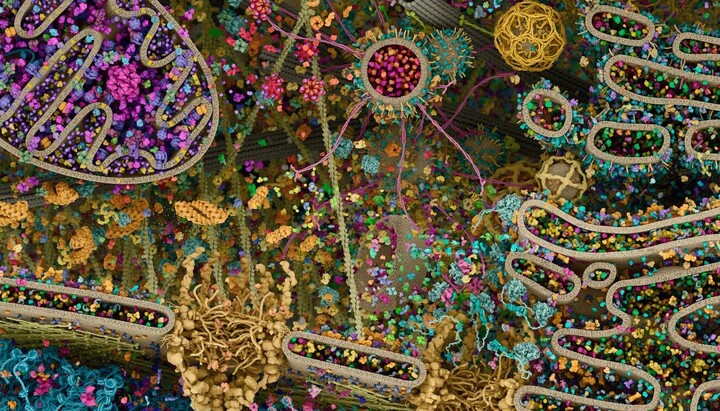
Human cell. Photo: open sources
In July 2025, Robert Endres of Imperial College London published a study casting doubt on the possibility of life arising by chance. Endres is a highly respected scientist, and Imperial College ranks 2nd in the QS World University Rankings and boasts 14 Nobel laureates.
Using modern mathematical methods and information theory, Endres demonstrated that even the simplest living cell requires about a billion bits of structured information. He compared the probability of life’s spontaneous emergence from the chemical “soup” of ancient Earth to a scientist trying to write a complex research paper by randomly scattering letters on a page. Another analogy: it is like assembling a functioning computer by tossing a pile of parts onto the ground. That, according to his calculations, is the likelihood of the first cell “self-assembling” from inorganic matter.
In other words, the dominant theory of life’s origins has been shattered. And if you say “A,” you must also say “B.” If life could not appear on its own, then someone must have created it. A believer knows Who. But atheism has become so deeply ingrained in the minds of modern society (including the scientific community) that researchers invent the most far-fetched explanations, simply to avoid acknowledging the obvious.
Convinced that life could not have arisen spontaneously, Endres turned to the hypothesis that aliens brought life to Earth. Yet here a logical problem immediately arises, one obvious even to casual readers of scientific articles. If aliens created us, then who created the aliens? And if they were created by other aliens, then who created them? This produces an infinite regress, leaving the core question unresolved and merely pushing it further back.
Today, as technology reaches unimaginable heights, we are told that everything can be explained by science, logic, and reason – and that faith is nothing but superstition and fanaticism. Yet here lies the paradox: even with supercomputers capable of calculating trillions of possibilities, scientists cannot reach the simple conclusion that any child in Sunday school would state without hesitation.
Read also
Ternopil post on Feast of Intercession: Has calendar reformn failed?
A significant number of believers have rejected the new church calendar introduced by the OCU and UGCC with government support.
Shoulder straps or a cassock: who writes the script for UOC "fighters"?
Everything indicates that both Veliar and Pshenychny are ordinary performers of someone else's script. There is only one question – does the scriptwriter wear shoulder straps or a cassock?
Why is it legal to kill a person before birth but not after?
Children are the most privileged members of society. Yet that same society officially permits children to be killed – and on a massive scale.
Honoring the Bolsheviks’ successors at Kyiv Lavra
It was under the Reserve that the relics of the saints were desecrated, Lavra churches were turned into an atheism museum, and toilets were installed in sanctuaries.
"Degenerates" and "stupid animals": anti-UOC activists turn on children
Future historians will wonder how a vast country’s information agenda could have been shaped for so long by people so petty, vicious, and utterly contemptible.
Zelensky sees murder of Polish priest but not of Sviatohirsk monk
Why does Zelensky react so emotionally and swiftly to the murder of a Catholic cleric while remaining completely silent about the murder of an Orthodox monk?