Yelensky urges to change state–church relations
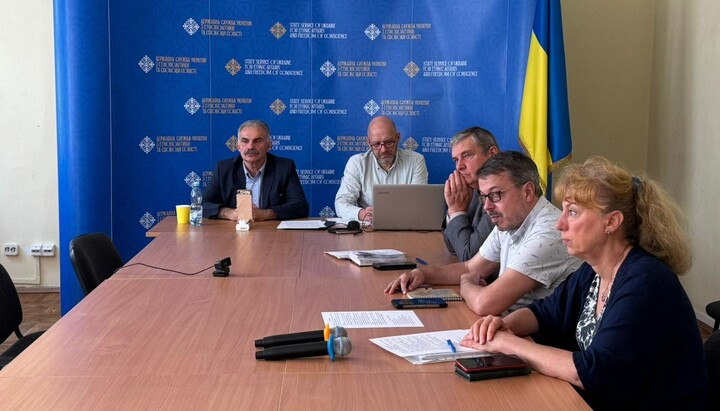
Yelensky with colleagues. Photo: DESS website
On September 10, 2025, Viktor Yelensky, head of the State Service for Ethnopolitics and Freedom of Conscience (DESS), convened a meeting to discuss relations between the state and religious organizations. Participants included members of the AUCCRO, Members of Parliament, DESS officials, and representatives of other government agencies.
Yelensky recalled that in October 2024, President Zelensky, while presenting the Resilience Plan in the Verkhovna Rada, “outlined a new paradigm for relations between the state and the Church.” Now Yelensky has decided to implement that paradigm.
According to him, the Law “On Freedom of Conscience and Religious Organizations” was adopted 34 years ago and has lost its relevance. “Over the past decades, the Ukrainian state has traveled a long road of development, and religious organizations have become an important factor in the social, civic, cultural, and spiritual life of the country,” the official stated.
Yelensky called for a “partnership model between the state and the Church,” though he did not specify what that model should look like. He believes the authorities must declare a final transition to a model of state–church partnership while maintaining the secular nature of the state, non-interference in the internal life of the Church, and the inadmissibility of instrumentalizing or abusing religion to the detriment of Ukrainian society.
He argued that amendments must be made to the Law “On Freedom of Conscience and Religious Organizations” in order to ensure the “deepening of state–church interaction” in social, humanitarian, educational, and cultural spheres.
What prevents such “deepened interaction” under current legislation, Yelensky did not explain.
Earlier, the UOJ reported that Yelensky and his associates had called Bandera, Shukhevych, and Petliura enemies of the Ukrainian people.
Read also
OCU activist admits breaking into UOC church in Sloviansk
Oleksandr Onyshchenko said that the OCU held its first "service" at the Seraphim Church, which had previously been broken into by forcing the locks and doors.
Archimandrite Ioustinos, longtime keeper of Jacob's Well, dies in Jordan
Archimandrite Ioustinos (Mamallos), the keeper of Jacob's Well in Nablus, has died after a prolonged illness.
Pilgrim group from Kyiv Theological Seminary visits Mount Athos
KTS students are making a pilgrimage to the holy sites of Romania, Greece, Mount Athos and Italy.
UOC cathedral celebrates its patronal feast in Ternopil
The service in the cathedral of the Holy Martyrs Faith, Hope, Love and their mother Sophia was led by Metropolitan Serhii of Ternopil, concelebrated by four hierarchs.
MinCulture marks centenary of Soviet-era reserve at Lavra's Refectory Church
Representatives of the Ministry of Culture presented awards to the Reserve's employees on the occasion of the anniversary at the Refectory Church of the Lavra.
Conference to mark 1700th anniversary of Christianity adoption held in Georgia
In Georgia, representatives of the Church and the state noted the defining role of Christianity in the country's cultural development.