Pope Leo allows Traditionalists to celebrate Latin Mass banned by Francis
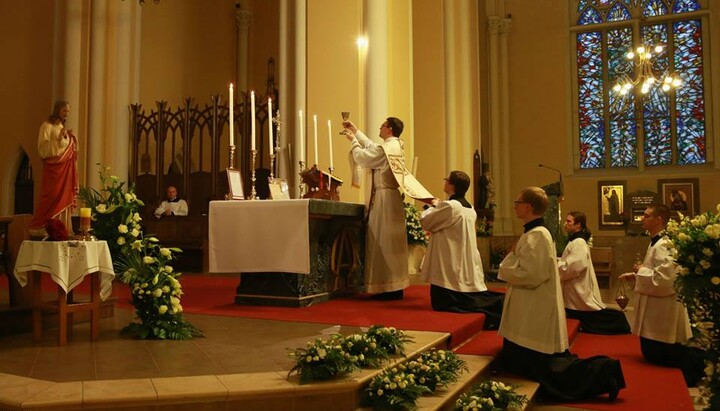
Latin Mass in a Catholic church. Photo: summorum-pontificum
In September 2025, Pope Leo XIV granted Catholic traditionalists permission to celebrate Mass in the old Latin rite at St. Peter’s Basilica in the Vatican, despite the fact that its celebration had previously been prohibited by Pope Francis, reports Associated Press.
The permission is linked to the annual pilgrimage of supporters of the traditional liturgy, which this year will gather the faithful in Rome. Organizers clarified that on October 25 the Latin Mass will be celebrated by American Cardinal Raymond Burke – one of the main opponents of Pope Francis and a leader of the conservative wing of the Roman Catholic Church.
This event carries special significance, since it was Pope Francis in 2021 who sharply curtailed the use of the ancient Roman liturgy, overturning the relaxations introduced by his predecessor, Pope Benedict XVI. Pope Francis’ decision caused strong discontent among traditionalists, notably in the United States and Europe. At that time, many priests and lay people claimed that such measures would “do more harm than good” and would push some Catholics toward schism.
Cardinal Burke, a well-known critic of Pope Francis’ pontificate, played a prominent role in the May 2025 conclave that elected Robert Prevost as the new pope, Leo XIV. Burke has already met with Pope Leo XIV at least twice, with the most recent meeting taking place on August 22. According to experts, it was he who pressed for the return of the Latin Mass to the principal church of the Catholic Church.
Pope Leo XIV himself stressed that his main goal is “unity and reconciliation in the Church.” Many conservatives and traditionalists saw in this step a signal of change.
The pilgrimage to Rome is organized by Una Voce International, a federation that unites supporters of the Latin liturgy. “Green light for Burke to celebrate the Mass in the heart of the Vatican is the first concrete indication of the attitude of Pope Leo XIV to the Traditional Mass,” said federation president Joseph Shaw. “We are all delighted by this development, which shows Pope Leo’s true pastoral heart.”
The Latin Mass (traditional Roman liturgy) has repeatedly been a subject of controversy in the Catholic Church in the 20th and 21st centuries. In 2007, Pope Benedict XVI allowed its wider celebration, but in 2021 Pope Francis once again imposed serious restrictions. In 2023 and 2024, pilgrims were allowed only to pray in St. Peter’s Basilica but were forbidden to celebrate the Mass according to the old rite. Now, for the first time in several years, the Latin liturgy will once again be heard in the Catholic Church’s principal sanctuary.
Earlier, the UOJ reported that the Vatican had canonized a 15-year-old programmer.
Read also
Reports to SBU of weapons in UOC churches were always false, Novynskyi says
The protodeacon said that under Maliuk, inspections began to be accompanied by public accusations against the Church without evidence.
Culture Ministry pledges to speed up seizure of Kyiv-Pechersk Lavra from UOC
Culture Minister Tetiana Berezhna has pledged to personally attend a court hearing in the Kyiv-Pechersk Lavra case.
Kamianske Eparchy honors Dnipro Icon of the Mother of God for first time
A festive service was held at a cathedral in Kamianske, where the Dnipro Icon of the Mother of God was brought out for veneration by the faithful for the first time.
Kyiv conscription officers abduct UOC priest
TRC officers reportedly abducted Maksym Kostiuchenko, a cleric of a UOC church in the Ukrainian capital.
Court grants DESS lawsuit to dissolve UOC’s Rovenky Eparchy
The appeals court partially granted the DESS lawsuit seeking to dissolve the Rovenky Eparchy but rejected the request to seize its property, citing a gap in Ukrainian legislation.
Met. Meletiy consecrates house of worship for UOC community in Dankivtsi
Members of the persecuted UOC Intercession parish in Dankivtsi have converted a house into a place for communal prayer and worship services.