Artificial intelligence: A Christian view on the challenges of our time
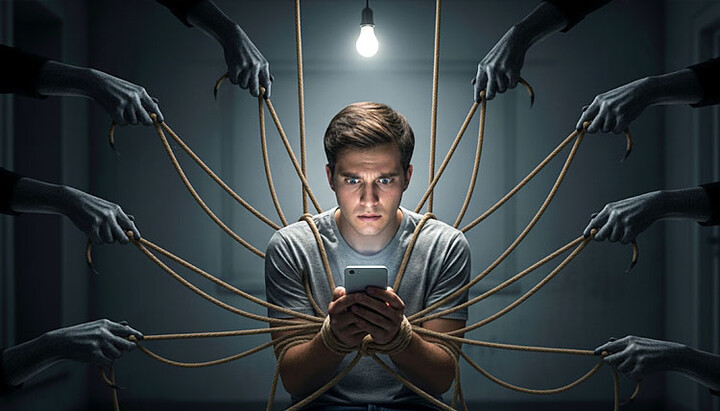
Neural networks enslave the will of man. Photo: UOJ
The development of technology – especially that which radically changes human life – has always prompted reflection on the very nature of these inventions, responsibility for discoveries made, and the consequences of their use. Today, this urgency is especially visible in the discussion of artificial intelligence. The technology is young, yet it already wields enormous power, strongly influencing culture, science, the economy, and, most importantly, human thought and the human soul. Thus arises the inevitable need to comprehend this phenomenon from a Christian perspective.
Whose will stands behind the technology?
The fundamental question is: what is the nature of artificial intelligence? Is it merely a passive tool, or does it bear the imprint of a will? Neil Postman, in his book Technopoly: The Surrender of Culture to Technology, argues that no technology is neutral – it always carries someone’s will. Just as drones may appear neutral but are in fact extensions of an operator’s intent, so too a neural network conceals within itself another’s will.
The sooner we recognize this, the sooner we can move from shallow fascination with innovation to a thoughtful Christian discernment – asking whose will it serves, and how we may preserve spiritual freedom and our own subjecthood in dealing with AI.
That will is inevitably shaped by the worldview of those commissioning and developing the technology.
The first and most obvious driver is business: corporations seek to increase profit, reduce costs, and capture user attention. This leads directly to the second: control – from predicting user desires to manipulating public opinion. Algorithms not only anticipate but actively form human desires. Here lies not just economics but the lust for dominion over the human mind and will – bearing an unmistakably demonic character.
Another aim is ideological influence: through programmed protocols that select and present information in a way that shapes a particular worldview.
Finally, there is the factor of technological prestige: nations and corporations competing in a “new arms race,” where technology becomes a symbol of power and even a claim to be the creator of a new future. If the will behind the technology is driven by greed, pride, or the thirst for glory, its fruit will inevitably be poisoned by that same demonic spirit.
Who is master and who is slave? The illusion of control
Disguised as convenience, the technology hardly feels like coercion. On the contrary, the user believes he commands the system by giving prompts – yet, in reality, his choices are being guided by the coded architecture. He himself becomes the “drone,” steered by another’s will.
Algorithms, trained on the behavior of millions, predict desires, form habits, and manipulate choices, rendering individuals predictable cogs in a vast machine.
Resisting this requires awareness: our capacity for independent, willful decision-making must grow in proportion to the complexity of technology.
The problem is that the unseen consequences of AI in the future far outweigh the visible effects today. Jonathan Haidt’s The Anxious Generation documents how Instagram corroded the minds of young girls over fifteen years. In 2010, its creators may not have harbored malice, yet the outcome was devastating. Technological power is growing – and ought to be accompanied by caution and responsibility. But in practice, few care about the impact ten or twenty years down the line.
“Prosthetic” thinking and the substitution of living communication
In the past, technologies stripped man of physical skills. The keyboard weakened handwriting, digital media weakened memory. Neural networks now “prostheticize” thought itself – making us less capable of independent analysis. Research confirms that constant reliance on AI leads to cognitive shifts: people outsource their intelligence, becoming dependent on algorithms.
The greatest temptation lies in the illusion of communication. Neural networks mimic human interaction, but it is only an imitation.
True conversation demands effort, humility, patience, love, the ability to listen. With AI, none of this is required – it never contradicts, never demands, always adapts and flatters.
This poses a grave threat to the individual soul, to the family, and to authentic emotional bonds. It is no surprise that more stories appear of people in vulnerable psychological states “marrying” AI companions. A tragic case reported in The Wall Street Journal told of a man who, after intense exchanges with a chatbot, took his own life. The machine – incapable of compassion or responsibility – reinforced his destructive thoughts and, according to his family, nudged him toward the fatal act.
The Christian path to freedom in the age of AI
Neural networks expose human vulnerabilities: they prostheticize thought, substitute living relationships, foster dependency, exploit biology, and distort reality.
For the Christian, resisting this is an ascetic struggle. It is a battle with the enemy of mankind – the devil – who subtly diverts us from salvation, turning us inward upon ourselves, feeding the illusion of self-sufficiency.
By offering instant solutions, the evil one inflates pride and encourages us to avoid confronting our true selves.
As in ages past, a clear worldview – knowing who I am, whom I serve, and for what purpose I live – guards against manipulation. Manual labor, craftsmanship, and sport anchor us in the material world. Self-reflection, watchfulness over one’s inner life, and repentance are keys to sobriety. Chatbots, however, undermine this, echoing only what the user wishes to hear.
Finally, fasting in the digital sphere – deliberate abstinence – can train the will and restore freedom.
Each interaction with AI must be conscious, intentional, directed toward creativity and real relationships, not passive consumption.
The Christian way is the choice of true freedom – through faith, discipline, and the primacy of living communion – leading to wholeness of soul and deliverance from digital chains.
Read also
Golgotha in the midst of a pogrom
In the autumn of 1938, the Jewish artist Marc Chagall painted the crucified Christ. Synagogues burn and refugees flee around the cross, while the Crucified One Himself is wrapped in a prayer shawl.
Stories of the Early Church. Level of governance: patriarch
How did several episcopal sees rise above the rest, why did the Church’s administrative map come to mirror that of the empire, and is the patriarchate a sacred form of Church governance?
A Chronicle without an author
We are accustomed to calling The Tale of Bygone Years the work of St. Nestor. Yet another monk left his signature on it, while the chronicle itself passed from one generation of scribes to the next.
How a wedding stopped a war
The young princess of Slutsk was married off to keep two powerful noble families from drowning the city in blood. Soon afterward, a Uniate metropolitan complained that Orthodoxy had been reborn in Slutsk.
Man before the forces of nature
A solitary figure on the shore seems insignificant before the immense power of the sea, yet it is he who stands before the Creator.
The mysteries of Golgotha in the light of archaeology
The veil of centuries obscures what really happened in the fourth century. Archaeology and ancient texts shed light on the true history of one of Christianity’s greatest sacred sites.