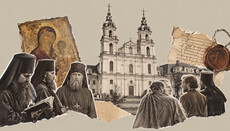

Armor of the invisible: why the Great Schema is the ultimate freedom
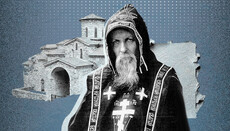
The black analavos with a skull is not a sign of mourning, but the attire of those who have left earthly vanity. How ordinary fabric becomes a shield from any earthly anxieties and fears.
In 1763, Poltava native Peter Velichkovsky, who had already lived on Mount Athos for seventeen years and taken the name Paisius, brought sixty-four monks to the Moldavian Dragomirna. The monastery was being built, the brotherhood was growing, and it was here, among the books and manuscripts he collected throughout the Orthodox world, that the Venerable Paisius took the Great Schema. What exactly changed that day, sources do not specify. But one thing is known for certain: the schemamonk, whom the historian Georgy Fedotov would later call "the father of Russian eldership," no longer held any administrative positions. His sole task from then on was prayer.
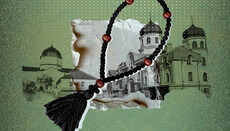
In the dim light of the monastery corridor, a figure sometimes appears that makes a passing visitor instinctively slow their step. The person is wearing a strange black cloth, embroidered with white and red symbols, among which a skull is clearly visible. This is the analavos, a central piece of the great schemamonk’s vestments. It is often mistaken for a burial shroud or a grim prop from medieval films. However, in the Church terms, this garment does not signify the end of life, but the beginning of the boldest and freest choice.
A person wearing such garments is officially crossed out from the lists of citizens, consumers, and debtors.
He becomes invulnerable to earthly manipulations, political storms, and market crises. This is the uniform of a warrior who operates in the deep rear of human fears, having nothing with him except prayer.
From the leather belt to the Byzantine cipher
The history of this "uniform" began in the fourth century with the Venerable Pachomius the Great. Initially, the schema was extremely simple: a short cloak-cowl or leather strap, emphasizing the state of infancy in Christ. It only fixed a person's readiness for complete obedience and conscious non-possessiveness.
By the sixteenth century, the modest piece of cloth had transformed into a complex structure covered with symbols and cryptograms of the Paleologus era.
The modern analavos is a long, rectangular piece of black fabric with a hole for the head. It hangs down in front and back almost to the knees, covering the shoulders and chest. Five crosses are placed on the chest, back, both shoulders, and the koukoulion (hood), symbolizing the complete sanctification of the human "five senses" through sharing in the crucifixion with the Savior.
.jpeg)
Along with the analavos, the schemamonk wears a cowl — a pointed hood of humility, a paramand — a small cloth as a reminder of Christ's wounds, a leather belt, and simple sandals. The fabric is always coal-black, reminding one of the ashes of former passions and the final break with the world.
Mathematics of Golgotha and passwords for eternity
The letter abbreviations on the analavos are not just calligraphy, but semantic knots that hold the mind in the space of continuous standing before God. The central element is the Golgotha Cross on a base of three steps, signifying faith, hope, and love.
.jpeg)
According to ancient tradition, Christ was crucified precisely over the grave of the first man — Adam. The blood of the New Adam, seeping through a crack in the rock, washed the ancient skull, cleansing original sin. The letters G.G. (Gora Golgofa - Mount Golgotha) and G.A. (Glava Adama - Head of Adam) mark the place where the beginning of history meets its new continuation. There is no room for improvisation here: every thread of the analavos is subject to the strict logic of heavenly spheres and angelic orders.
Adam's skull vs the "Jolly Roger"
The skull and crossbones at the foot of the Cross evoke false associations with pirate symbolism in many people. For pirates, the "Jolly Roger" served as a sign of danger and inevitable death, a promise that a person would lose everything. In the Great Schema, this symbol has the opposite meaning – it is a triumph over death.
Adam's skull at the heart level is a testimony that death has been officially recognized as a passed stage.
It has already been trampled by the Cross and lies at its foot in a state of complete defeat. The schemamonk wears these bones on himself because he has stepped over fear and no longer fears the physical decay of his body.
Tonsure into the schema is a special event during which a person actually hears his own funeral service. Radical acceptance of mortality transforms the analavos into armor that no earthly threat can penetrate. If a person recognizes himself as "deceased" to vanity, any external insult flies right through without touching him.
Wool as an archive of repentance
Monastic tradition insistently requires natural sheep's wool for the analavos. The old vestment becomes heavier over time, becoming a natural extension of the ascetic's body. The fabric becomes saturated with the salt of years of prayer labor, transforming from an item of clothing into a tangible document of repentance.
The soft thread dampens external sounds, creating around the schemamonk a space of hesychia — sacred silence. If attention scatters, the person instantly falls into an abyss of empty arguments and anxieties. The analavos in this sense is a constant reminder that the monk has only one task — prayer for the world.
Freedom without Pockets and administrative positions
In ancient law, "civil death" deprived a person of all rights, but in the schema it grants absolute freedom. The schemamonk has no pockets, there is nothing to hide in the analavos, which means nothing can be taken from him. According to canonical rules, such a monk cannot hold any administrative positions within the monastery.
A schemamonk is never an abbot or steward — his only business is continuous prayer for the entire wounded world.
This is exactly what apparently happened to Saint Paisius (Velichkovsky): having taken the schema at Dragomirna, he left behind only what is considered most important in the monastic tradition. His manuscripts, corrected translations of patristic books, his "Philokalia" — all this was the work of a schemamonk who formally had no authority except prayer. One detail is striking: it was precisely this man without position or pockets who became, in the historian's words, the "father" of an entire spiritual movement.
When the individual dissolves into "facelessness" beneath the black koukoulion, they find their true reflection in the Face of Christ. Even death does not strip them of this form: a schemamonk is buried in the analavos. The black wool decays along with the body, leaving historians no chance to display these garments behind museum glass.
At the moment of tonsure, the schemamonk receives a new name, completely severing biographical ties with the past. The more signs of death on the garment, the more true life is felt in the person. Reading the sources about the Great Schema, one can't help thinking: this is the only officially recognized way to become truly free.