UN accuses Ukraine of persecuting UOC clergy, communities, and journalists
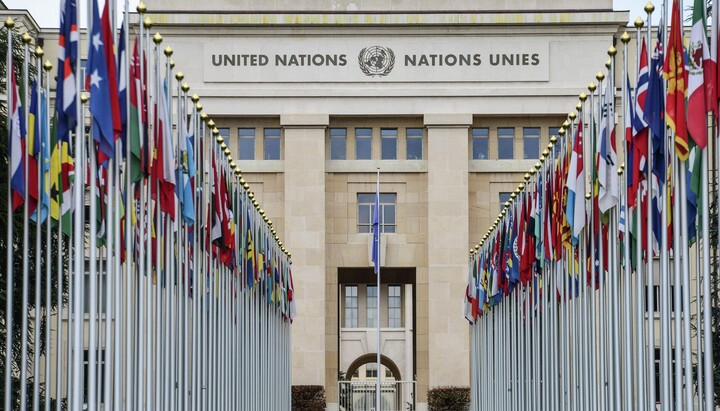
UN Headquarters in Geneva. Photo: iStock/SanderStock
Seven UN Special Rapporteurs on human rights have sent an official letter to the Ukrainian government, accusing it of systematic violations of religious freedom against the Ukrainian Orthodox Church.
In the 15-page document, dated May 14, 2025, the independent UN experts express “serious concern” over alleged persecution of UOC clergy, believers, as well as journalists and human rights defenders who protect them.
Main accusations
Forced dissolution of religious communities. According to the rapporteurs, the “Law on the Protection of the Constitutional Order in the Sphere of Religious Organizations’ Activities” of August 20, 2024, allegedly created a legal basis for dissolving thousands of UOC parishes due to their canonical ties with the ROC. The UN notes that this legislation classifies canonical or historical ties with the ROC as a threat to national security. Parishes are effectively offered either to disassociate from the UOC or face dissolution and criminal liability for continuing religious activity.
Arrests of clergy. The document cites specific cases of detention of senior hierarchs of the UOC:
- Metropolitan Theodosiy of Cherkasy – accused of “justifying aggression” and “violating citizens’ equality” (Articles 436-2 and 161 of the Criminal Code). Since November 2022, he has faced multiple criminal proceedings. On October 17, 2024, during the seizure of St. Michael’s Cathedral, he sustained a serious head injury from unidentified attackers.
- Metropolitan Pavlo, abbot of the Kyiv Pechersk Lavra – accused of “inciting religious hatred” and “justifying aggression” (Articles 161 and 436-2). Under house arrest since April 2023, preventing him from fulfilling monastic duties. Briefly imprisoned due to a high bail.
- Metropolitan Arseniy of Sviatohirsk – accused of “disclosing military positions” (Article 114-2). Arrested in April 2024 after a raid by 200 SBU officers, over a sermon about praying for pilgrims at checkpoints. He has been held in pretrial detention since April 2024, repeatedly denied bail despite health problems.
- Metropolitan Lonhin of Bancheny – accused of “inciting religious hatred” (Article 161) for affirming the canonical legitimacy of the UOC and criticizing the recognition of the OCU. Known for his humanitarian work and adopting more than 500 orphans.
- Fr. Yevhenii Koshelnyk – accused of “justifying aggression” (Article 436-2). In December 2024, sentenced to five years in prison. The court interpreted his use of Church Slavonic and canonical references to the Moscow Patriarchate as “glorification of aggression.”
Seizures of churches. The UN experts documented forced takeovers of religious property:
St. Michael’s Cathedral in Cherkasy – on October 17, 2024, about 100 armed men stormed the cathedral. Clergy and parishioners resisting were attacked with tear gas. Law enforcement did not intervene; some defenders of the church were charged with hooliganism.
Yelets Monastery in Chernihiv – local authorities initiated court proceedings to transfer the monastery to a state-approved or OCU-linked body. The UOC was deprived of the possibility of fair legal defense.
Persecution of defenders.
The document describes an atmosphere of fear for journalists and human rights defenders:
- Dmytro Skvortsov, journalist, held in custody for 23 months on “treason” charges for articles about the persecution of the UOC. Though released on bail in October 2024, proceedings continue with the threat of a 15-year sentence.
- Svitlana Novytska, human rights activist, arrested in February 2024 on charges of “treason,” “inciting religious hatred,” and “justifying aggression” for defending UOC clergy and speaking at OSCE conferences. Held without bail in Lviv pretrial detention center.
Legal aspects and international obligations
The rapporteurs state that the described actions may violate Ukraine’s obligations under the International Covenant on Civil and Political Rights, ratified in 1973. They emphasize that freedom of religion remains “a non-derogable right even under martial law.”
They criticize the use of vague terms like “Russian World ideology” for criminal prosecution of theological views and liturgical practices. According to them, the authorities apply criminal law not for “explicit calls to violence,” but for “sermon references to traditional liturgical language, calls for canonical unity, or expressions of disagreement with state-endorsed Orthodox jurisdictions.”
The experts underline that while armed conflict may justify extraordinary measures, “the right to freedom of religion is non-derogable under all circumstances.” The UN Human Rights Committee has previously held that restrictions on freedom of religion for reasons of national security are impermissible even during wartime.
The letter also references European Court of Human Rights rulings, including Metropolitan Church of Bessarabia v. Moldova (2001), which stresses that states cannot compel religious communities to change their spiritual allegiance for political reasons.
Systemic nature of violations
The rapporteurs are particularly alarmed at the “comprehensive character” of practices against the UOC, amounting to a “systematic campaign to dismantle or forcibly redirect the religious life” of Church communities.
According to the UN, in all cases of persecution UOC clergy “faced prolonged pretrial detention or restrictive house arrest,” often denied bail. Courts allegedly relied on linguistic “expertise” claiming “pro-Russian sympathies” instead of concrete evidence of criminal intent.
The experts note that “the nature of the charges and the minimal factual basis apart from theological discussions, sermons, or liturgical practices” indicates that criminal law is being used to curtail the influence of the UOC.
UN demands of the Ukrainian authorities
The letter contains eight specific questions requiring a detailed response, including:
Religious persecution: Clarify the legal grounds for dissolution, eviction, and prosecution of UOC communities, and explain how restrictions comply with principles of legality, necessity, and proportionality.
Criminal cases: Provide the legal and evidentiary basis for prosecuting clergy for “incitement,” “justifying aggression,” or references to the “Russian World,” especially when involving peaceful religious activity.
Fair trial: Indicate guarantees of fair trial rights in line with international standards, including judicial independence, access to legal aid, and presumption of innocence.
Church property: Detail procedures for restitution of seized property, compensation, and judicial review of forced transfers.
Protection of defenders: Report on measures to protect journalists, lawyers, and activists documenting abuses against the UOC from persecution and unlawful arrests.
Deprivation of citizenship: Clarify the legal grounds, procedures, and appeal options in cases of deportation of UOC hierarchs.
Martial law: Explain measures to prevent excessive restrictions on religious freedom under the pretext of emergency law.
International procedure
The UN experts’ appeal results from the systematization of information from human rights organizations, witnesses, and victims. The rapporteurs stress that they “do not wish to prejudge the accuracy of the allegations” but consider it necessary to formally request clarification from the Ukrainian authorities.
The letter was sent under the UN’s “urgent appeal” procedure – a mechanism enabling experts to react swiftly to reports of grave human rights violations. This tool does not involve prior judicial rulings but obliges states to provide clarifications.
The document was signed by seven independent UN experts: Georgios Katrougalos (democratic international order), Irene Khan (freedom of expression), Clément Voule (peaceful assembly), Margaret Satterthwaite (judicial independence), Nicolas Levrat (minority rights), Nazila Ghanea (freedom of religion), and Ben Saul (counter-terrorism).
The Ukrainian authorities are required to respond within 60 days. The correspondence will be published on the official UN website and included in the annual report of the Human Rights Council. In case of no reply or unsatisfactory explanations, the matter may be referred to international human rights bodies.
The UN experts urged Ukrainian authorities “to take all necessary interim measures to halt the alleged violations and prevent their re-ocurrence,” as well as “to ensure accountability for any persons responsible for the alleged violations.”
Earlier, the UOJ reported that, according to a UN report, Ukraine failed to prove the legality of the ban on the UOC.
Read also
UOC's Sign Church damaged in Kherson air strike
In Kherson, Russian airstrikes shatter windows and damage the façade of the UOC’s Church of the Sign.
Yelensky: Not recognizing OCU means indirectly denying Ukrainian statehood
Viktor Yelensky believes that Local Churches that do not recognize the OCU thereby indirectly fail to recognize Ukrainian statehood as well.
UOC Lavra priest urges believers to accept hardships with gratitude
Archpriest Heorhiy Boyko at the prayer vigil near the Kyiv-Pechersk Lavra recalled the sufferings of Great Martyr George the Victorious.
UOC honors patron saint of Kherson land
A Divine service was held at the Holy Spirit Cathedral of Kherson on feast day of St. Barsanuphius of Kherson.
Nativity of John the Baptist Church of UOC damaged by shelling in Kharkiv
A church of the Kharkiv Eparchy (UOC) was damaged during another shelling.
Patriarch Bartholomew not to concelebrate with Bulgarian Church Primate
The Ecumenical Patriarch will attend the service at St. Alexander Nevsky Cathedral in Sofia as a guest.