Do not revile the ruler of your people
Let us examine whether there are boundaries to this command and what meaning the Apostle himself intended.
First, Paul is quoting Exodus (22:28): “You shall not revile the judges, and you shall not curse the ruler of your people” (in more precise translations: “You shall not blaspheme God, nor curse a leader of your people”).
Biblical scholar Alexander Lopukhin notes that the command “do not revile Elohim” in Exodus is linked with the injunction not to delay in offering the first fruits of one’s harvest and livestock (Ex. 22:29–30). The moral precepts of Exodus 22:21–27 hindered people from enriching themselves at the expense of the poor, and so they murmured – both against the Law itself and against those who enforced it. Hence the demand: “do not revile.”
Thus, the original meaning was not that a believer must remain silent when witnessing injustice and falsehood. Rather, the words were aimed at the sinner, who was displeased that God and those who uphold His law restrain his desire to commit evil.
Paul before the Sanhedrin
To understand what Paul meant, we need to look at the whole scene.
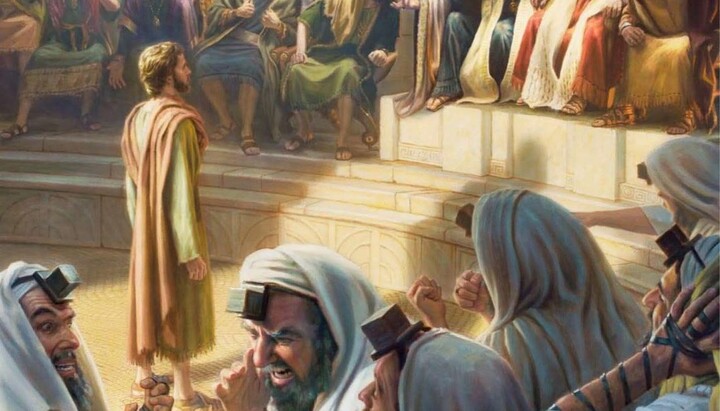
Appearing before the Sanhedrin, Paul addressed the judges as “brothers.” This in itself was audacious – placing himself on equal footing with the court, instead of addressing them as “Rulers of the people and elders of Israel.”
The high priest Ananias immediately ordered Paul to be struck on the mouth. Paul retorted: “God will strike you, you whitewashed wall! You sit there to judge me according to the law, yet contrary to the law you order me to be struck” (Acts 23:3).
This could be seen as direct insult – apparently breaking the biblical command. Paul then seemed to retract, saying: “I did not know, brothers, that he was the high priest; for it is written: ‘You shall not revile the ruler of your people’” (Acts 23:5).
But was this truly an apology? Some commentators note it is unlikely Paul did not realize the man presiding was the high priest. More likely, his words are ironic: “I would never have thought that someone who violates justice could be a high priest.”
His epithet “whitewashed wall” recalls Ezekiel 13:2–16, where false prophets “whitewash” a flimsy wall that will surely collapse. Paul is accusing Ananias of leading the people astray, and foretelling his downfall.
Rebuke, not slander
Paul’s words are not mere rudeness, but prophetic rebuke. The reference to Exodus is also deliberate: the very passage is framed by two themes – mercy toward the vulnerable (Ex. 22:22–27) and offering first fruits to God (Ex. 22:29). Josephus tells us Ananias sent servants to seize tithes from ordinary priests. Paul’s words thus strike at his hypocrisy: the high priest was usurping God’s place.
Paul further destabilized the Sanhedrin by exploiting their division: Pharisees (who affirmed resurrection) and Sadducees (who denied it). By declaring: “I am a Pharisee… I stand on trial because of the hope of the resurrection” (Acts 23:6), he turned them against each other, forcing the Roman officer to remove him amid uproar.
The principle of rebuke
So, from Paul’s example it does not follow that believers must keep silent before evil committed by rulers. On the contrary, Paul boldly and skillfully rebuked the high priest who had forgotten that God placed him to restrain evil, not commit it.
The Old Testament makes clear that silence is guilt. Through Ezekiel (33:8), God warns: “If I say to the wicked, ‘You will surely die,’ and you do not speak to dissuade them… I will hold you accountable for their blood.” Likewise, Leviticus 19:17 commands: “Rebuke your neighbor so you will not share in his guilt.”
Christ, too, taught rebuke in Matthew 18: “If your brother sins, go and point out their fault, just between the two of you…”
And Paul himself rebuked not only Ananias but even the Apostle Peter, when Peter withdrew from fellowship with Gentiles out of fear (Gal. 2:11–14).
The difference between reviling and rebuke lies in love and truth. Rebuke is a work of love – towards the sinner, and towards those harmed by his sin.
Conclusion
A Christian’s heart aches when confronted with lies and injustice. It cannot endure when evil calls itself good, and falsehood demands respect. Nothing is more destructive for a people than rulers – secular or ecclesiastical – who forget their dust-born origins and fill themselves with greed, hatred, and pride, drowning the land in blood.
Whether Paul’s words to Ananias are read as insult or prophecy matters little. What matters is that his prediction was fulfilled: the “whitewashed wall,” the false leader of Israel, perished shamefully at the hands of the very people he deceived.
“For the wrath of God is revealed from heaven against all ungodliness and unrighteousness of men who suppress the truth by their wickedness” (Romans 1:18).
Read also
How anti-church media shape our agenda
It is striking how anti-Church media outlets manage to set the agenda for us Orthodox Christians. They have somehow convinced people that concelebrating with Russian Orthodox Church (ROC) clergy, or even attending an ROC service, is haram, taboo, a red flag. But why on earth should that be?!
Two tragedies. Two very different standards
Oleksandr Matsievskyi said “Glory to Ukraine!” before he was executed. The whole world witnessed his murder. Politicians, government officials, and Ukrainian and international media spoke about him. He was posthumously awarded the title of Hero of Ukraine. And rightly so. Because the killing of an unarmed person is a tragedy and a crime.
Regarding the attack on the Holy Dormition Sviatohirsk Lavra's monks
As of now, there has been no official information about the opening of a criminal investigation into the attack on the monks of the Holy Dormition Sviatohirsk Lavra.
Culture Ministry paves way for mass seizure of UOC churches?
In recent years, we have seen the Ministry of Culture increasingly terminating unilaterally long-term lease or free-use agreements concluded with the UOC for those churches or monasteries that are architectural monuments and are state-owned (or communally owned). The goal is clear: to push the UOC out of Ukraine's religious landscape.
About “our own” God on both sides of the war
Two similar “miracles” – and two opposite conclusions about God.
If Christians “moved in” like this
A text with reverse logic about migration and expectations from society.