Veneration of saints: from the Reformation to the present day
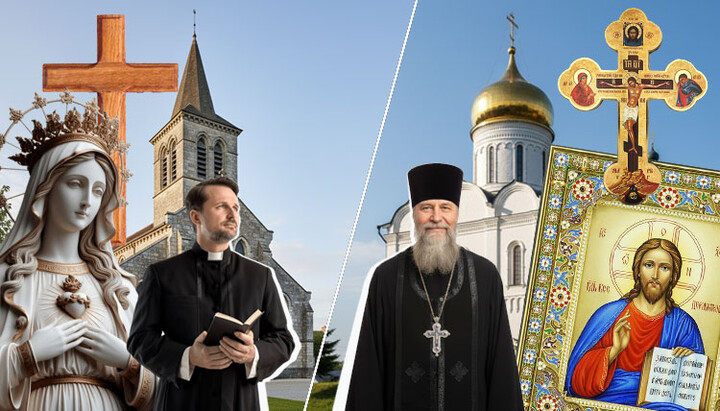
Latin and Orthodox traditions of venerating saints differ. Photo: UOJ
Reformation and Counter-Reformation (16th century)
The criticism of obvious abuses in the veneration of saints became especially sharp during the Reformation. Martin Luther and other reformers directly accused the Catholic Church of the Christianity decline through the sale of relics, the sale of indulgences, and the dominance of power-seeking. For example, John Calvin wrote: "Let's be frank: there is nothing so filthy and shameful as the cult of relics as it is currently practiced. Most of what is shown as holy relics are crude and brazen forgeries." Interestingly, he contrasted the genuine veneration of saints of the early centuries "in memory of their virtues" with the late medieval worship of "any bone that comes along".
The Catholic Church responded to this with the Counter-Reformation: eradicating the most blatant abuses, abolishing the sale of indulgences, improving the education of the clergy, and tightening the requirements for canonization.
The Council of Trent in 1563 decreed: "... in the invocation of saints, the veneration of relics, and the sacred use of images, every superstition shall be removed, all filthy lucre be abolished, finally, all lasciviousness be avoided."
Differences in the veneration of saints in Orthodoxy and Catholicism
By approximately the 16th century, the Latin and Orthodox traditions of venerating saints had acquired their distinctive features. Although they are similar in many ways, they embody different theological understandings.
- Theological accents. In Orthodoxy, the veneration of saints has a mystical character: a saint is a friend of God, a deified person, a member of the Heavenly Church, an intercessor for the members of the earthly Church. In Catholicism, during this time, the legal doctrine of «supererogatory merits» (opera supererogatoria) developed. Simplified, it means that saints earn more "righteousness points" in their lives than needed for salvation. These "extra" merits go into the Church's "treasury" and can be distributed (or sold through indulgences) to those who "fall short".
- Canonization procedure. In Orthodoxy, canonization remains a conciliar and often local matter. In Catholicism, it becomes centralized. The bull of Pope Alexander III (12th century) secured the exclusive right of canonization to the Roman pontiff, which became another tool of his influence in Europe.
- Types of holiness. In Orthodoxy, the monastic (hesychastic) type of holiness was more revered: personal asceticism and acquisition of the Holy Spirit (Athonite and Kiev Caves saints, St. Sergius of Radonezh). In Catholicism, saints with an active life position dominated: preachers and missionaries (Francis of Assisi and others).
- Liturgical practice. In Orthodoxy, the veneration of saints was mainly integrated into the Liturgy and the daily liturgical cycle. In Catholicism, on the contrary, it becomes separate: the "private mass" develops, along with numerous services and processions dedicated exclusively to a particular saint.
Despite these differences, the denunciation of abuses was heard both in the East and the West. St. Nilus of Sora (15th century) wrote: "The power is not in the bones, but in the grace of God; relics are honored as vessels of grace." He was echoed by Bernard of Clairvaux (12th century), criticizing the pomp and greed in the veneration of relics.
Synodal period in the Russian Church (1721–1917)
In the Russian Empire, which included Ukraine, the Synodal period began, during which the Church was governed not by a Patriarch, but by the Holy Synod, headed by a state official appointed by the Tsar.
Peter I reformed the empire following the model of Protestant countries, where the church was subordinated to the state.
In the context of the veneration of saints, this manifested in a sharp decrease in the number of canonizations compared to the 15th–17th centuries. Throughout the 18th century, only a few saints were glorified (for example, St. Demetrius of Rostov), and in the 19th century, also only a few (St. Tikhon of Zadonsk).
The focus shifted from the veneration of miracles to education, catechization, and the spread of the Holy Scriptures. The canonization procedure itself became highly formalized, which, for example, explains the long reluctance of the Synod to glorify St. Seraphim of Sarov.
20th century: the era of new martyrs
The 20th century brought a renewal of active canonizations and a change in the grounds for glorification. If earlier martyrs were glorified for the conscious choice of suffering for Christ, in the 20th century, many Christians who became victims of totalitarian regimes were glorified: Nazi, Communist, and Francoist. These people were often not given a choice, they were killed as representatives of a "hostile class".
The end of the 20th century was marked by an explosive growth in the number of canonizations. Pope John Paul II (1978–2005) canonized more than 480 saints, more than almost all his predecessors combined. His successors continued this trend.
In the Local Orthodox Churches (Constantinople, Greek, Serbian, etc.), the traditional practice of canonizing ascetics, elders, and confessors continued. With the fall of the USSR, an explosive growth in the number of saints also occurred in the Russian Church. The Jubilee Bishops' Council of 2000 canonized over a thousand new martyrs and confessors, victims of the Soviet regime.
Afterword
Over two thousand years, the cult of saints has come a long way: from simple prayerful memory («Peter, remember Anthony») to million-strong pilgrimages to the relics of modern ascetics, such as Carlo Acutis. It is interesting to note the chronological coincidence of the development of the veneration of saints and the decline of the practice of frequent communion of the Holy Mysteries of Christ.
In the early centuries, Christians primarily realized their religiosity through participation in the Eucharist, and later through the veneration of relics, the decoration of icons, and pilgrimages.
Perhaps there is a connection between these two phenomena, but that is a topic for another conversation.
Read also
Trial of a dead pope
Once in Rome, the body of a deceased pope was seated on the throne and put on trial. The accusation relied on a church canon that had once saved his see.
Monastery built in defiance of king
When Orthodox believers in Minsk were left with just one church, townspeople decided to build another – and even a royal decree did not stop them.
Young Mother and Sleeping Christ
Michelangelo carved a Virgin Mary who looks younger than her Son – and signed his name in marble for the only time in his life. Neither of these peculiarities was accidental.
Orthodox books from a Uniate printing press
In the 18th century, Uniate monks at Pochaiv printed books used in prayer by Orthodox Christians and Old Believers alike.
The story of the honey brotherhood
The Mogilev Brotherhood began with members pooling money to brew honey drinks for feast days – and eventually grew to have its own printing press.
Golgotha in the midst of a pogrom
In the autumn of 1938, the Jewish artist Marc Chagall painted the crucified Christ. Synagogues burn and refugees flee around the cross, while the Crucified One Himself is wrapped in a prayer shawl.