Churchly absurdities in today’s Ukraine
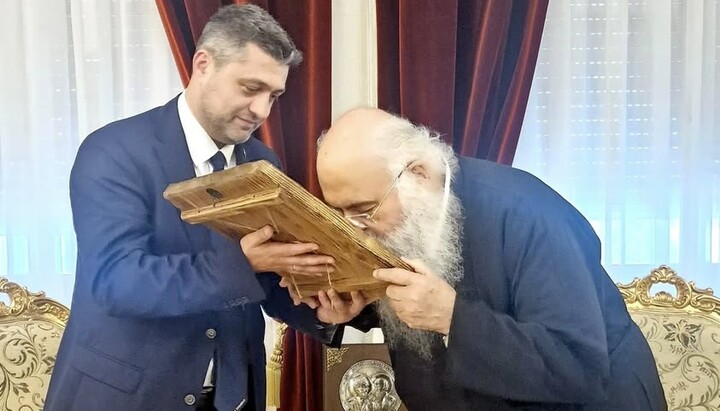
Nezhynskyi presents Archbishop of Cyprus with an icon of St. Luke Voino-Yasenetsky. Photo: Embassy of Ukraine in Cyprus
Why are these attempts absurd? Just a few recent examples.
1. Ukraine’s ambassador to Cyprus, Nezhynskyi, presented Archbishop Georgios with an icon of St. Luke containing a relic and declared that “his earthly title ‘of Crimea’ will always and forever remind all who turn to him for help that Crimea is Ukraine.”
Why is this foolish?
First, Khrushchev transferred Crimea to the Ukrainian SSR in 1954, whereas the episcopal title “of Crimea and Simferopol” was bestowed on the saint back in 1946, when the peninsula belonged to the RSFSR.
Second, the saint was a bishop of the Russian Church – in today’s parlance, a “Moscow priest” and an “occupier.” So when convenient, the ROC are enemies, but when not, the titles of its bishops (appointed in Moscow) are pressed into service for geopolitical statements.
And that’s not even the main point. In St. Luke’s lifetime, there was no Russian-versus-Ukrainian national rivalry on the table; no one thought in those terms. For example, St. Luke once wrote: “Vast multitudes of the Russian people went on pilgrimage to the saints in the Kyiv-Pechersk Lavra, carrying their love there and bowing their hearts.” Does that mean he was “Ukrainophobic” for calling Ukrainians “the Russian people”? Of course not. But trying to leverage his “Crimean” title in today’s political conflicts looks wildly out of place.
2. OCU “Metropolitan” M. Zinkevych said the biographies of “Russian” saints should be researched and, if they were haters of Ukrainians, their icons should not be kept in churches. He counted among such “Ukrainophobes,” for instance, the Kyivan prince Alexander Nevsky.
Here one is simply baffled. How could Alexander Nevsky hate the very land he ruled for several years while residing in Kyiv? How could he, in the 13th century, be an enemy of a Ukrainian state that would appear many centuries after his death?
Against the backdrop of the OCU’s rejection of “Russian” saints, the mid-air flip-flop of one of the OCU’s fiercest church raiders, Roman Hryshchuk, is striking. He had called St. Xenia of Petersburg and St. Matrona of Moscow “unhinged Russian women.” Hryshchuk prowls UOC churches and denounces any saints he deems “connected to Russia.” Yet in May 2025 a “miracle” occurred: he called St. Seraphim of Sarov “our Ukrainian saint.”
This, even as the OCU sneers by dubbing St. Seraphim of Sarov the patron of Russia’s nuclear weapons. Hryshchuk’s “transfiguration” had a very simple explanation – a church dedicated to St. Seraphim was consecrated, and its rector voluntarily defected to the OCU (one of very few such cases in Bukovyna). Therefore, St. Seraphim, suddenly, is no longer a “nuclear” saint but a fine Ukrainian.
Of course, there are far more than three such examples. There are so many, in fact, that we have almost stopped noticing their absurdity.
Read also
Why is it legal to kill a person before birth but not after?
Children are the most privileged members of society. Yet that same society officially permits children to be killed – and on a massive scale.
Honoring the Bolsheviks’ successors at Kyiv Lavra
It was under the Reserve that the relics of the saints were desecrated, Lavra churches were turned into an atheism museum, and toilets were installed in sanctuaries.
"Degenerates" and "stupid animals": anti-UOC activists turn on children
Future historians will wonder how a vast country’s information agenda could have been shaped for so long by people so petty, vicious, and utterly contemptible.
Zelensky sees murder of Polish priest but not of Sviatohirsk monk
Why does Zelensky react so emotionally and swiftly to the murder of a Catholic cleric while remaining completely silent about the murder of an Orthodox monk?
UOC vs. OCU numbers: pollsters count, social media recount
Official polling suggests Dumenko’s structure has an overwhelming lead in the number of parishioners, while social media polls paint a very different picture. Which should we believe?
Who is working for the Kremlin in Poland? OCU, Uniates and Catholics versions
Who in the conflict between Poland and Ukraine is "an agent of the Russian Federation"? Zelensky, who gave the UPA name to an AFU special operations center? Nawrocki, who stripped him of an order for it? Polish MEPs?