Five amazing facts from the life of schema-monk Elijah of Makiivka
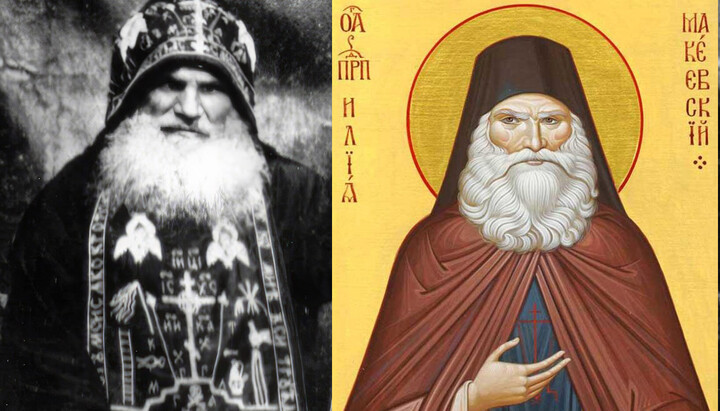
Venerable Elijah of Makiivka. Photo: UOJ
Although fewer biographical details of the elder’s life have been preserved than researchers would wish, people know the most important thing: this remarkable man sincerely loved God and his neighbors, bore the light of Christ into the world, and was a true comforter and helper to all who suffered.
1. From Donbas to Athos: A path to holiness
Venerable Elijah (in the world – Ilya Yakovlevich Ganzha) was born in 1837 in the town of Makiivka, then a settlement of the Mius district of the Don Cossack Host region. In his 109 years of life, he became a living treasury of Athonite monastic wisdom and Russian piety.
At the age of fifteen, young Elijah made a decision that defined his entire life – he left his parents’ home with the words: “I have gone to seek holy places – now I have returned here to die.”
His spiritual search led him to Mount Athos, where he labored for many years in the Skete of St. Elias.
He spoke little of his ascetic life, but once mentioned a remarkable detail: his cell was so inaccessible that food had to be delivered to him by rope. These long years of spiritual struggle prepared him for the extraordinary ministry that awaited him later.
2. The saint’s mysterious appearance
When Schema-monk Elijah returned to his native Makiivka in 1927, people could not take their eyes off him – he literally radiated inner light. But the most striking feature was that one of his eyes was always closed.
Many thought the elder had lost an eye, but in fact both were perfectly healthy.
“One eye is enough to look at this world,” he explained.
Perhaps for this reason, the curtains in his cell were always drawn – the saint consciously limited his view of worldly vanity, focusing on the spiritual.
3. Prophetic gift during the war
As early as 1935, Venerable Elijah foretold the coming war. When the Great Patriotic War began, he became a true spiritual beacon for the people of Makiivka.
His gift of foresight manifested with astonishing accuracy: he predicted the fates of soldiers, and all his prophecies came true – both joyful and sorrowful.
During the occupation, the elder did remarkable things: he blessed families to plant certain vegetables, knowing in advance what the harvest would be. In autumn, he instructed families to exchange their surpluses – thus under his spiritual protection no one went hungry. When the Germans staged raids and burned houses, his prayer and blessing became a sure defense.
4. Healings and spiritual feats
Schema-monk Elijah was endowed with the gift of healing the sick and delivering people from demonic possession. Witnesses recalled that it was terrifying to be present at such healings – the possessed howled, barked, and spun in place, but after the elder’s prayer they calmed down, wept quietly, and began to pray with him.
“Cross yourselves, cross yourselves! And do not look back!” he would tell those present at the healings.
His foresight was striking: he knew in advance who was coming to visit, warned about police raids, and avoided encounters with those who could harm him.
5. Prophecy of the future and peaceful repose
After the victory in the Great Patriotic War, people asked the elder whether peace would now come.
His answer was prophetic: “A time will come – our Fatherland will be divided into many parts without war. And war, as it has gone on, will go on still!” Sadly, these words were confirmed by history.
On April 17, 1946, on Holy Wednesday, the hundred-year-old elder peacefully reposed in the Lord, having foretold his own passing. He was buried on Good Friday, and a great multitude of people came to bid him farewell. Even after his death, the path to his grave never grew over.
Pilgrims from different cities came to the Athonite monk for help and consolation, confirming his last words: “Whoever on earth prays for me – will be with me.”
Read also
Facade of bones and facade of light
Antoni Gaudí spent forty-three years building a church in Barcelona, knowing that this construction was for the ages.
Trial of a dead pope
Once in Rome, the body of a deceased pope was seated on the throne and put on trial. The accusation relied on a church canon that had once saved his see.
Monastery built in defiance of king
When Orthodox believers in Minsk were left with just one church, townspeople decided to build another – and even a royal decree did not stop them.
Young Mother and Sleeping Christ
Michelangelo carved a Virgin Mary who looks younger than her Son – and signed his name in marble for the only time in his life. Neither of these peculiarities was accidental.
Orthodox books from a Uniate printing press
In the 18th century, Uniate monks at Pochaiv printed books used in prayer by Orthodox Christians and Old Believers alike.
The story of the honey brotherhood
The Mogilev Brotherhood began with members pooling money to brew honey drinks for feast days – and eventually grew to have its own printing press.