Faith, Hope, Love, and Sophia: Three virtues and their spiritual mother
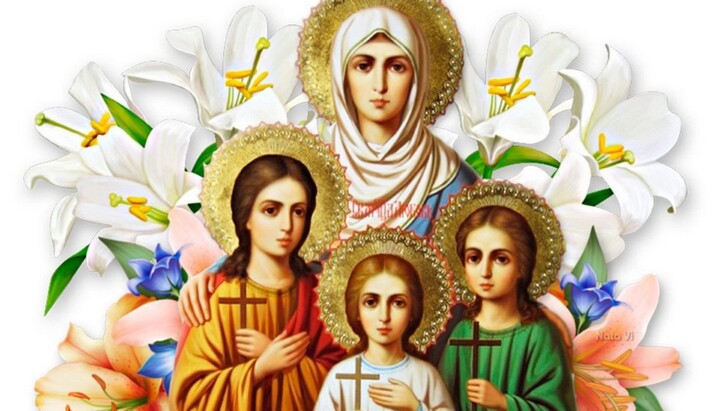
The names of the holy martyrs – three pillars of the Christian soul. Photo: mari-mitropolia
The Church calendar recalls many martyrs who suffered for their faith in Christ during the years of pagan persecutions. Yet the story of the sisters Faith, Hope, and Love, and their mother Sophia, differs from the others. Their death became the summit of Christian confession.
The martyrs honored today reveal a striking example of spiritual steadfastness. They proved their readiness and determination to die for Christ, openly defying the pagan emperor who sought to make them betray their faith.
The suffering and motherly love of Saint Sophia
To describe the torments endured by the young girls – the cruel tortures they suffered – is terrifying not only to write, but even to think about. Yet for us, it is important not only to acknowledge their readiness to endure everything for the sake of faith, but also to try, if only for a moment, to understand what their mother Sophia felt as she watched her children endure unspeakable agony.
She was already a widow. Having lost her husband, she now saw with her own eyes her beloved daughters torn from her. She became a living witness to the nightmare of their torment.
And yet, she knew and sensed that the Lord was granting her such a trial so that her trust in Him would not weaken but, on the contrary, be strengthened in the furnace of suffering.
The sisters were tortured and brutally killed. Their mother herself laid their mutilated remains into the earth and remained by the grave for several days, keeping vigil in fervent prayer. There, by the tomb of her children, she found her own repose in the Lord.
Perhaps today, it would be almost impossible to find a mother who, instead of cursing and seeking vengeance on the murderers, could receive such a horror as the very will of God.
Three virtues – three pillars of the Christian soul
The names Faith, Hope, and Love – representing the chief virtues – have always been sacred to our people. Up until the 18th century, out of reverence, these names were not given to children in our lands, so holy were they considered.
The names of the martyrs became three pillars upon which the Christian soul is built.
Faith, as the Apostle Paul tells us, is “the substance of things hoped for, the evidence of things not seen” (Hebrews 11:1). These two foundations of faith are inseparable. At first, a person directs prayer to God without being fully assured of an answer. But once what is hoped for is fulfilled, faith in the unseen is born. The soul not only trusts God but becomes confident that He truly answers prayers. Thus faith is born – that quality without which the spiritual life is baseless.
The second pillar of the believer is hope. Hope, the longing to experience the mercy of the Higher Power, existed even before Christianity. “While I breathe, I hope” – this was the motto of the ancient Roman. Yet he hoped for a favorable end to life without ever knowing its true fulfillment, which was revealed only in the Resurrection of Christ the Savior.
Hope for salvation cannot exist without faith in God.
If we hope only in human aid, we may wait in vain. For man, wounded by sin, can betray us – but the loving Lord will never forsake us.
And it is no accident that we speak of the greatest quality of God – love. “God is love, and he who abides in love abides in God, and God in him” (1 John 4:16), writes the Evangelist John. And the Apostle Paul, speaking of the threefold virtues, declares: “And now remain these three: faith, hope, and love. But the greatest of these is love” (1 Corinthians 13:13).
Why is love greater than faith and hope?
Because love is the very essence of God Himself. At the same time, it is the virtue to which the whole of human life must be dedicated.
Faith and hope can wither in the soul when crushed by sorrows and hardships. Love never fades, for its source is God Himself.
Sophia – the Wisdom of God
While meditating on these three Christian virtues, we must not forget their spiritual mother. The mother of the holy martyrs was Sophia – her name meaning “wisdom.” Thus, the mother of all Christian virtues is none other than Divine Wisdom.
The concept of Wisdom is found in ancient philosophy, in Jewish tradition, and in the Old Testament. In the books of Solomon, Wisdom is already personified as a living reality, endowed not with human but divine attributes. But it is in the Gospel that the teaching of Sophia finds its fullest revelation.
Christian theology ascribes to Wisdom the attributes of God Himself, naming Sophia (Wisdom) the “Incarnate God” – that is, the Lord Jesus Christ.
Therefore, alongside icons of the holy martyr Sophia, Orthodoxy venerates the image of Sophia, the Wisdom of God, often depicted as an Angel in fiery radiance.
Thus, today may be regarded both as a feast of the Lord and a day of honoring spiritual asceticism. In imitation of the holy martyrs, many Orthodox Christians continue even now to stand steadfast in the faith, answering the difficult challenges of our times and enduring fierce persecutions raised against the Church of Christ.
Let us therefore preserve and increase the treasures God has given us – faith, hope, and love. And let us take to heart the precious counsel of Saint Luke of Crimea: “We must live by faith, hope, and love. This is our foundation, this is our breath. But we must remember that however great faith may be, however blessed hope may be, love is above all. Strive to acquire the love of Christ, purify your hearts, and make room in them for holy love!”
Read also
A shepherd boy with a letter from Christ to French king
In the summer of 1212, thousands of pilgrims carrying staffs waited for the sea to part before them. Later chroniclers added ships, slave traders, and a pope's lament to their story.
Facade of bones and facade of light
Antoni Gaudí spent forty-three years building a church in Barcelona, knowing that this construction was for the ages.
Trial of a dead pope
Once in Rome, the body of a deceased pope was seated on the throne and put on trial. The accusation relied on a church canon that had once saved his see.
Monastery built in defiance of king
When Orthodox believers in Minsk were left with just one church, townspeople decided to build another – and even a royal decree did not stop them.
Young Mother and Sleeping Christ
Michelangelo carved a Virgin Mary who looks younger than her Son – and signed his name in marble for the only time in his life. Neither of these peculiarities was accidental.
Orthodox books from a Uniate printing press
In the 18th century, Uniate monks at Pochaiv printed books used in prayer by Orthodox Christians and Old Believers alike.