Council's decisions were a response to challenges of war, Kamianske bishop
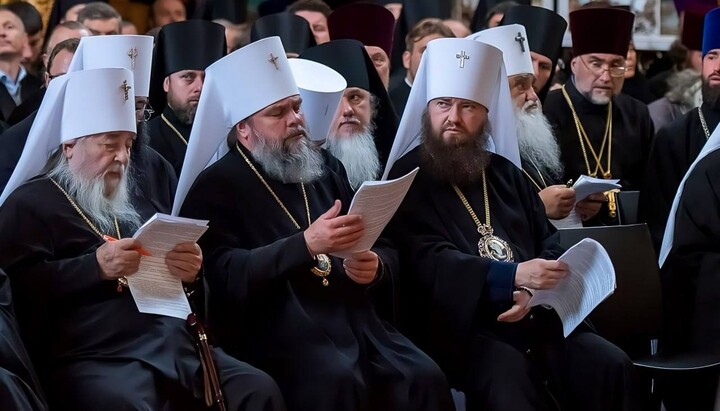
Metropolitan Volodymyr of Kamianske and Tsarychanka at the UOC Council on May 27, 2022 Photo: the eparchy's press service
Metropolitan Volodymyr of Kamianske and Tsarychanka stated that the Council of the Ukrainian Orthodox Church, held on May 27, 2022, in Feofania, was an important and logical step for the Church in the conditions of wartime and societal challenges. The statement of the ruling archbishop was published by the press service of the Kamianske Eparchy on social networks.
"The Council in Feofania was an important step for our Church on the path of spiritual responsibility, unity, and internal freedom. We gathered as one Body of Christ – in the spirit of peace, faith, and love for our Church," emphasized the archbishop.
According to Metropolitan Volodymyr, the initiative to hold the Council came from within – from the archbishops, clergy, and laity, who asked to respond to the challenges faced by the Ukrainian Orthodox Church after the start of the full-scale war.
"There was no external pressure or interference. All this talk about 'control by security services' or 'influence from the authorities' is speculation that has nothing to do with reality," noted the bishop.
He explained that delegates from the Kamianske Eparchy were openly elected at the eparchial meeting, where anyone could propose candidates. At the Council itself, there was an atmosphere of openness and brotherly love: every participant had the opportunity to freely express opinions, make proposals, and participate in discussions.
Metropolitan Volodymyr emphasized that all decisions were made collectively and prayerfully. "His Beatitude Metropolitan Onuphry personally adhered to the principle of non-interference and would not have allowed the Council to be convened if there was even a hint of external pressure," he added.
The archbishop also commented on the issue of the Council's canonicity.
"According to the Statute on the UOC governance, the Council has the highest authority in our Church, and its resolutions come into force immediately after adoption. Therefore, any claims of 'illegitimacy' or 'non-canonicity' of the Council's decisions do not correspond to either the facts or church law," concluded the archbishop.
As reported by the UOJ, earlier Metropolitan Victor of Khmelnytskyi stated that the words about "pressure" in the context of the initiative to convene the Council can indeed be used. But this pressure was not from outside, but from within the Church. "This pressure, or more precisely, the expression of will, came from within the Church – from the episcopate, clergy, and faithful of the Ukrainian Orthodox Church," stated the archbishop.
The discussion around the situation at the UOC Council began after Metropolitan Cherkasy Theodosiy stated on a podcast in Vinnytsia that the Council in Feofania, in his opinion, was not free.
Read also
Kyiv’s Vvedensky Monastery damaged in shelling, Two injured
A cluster munition struck the monastery, injuring a cook and a kitchen assistant and damaging the facade, the roof of the monks’ residential building, and several monastic cells.
Medieval сhurch сrumbles as Culture Ministry сites missing agreement
The 14th–15th-century St. Nicholas Church in Chesnyky, Ivano-Frankivsk Region, is falling into disrepair.
Poland сondemns Lviv Regional Council's decision to declare 2007 year of UPA
Polish Prime Minister Donald Tusk says the Lviv Regional Council's decision to dedicate 2027 to the UPA and Roman Shukhevych is harmful to Ukraine.
OCU seeks court recognition of ownership of seized Cherkasy cathedral
The Cherkasy Regional Commercial Court will hear an OCU lawsuit seeking ownership of St. Michael's Cathedral, which was seized from UOC believers.
Lithuanian bishop: Ukraine is no model for believers' rights
Vicar of Vilnius Diocese voices concern over attempts to import Ukraine's religious conflict into Lithuania.
Hundreds of believers honor St. Alexis of Carpatho-Russia in Khust Eparchy
At the St. Nicholas Monastery in the village of Iza-Karputlash, Metropolitan Mark of Khust led a festive liturgy, concelebrated by six metropolitans, five archbishops and three bishops.