Iran abolishes mandatory hijab for women
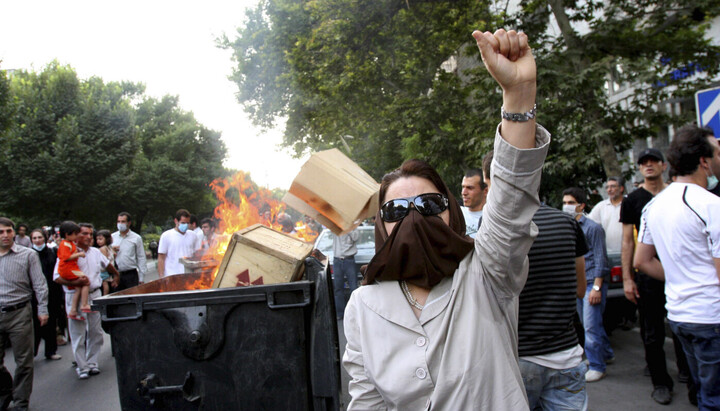
Street protests in Tehran, 2009. Photo: Reuters
In October 2025, the Iranian authorities effectively abolished the requirement for women to wear the hijab. The Verstka outlet reported this, citing Mohammadreza Bahonar, a member of Iran’s Expediency Discernment Council.
“At present, there is no mandatory law on the hijab. The general decision of the regime is that such a law no longer exists,” Bahonar stated. According to him, women will no longer face fines or legal penalties for appearing in public without head coverings.
It will be recalled that in 2022, the morality police detained 22-year-old student Mahsa Amini for “improperly wearing her hijab.” She soon died under unclear circumstances. Her death sparked mass protests across the country: hundreds of thousands of Iranians took to the streets demanding freedom and justice. The unrest spread not only in Tehran but also across dozens of provincial cities.
Analysts believe the authorities decided to ease the restrictions to prevent a new wave of protests and preserve domestic stability amid growing geopolitical tensions with Israel and the United States. “The regime is trying to balance ideology and reality so as not to trigger a social explosion,” experts note.
Meanwhile, observers point out that the opposite trend is visible in Europe. In Paris, for example, discussions are underway on imposing restrictions on religious clothing, even as Islamic symbols increasingly appear in shop windows and the Arc de Triomphe and Eiffel Tower become backdrops for rallies in defense of Muslim rights.
Earlier, the UOJ reported that a Spanish Roman Catholic priest faces up to three years in prison for criticizing Islam.
Read also
Volodymyr-Volynskyi Eparchy marks 30 years since restoration
The Pantanassa Icon and relics of Prince Volodymyr have arrived in Kovel and will visit churches across the Volodymyr-Volynskyi Eparchy to mark the 30th anniversary of the restoration of the episcopal see.
Bukovyna faithful bring humanitarian aid to Kherson region residents
The UOC’s Chernivtsi Eparchy delivered food to Holy Spirit Cathedral in Kherson.
Ukraine must have its own faith: Poroshenko's party lays out peace terms
Poroshenko’s party European Solidarity described church policy as a matter of national sovereignty and said there can be no compromises in this area.
432 UOC churches damaged in Ukraine during war, report says
According to the Religion on Fire project, 807 religious buildings in Ukraine have been damaged or destroyed as a result of hostilities.
DESS official gives number of clergy exempt from mobilization in Ukraine
A DESS representative said the actual number of clergy exempt from mobilization is significantly lower than the number of religious organizations designated as critical.
Cabinet keeps gas prices unchanged for religious organizations
The Cabinet has fixed gas prices for religious organizations through the end of the 2026–2027 heating season.