Are deliberations regarding autocephaly and Feofania needed today?
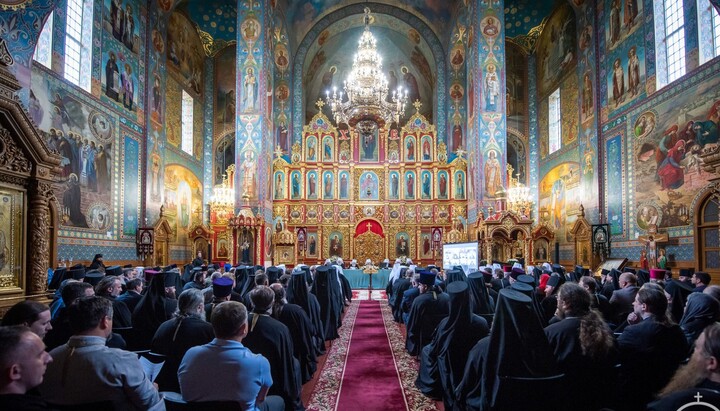
Council of the UOC in Feofania. Photo: UOC Press Service
Since mid-September, several respected hierarchs of the Ukrainian Orthodox Church have entered into sharp polemics about autocephaly, taking diametrically opposed positions regarding the possibility of granting the Church an autocephalous status. After Metropolitan Theodosiy’s podcast, the discussions abruptly shifted to the Council of the UOC in Feofania. Some hierarchs insist that the Council was held under government pressure, while others claim that no pressure was exerted. The statements are becoming increasingly harsh – at times even offensive.
Some believers take the side of “their” hierarchs and accuse the “others.” The rest simply watch the situation with bewilderment and dismay, unable to understand how such a thing can happen under the current circumstances the Church is facing.
1. The UOC stands one step away from a ban.
Amid church seizures and the relentless mobilization of clergy, the authorities have decided to ban the activities of the Kyiv Metropolis of the UOC. Should this occur, the Church will face extremely serious challenges to its very functioning. How appropriate, then, are disputes among the hierarchy on any subject at all?
2. The topic of autocephaly is entirely out of place right now.
Both its proponents and opponents clearly understand that the issue they are debating is purely theoretical. The topic of Feofania is even less relevant – its discussion can bring no benefit whatsoever to the Church.
The UOJ conducted two polls on social media and its website, asking believers whether they supported the public polemics among UOC hierarchs on the subjects of autocephaly and Feofania. Two-thirds responded that such debates today only undermine the unity of the UOC and scandalize the faithful. This result is hardly surprising. People observe the “showdowns” among bishops with confusion and anxiety – while the enemies of the Church rub their hands in satisfaction.
At a time when the Church needs maximum mobilization and unity, the opposite is occurring. And, sadly, these processes have very little in common with Christianity. For in these mutual jabs and accusations there is everything but love. And without love, any claim to correctness or appeal to the canons is nothing but “a resounding brass.”
“Owe no one anything, except to love one another; for he who loves another has fulfilled the law,” wrote the Apostle Paul.
To this – we call everyone.
Read also
Who destroyed and restored Kyiv Lavra? MinCulture's video reveals the truth
The Culture Ministry’s propaganda about the Kyiv-Pechersk Lavra has inadvertently revealed the truth.
Ternopil post on Feast of Intercession: Has calendar reformn failed?
A significant number of believers have rejected the new church calendar introduced by the OCU and UGCC with government support.
Shoulder straps or a cassock: who writes the script for UOC "fighters"?
Everything indicates that both Veliar and Pshenychny are ordinary performers of someone else's script. There is only one question – does the scriptwriter wear shoulder straps or a cassock?
Why is it legal to kill a person before birth but not after?
Children are the most privileged members of society. Yet that same society officially permits children to be killed – and on a massive scale.
Honoring the Bolsheviks’ successors at Kyiv Lavra
It was under the Reserve that the relics of the saints were desecrated, Lavra churches were turned into an atheism museum, and toilets were installed in sanctuaries.
"Degenerates" and "stupid animals": anti-UOC activists turn on children
Future historians will wonder how a vast country’s information agenda could have been shaped for so long by people so petty, vicious, and utterly contemptible.