On the work of the SBU against the UOC
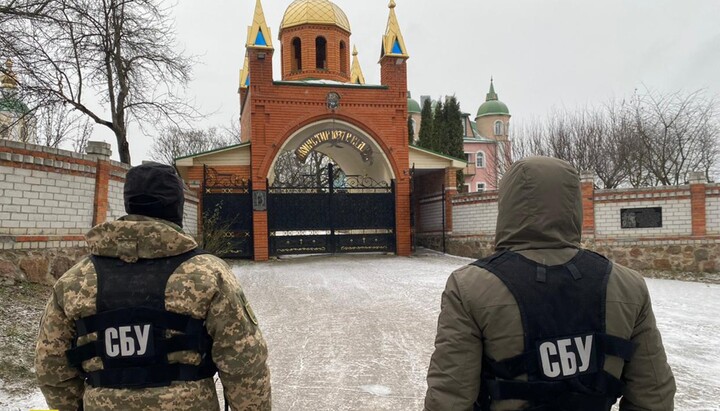
Search conducted by the SBU in a UOC church. Photo: SBU
In the government’s campaign against the Ukrainian Orthodox Church – which has been ongoing on all fronts since late 2022 – black PR plays a very significant role. And, surprisingly, the Security Service of Ukraine (SBU) has taken an active part in it.
We may recall the mass raids carried out by security officers in UOC dioceses, during which they seriously presented as “evidence” of ties with Moscow – Bibles printed in Russia, old prayer books, and even planted leaflets containing speeches by Patriarch Kirill.
But the SBU’s main “trump card” is its criminal prosecutions of UOC clergy. Figures such as 180 cases and more than 30 sentences are widely circulated in the media as proof of the UOC’s “Moscow affiliation.” That these cases represent only a tiny fraction of a percent of the total number of clergy is something no one mentions. What is more interesting, however, is what kind of cases these are, and how convincing the evidence of guilt actually is.
In this context, a very illustrative example was presented by the SBU involving a UOC priest from the Dnipropetrovsk region, about whom the service reported on October 17.
Allegedly, the priest “praised the ‘rashists’ during liturgies and urged Ukrainians to lay down their arms before the enemy,” and “spread Russian propagandists’ appeals for the capture of Ukraine via Telegram channels.” These are serious accusations by today’s standards – especially when many people have spent years in prison for little more than “likes” or “reposts” on social media.
But there are some oddities. Usually, investigations in such cases last months, and court proceedings drag on for years. Here, however, only three weeks passed between arrest and sentencing – which is almost unheard of. Moreover, the SBU did not even specify which articles the priest was charged under. The court gave him only three years, and even that with a one-year probation period – meaning he remained free. This leniency was explained by the fact that the priest had “cooperated with the investigation.”
Yet anyone who has ever been behind bars is ready to “cooperate” in any way just to be released – and still, such outcomes are extremely rare. So why was this priest so “lucky”? What explains the SBU’s unusual leniency toward a so-called “Moscow priest”?
We have no insider information, but simple logic suggests this: if there had been solid evidence for imprisonment – the priest would be sitting in prison. Most likely, during his sermons he used some ambiguous expressions – not enough for criminal charges, but sufficient to warrant a “serious conversation” with the SBU. As a result, the priest “cooperates” and remains free; the SBU adds another case to its statistics of the “fight against the Moscow Church”; and the authorities gain yet another argument for destroying the UOC.
Everyone wins – in their own way.
And it seems likely that many similar examples exist within the overall statistics of the SBU’s “work” against the Ukrainian Orthodox Church.
Read also
Why is it legal to kill a person before birth but not after?
Children are the most privileged members of society. Yet that same society officially permits children to be killed – and on a massive scale.
Honoring the Bolsheviks’ successors at Kyiv Lavra
It was under the Reserve that the relics of the saints were desecrated, Lavra churches were turned into an atheism museum, and toilets were installed in sanctuaries.
"Degenerates" and "stupid animals": anti-UOC activists turn on children
Future historians will wonder how a vast country’s information agenda could have been shaped for so long by people so petty, vicious, and utterly contemptible.
Zelensky sees murder of Polish priest but not of Sviatohirsk monk
Why does Zelensky react so emotionally and swiftly to the murder of a Catholic cleric while remaining completely silent about the murder of an Orthodox monk?
UOC vs. OCU numbers: pollsters count, social media recount
Official polling suggests Dumenko’s structure has an overwhelming lead in the number of parishioners, while social media polls paint a very different picture. Which should we believe?
Who is working for the Kremlin in Poland? OCU, Uniates and Catholics versions
Who in the conflict between Poland and Ukraine is "an agent of the Russian Federation"? Zelensky, who gave the UPA name to an AFU special operations center? Nawrocki, who stripped him of an order for it? Polish MEPs?