Power and UOC: Schizophrenia as state policy
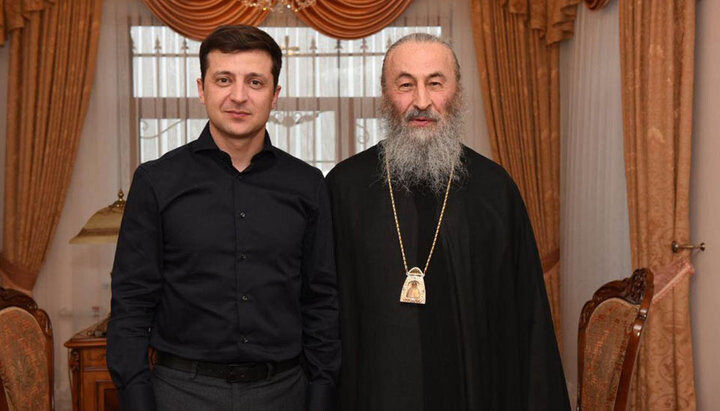
Zelensky and Metropolitan Onuphry. Photo: Office of the President
Ukraine’s Prosecutor General’s Office and the SBU announced charges against Metropolitan Kirill of Stavropol, head of the ROC Synodal Department for Cooperation with the Russian Armed Forces.
Among the accusations was the curious phrase: “Kirill contributed to subordinating Ukrainian dioceses to Moscow.”
As we all understand, no dioceses of the OCU or UGCC have ever been subordinated to Moscow. Which means that by “Ukrainian dioceses,” the prosecution clearly means the Ukrainian Orthodox Church (UOC). And this isn’t a slip of the tongue – it’s a pattern. Back in April 2025, the SBU announced suspicions against 14 “high-ranking” ROC clerics who had allegedly “helped seize Ukrainian churches in the temporarily occupied territories.”
At the same time, every branch of government – from Zelensky downward – insists on calling the UOC “Moscow’s” and “Russian.” The State Service for Ethnopolitics (DESS) even produced an entire “study” supposedly proving that the UOC is part of the ROC.
On the basis of this “Russianness,” the state keeps expelling communities from their historic churches, forcibly “transferring” them to the OCU, stripping clergy of mobilization exemptions, and in general implementing a law aimed at the total destruction of the UOC.
So – when convenient, the UOC is “Russian”; when not, it’s “Ukrainian.” The authorities behave schizophrenically – splitting their own narrative whenever convenience demands. Nothing less than a political split personality disorder.
The etymology of the word schizophrenia comes from “split mind.” In popular culture, it’s often confused with “split personality.” In reality, schizophrenia is quite rare – about 4 to 6 cases per thousand people. But judging by current events, the concentration among our government officials appears to be significantly higher.
Read also
Who destroyed and restored Kyiv Lavra? MinCulture's video reveals the truth
The Culture Ministry’s propaganda about the Kyiv-Pechersk Lavra has inadvertently revealed the truth.
Ternopil post on Feast of Intercession: Has calendar reformn failed?
A significant number of believers have rejected the new church calendar introduced by the OCU and UGCC with government support.
Shoulder straps or a cassock: who writes the script for UOC "fighters"?
Everything indicates that both Veliar and Pshenychny are ordinary performers of someone else's script. There is only one question – does the scriptwriter wear shoulder straps or a cassock?
Why is it legal to kill a person before birth but not after?
Children are the most privileged members of society. Yet that same society officially permits children to be killed – and on a massive scale.
Honoring the Bolsheviks’ successors at Kyiv Lavra
It was under the Reserve that the relics of the saints were desecrated, Lavra churches were turned into an atheism museum, and toilets were installed in sanctuaries.
"Degenerates" and "stupid animals": anti-UOC activists turn on children
Future historians will wonder how a vast country’s information agenda could have been shaped for so long by people so petty, vicious, and utterly contemptible.